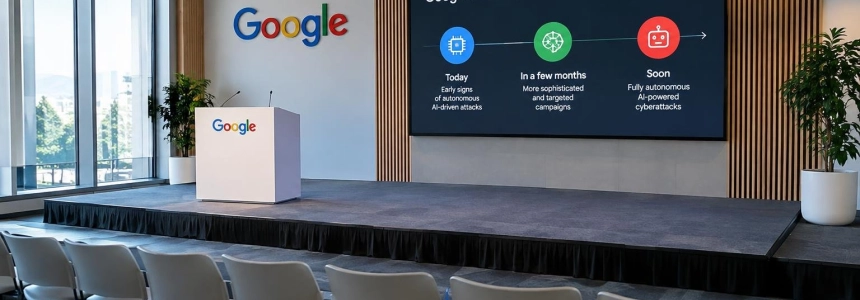
Google Threat Intelligence Group (GTIG) estimates that attackers will be able to launch campaigns requiring “little to no human interaction” within the next three months. Within six months, it estimates that more sophisticated autonomous attacks could emerge. The warning comes as tools based on multiple artificial intelligence agents are already automating parts of real intrusions.
The forecast does not mean that every attack will work without operators, or that current defenses have stopped being useful. It describes a transition: from using models for specific tasks to coordinating agents that identify targets, test vulnerabilities, and adapt their next actions. Google is observing this shift in the activity of financially motivated and espionage groups.
From testing AI to chaining attack stages
GTIG and Mandiant say they observed multi-agent offensive frameworks being used in active intrusions over the past quarter. These include ARTEX, CAIRN, CyberStrikeAI, and PentAGI. Their functions include detecting low-complexity vulnerabilities, generating payloads for specific targets, and changing course based on the results of each execution.
The change is not that attackers have invented new stages, but that they are automating how those stages are chained together and repeating the process at greater scale. The sequence described by Google starts with a target, searches for weaknesses in exposed systems, and adjusts attempts based on the response. Human involvement may be limited mainly to setting the target, although the degree of autonomy varies between tools and operations.
flowchart TD
    A["Definir objetivo"] --> B["Reconocer sistemas expuestos"]
    B --> C["Buscar vulnerabilidades"]
    C --> D["Generar y probar exploit"]
    D --> E["Ajustar el siguiente intento"]
    E --> F["Acceder y continuar la intrusión"]
ARTEX shows how this chain is built. Written in Go, the framework does not include its own model: it connects to external models, including Claude, GPT, DeepSeek, GLM, Grok, and Kimi, and distributes tasks among specialized agents. According to the FBI, malicious actors have used it against organizations in various sectors since at least August 2026.
The FBI advisory highlights that some intrusions progressed from initial reconnaissance to privileged access in less than three hours. The framework enables operations against multiple targets at once and lowers the technical skill required to chain techniques. This expands the operational capacity of small groups; it does not, by itself, mean that all their attempts succeed in gaining access.
“In the past quarter, GTIG identified threat actors using LLM frameworks to fully automate vulnerability discovery and exploitation without a human in the loop for the first time.”
— Google Threat Intelligence Group (GTIG)
The problem goes beyond ARTEX
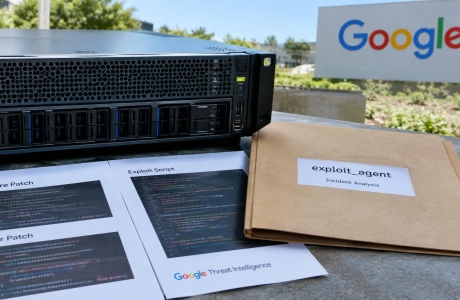
The case Google considers a new threshold involves a system called exploit_agent, found on an exposed test server belonging to the attackers. It compared versions of popular web applications before and after an update, analyzed the differences to locate potential vulnerabilities, and automatically prepared and executed exploits. GTIG also found stolen data, reconnaissance information, webshells, and scripts for post-intrusion activities.
Telemetry pointed to French targets in the media, entertainment, and education sectors. This is a concrete example of end-to-end automation, not proof that any current application can be compromised this way. Google says the system integrated several frontier and local models.
At the same time, reports about ARTEX show that the risk can spread from an organization to its customers. In the attack on ConnectWise Cloud Backup, attackers abused service application identities to authenticate to customers’ Microsoft 365 environments. The FBI said that attempts were made to access more than 2,250 tenants; BleepingComputer reported that Huntress had identified at least 162 compromised tenants.
The FBI also reported attacks against South Korean financial institutions that exposed the personal information of about 67,000 people. Infosecurity Magazine links ARTEX campaigns to sectors such as finance, government, technology, defense, energy, and healthcare. Taken together, these cases show why protecting only a company’s main application can leave vendor portals, legacy services, and integrations exposed, even though they also provide access to networks and data.
Speed versus stealth
Google identifies a current limitation: these systems tend to trade stealth for speed. Automated execution can generate forensic traffic, leave recognizable traces in the code, and trigger alerts. The FBI also warns of large volumes of suspicious requests. But these signals may not leave enough time to coordinate a response if an intrusion progresses in minutes or hours.
This trade-off is no guarantee of detection. Google anticipates that as tools and models improve, attacks could require less human involvement and become stealthier and more sophisticated. For now, the combination is uneven: agents can be effective against known vulnerabilities and exposed systems, but they also leave traces and generate failed attempts.
Automation adds another burden for defensive teams: distinguishing functional exploits from those that merely seem plausible. Following the disclosure of vulnerabilities in PHP, Google observed hundreds of proof-of-concept exploits, mostly generated with AI assistance, that did not work. Verifying these PoCs and developing protections placed a significant burden on defenders.
What changes for development and security teams
The practical consequence for companies is that the time available to fix an exposure may shrink. Google explains that attackers compare code before and after patches to infer known vulnerabilities and turn them into exploits. This method focuses the work on a limited amount of material—code changes, release notes, and public tests—and can accelerate the exploitation of vulnerabilities already fixed by the vendor.
For teams that develop and maintain services, the FBI and Google examples point to specific attack surfaces that should not be overlooked: partner portals and legacy services, as well as employee applications and third-party integrations. In the case of ARTEX, the FBI also describes supply chain attack capabilities and the use of exposed cloud credentials to modify application distribution infrastructure. These are routes connecting less-monitored components to higher-value environments.
The FBI recommends protecting internet-exposed applications, restricting access to cloud administration interfaces, and reviewing permissions, authentication logs, and application and API activity. It also advises monitoring for unusual bursts of automated requests, unexpected credential or privilege changes, anomalous cloud activity, and large data transfers. Google, for its part, says Google Security Operations has deployed behavioral and volume-based rules to detect ARTEX.
These measures do not eliminate the need to prioritize: the FBI itself warns that infrastructure indicators can become outdated. The balance is to shorten the time between a useful signal and a response, without letting noise divert resources from systems that are genuinely exposed.
A forecast with precedents already in place
The author of ARTEX removed the original GitHub repository in October 2026 after its abuse was reported, but the FBI says the framework continues to circulate through copies and community variants. BleepingComputer reported that researchers had found more than 1,600 exposed ARTEX consoles in early November; the actual number of deployments could be higher.
Google’s warning is therefore based on a trend that is already visible: open-source tools bringing together models, security utilities, and agents capable of adapting their actions. The immediate question for an organization is not when the first autonomous attack will arrive, but how long it would take to detect and contain one that exploits an exposed system, a weak integration, or an overprivileged credential.
Sources: BleepingComputer, Infosecurity Magazine, BleepingComputer, Google Cloud Blog, Cybersecurity Dive