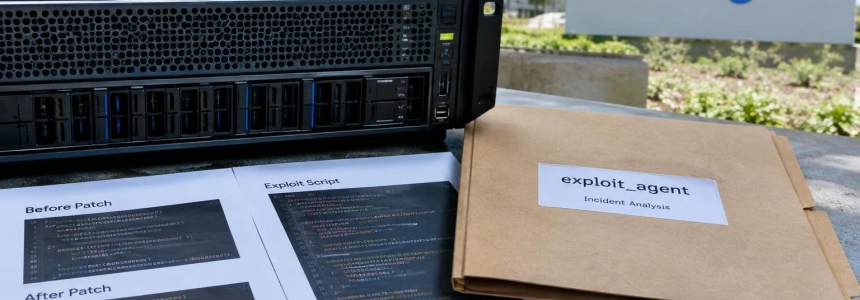
A system called exploit_agent generated and executed exploits after comparing web application code before and after patches, without human intervention. Google Threat Intelligence Group (GTIG) says this is the first time it has detected attackers using language model frameworks to fully automate vulnerability discovery and exploitation.
GTIG found the framework on a server exposed to the internet for testing. It was connected to several language models, including both advanced models and locally hosted models, and configured to continuously analyze popular web software. The process searched for differences between code before and after a security update, examined potential flaws, wrote an exploit, and executed it automatically.
The finding is part of Google's quarterly AI threat tracker, compiled with Mandiant and published on November 16, 2026. In the previous quarter, GTIG had documented experiments and partial automation, but had not observed these autonomous workflows deployed against real targets. That changed in the latest quarter.
“In the past quarter, GTIG identified threat actors using LLM frameworks to fully automate vulnerability discovery and exploitation without a human in the loop for the first time.”
— Google Threat Intelligence Group (GTIG)
An exposed server containing victims' data
The server contained more than just the exploitation framework: it also stored data extracted from attacked organizations and several post-intrusion scripts. These enabled reconnaissance within networks, brute-force password attempts, webshell installation, and the deletion of webshells left by other attackers.
The victim telemetry stored there suggests that the operator was especially interested in French media, entertainment, and education websites. The configuration included comments in Russian about the models' API keys. One said they should be entered in the configuration file, not in the chat.
The Register described the operator as apparently Russian-speaking; GTIG's tracker documents the use of tools and comments in Russian. The exposed server, meanwhile, showed an operation aimed at turning update analysis into an automated chain of exploitation and follow-on activity.
Why patches help find flaws
The method relies on n-day vulnerabilities, already fixed with a patch. Once an update is published, comparing software versions can reveal which parts of the code changed and what weakness the update was intended to fix. GTIG believes this limited material may be more efficient for attackers than searching for a zero-day vulnerability, which requires examining a broader range of possibilities.
Agents can review code versions, including preliminary or test versions, alongside release notes, security research, and proof-of-concept exploits. Automating this work reduces the time between a flaw's disclosure and the appearance of a working exploit, narrowing the window organizations have to apply the patch.
Google's report also notes a less direct effect: the circulation of proofs of concept that do not work. According to GTIG, the lower barrier to entry has led to the publication of exploits presented as operational but which are not. Defensive teams must check which ones work and which are false leads while monitoring for real exploitation.
PaperCut shows how quickly exploitation can happen
One case cited by Google involves two vulnerabilities in PaperCut print management servers, exploited as zero-days in late August 2026. The first, CVE-2026-81578, allowed authentication to be bypassed; the second, CVE-2026-82078, was related to unsafe dynamic class loading. Chained together, they could allow unauthenticated remote code execution.
| Vulnerability | Flaw described by Google | Context |
|---|---|---|
| CVE-2026-81578 | Authentication bypass | Chained with CVE-2026-82078 on PaperCut servers |
| CVE-2026-82078 | Unsafe dynamic class loading | The chain allowed unauthenticated remote code execution |
Security researchers and the company Huntress managed to generate working exploits with language models in less than a day after disclosure, according to GTIG. GreyNoise described a campaign four days after disclosure: the attacker reportedly used models to prepare and test exploits, compile a target list, and launch an operation against hundreds of organizations.
In that campaign, initial access was turned into domain administrator privileges within minutes, according to GreyNoise. The example illustrates the pace these techniques can achieve; it does not show that all automated attacks have the same scope or outcome.
From prompts to multi-agent frameworks
The exploit_agent case is part of a broader transition: attackers are moving from asking a model for help through manual instructions to deploying multi-agent frameworks for intrusions. GTIG and Mandiant observed several actors using open-source tools to automate specific stages of ongoing attacks.
The frameworks cited include ARTEX, CAIRN, CyberStrikeAI, and PentAGI. Google also detected experimentation with HexStrike AI. These tools can search for low-complexity vulnerabilities, generate payloads for a specific use, and adjust their tactics based on the responses they receive during execution.
GTIG observed CAIRN in intrusion activity against targets that included the U.S. aerospace sector. The framework organizes specialized agents through an observe, orient, decide, and act cycle, with a shared blackboard. In another case, between late August and early October 2026, an actor used a custom platform based on PentAGI to conduct systematic reconnaissance and search for vulnerabilities in organizations in Asia.
Google also recorded tests of CyberStrikeAI and HexStrike AI, as well as signs that a group with suspected links to China was developing its own automated framework for potential cyberespionage operations. Among related tools, the report mentions ZeroHollow, an inference service used for exploit development and model routing, and Agent Zero, an open-source agent framework with autonomous code execution and dynamic tool generation.
More speed, but also detectable traces
Frameworks can chain steps together and speed up operations, but GTIG believes that for now they trade stealth for speed. Unrestricted autonomous execution generates forensic traffic, may use recognizable identifiers, and leaves distinctive traces in the code. These clues can help detect and contain an intrusion, although Google warns that the tools can still achieve their objectives.
GTIG expects actors to continue adopting these systems because of their low barrier to entry, the ease of incorporating new exploits, and their ability to scale. As frameworks and models evolve, Google expects less human intervention and stealthier, more sophisticated operations.
BleepingComputer cites a more specific estimate from researchers: in the next three months, unsophisticated attacks with little or no human interaction and based primarily on multiple AI agents may emerge. According to that projection, sophisticated, fully autonomous attacks could appear within the following six months.
AI abuse goes beyond exploits
GTIG's tracker describes other operational uses of models in criminal and espionage activities. One is LLMjacking: actors steal model credentials and cloud computing resources from compromised enterprise environments to use them or resell access through clandestine proxy services known as LLM Mixers.
A Google report cited by The Hacker News mentions services such as APIMart and JetNight. Unite.AI adds that Mandiant responded to several LLMjacking incidents during 2026: some fraudulent charges in a single day exceeded $100,000, and the most serious cumulative abuse reached one million dollars before it was remediated. In Russian- and Chinese-language underground markets, GTIG observed advertised prices of between $0.10 and $25 per million tokens, depending on the model, service, and credentials offered.
Google also describes the use of models in influence operations, from creating localized content and profiles to automating distribution across multiple platforms. The report also covers cases of espionage and abuse of development tools.
To respond to these threats, Google Security Operations deployed behavioral and volume rules to detect ARTEX. Mandiant published a hardening guide and an architectural defense framework aimed at countering the speed and scale advantages of offensive tools using language models. The next challenge raised by GTIG is whether the traces that currently reveal autonomous execution will withstand more sophisticated frameworks and models.
Sources: theregister, Google Cloud Blog, BleepingComputer, The Hacker News, SiliconANGLE, Unite.AI