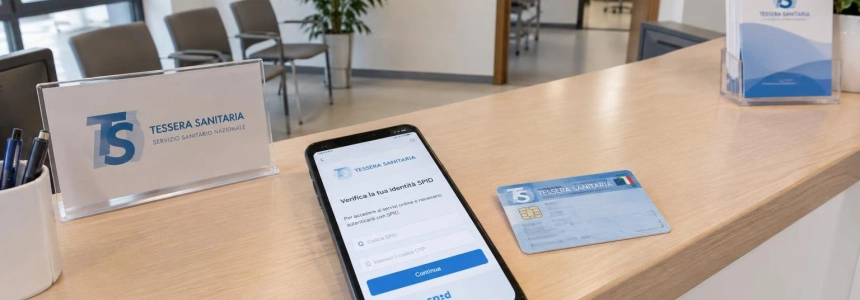
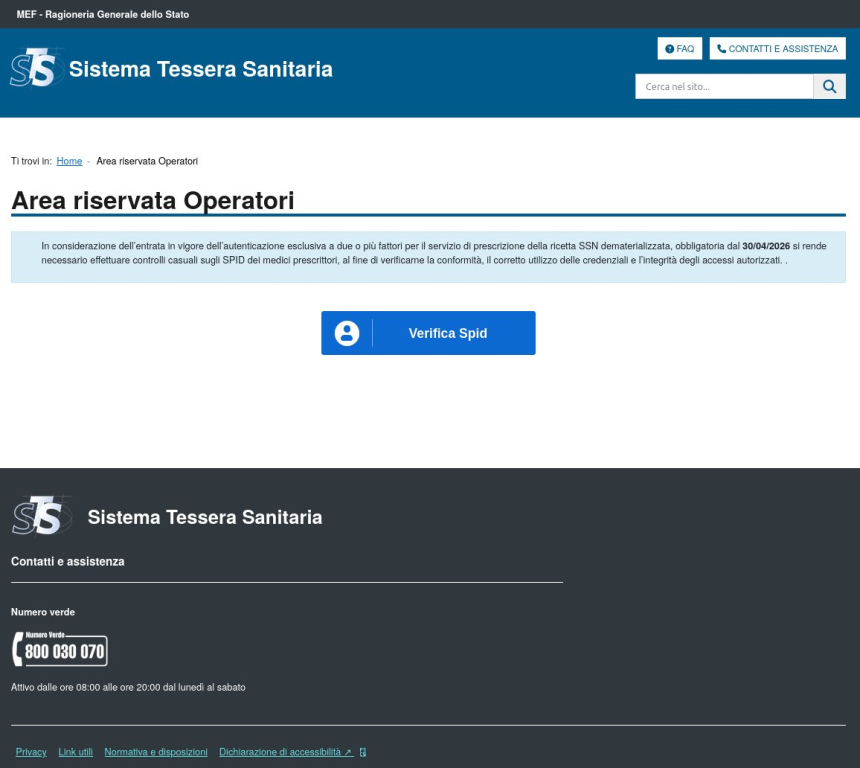
CERT-AGID has detected a fake Sistema Tessera Sanitaria portal that attempts to steal the SPID credentials of healthcare professionals, along with their OTP codes and identity documents. The email announces a supposed mandatory verification and threatens to suspend access to services—including the submission of electronic prescriptions—if it is not completed within 48 hours.
The clearest warning sign is the combination of a generic greeting—“Dear Professional”—a supposed “technical audit,” and pressure to act quickly. The fake portal reproduces SPID provider login screens and, after asking for a username, password, and OTP, requests images of both sides of the identity card and health card. This is not a legitimate verification: CERT-AGID describes an attempt to steal this information.
What to do if you receive the email
Do not click the link or reply to the message. The threat of temporarily losing access to healthcare services and electronic prescriptions is designed to make you act without checking the request. Do not follow the email’s instructions or enter information on the page it opens.
Verify the communication through an independent channel. If you need to check anything related to the Tessera Sanitaria, go directly to the institutional portals of the Ministry of Health, the Revenue Agency, or the Sistema Tessera Sanitaria. Do not access them through a link received by email or SMS.
Check the domain before signing in. The reported campaign uses sistemats4sanitafinanzeit[.]online, an address that imitates the service’s name. A URL containing terms such as “sistema” or “sanitaria” does not prove that it is official. If the link leads to that domain, do not enter credentials or upload documents.
Treat any urgent deadline with caution. The message describes a mandatory check and sets a 48-hour deadline. This urgency, combined with the threat of blocking work functions, is part of the lure described by CERT-AGID; do not let it stop you from checking through the official portals.
Forward the suspicious message to CERT-AGID. The agency accepts reports at
[email protected]. You do not need to open the link to report the email: keep the message and send it to that address.If you have already entered information, contact your SPID provider. Do so as soon as possible through its official channels and explain what information you provided: credentials, an OTP code, or images of documents. CERT-AGID recommends checking for suspicious logins and asking the provider what steps are needed to protect the account.
Also report any documents you submitted. If you uploaded photos of your identity card or health card, tell your SPID provider when explaining the incident. The fake portal requests these documents as well as passwords; do not downplay the incident just because you did not share your password.
Check your digital identity activity. Sign in to your provider’s account through its official channel and check for any logins you do not recognize. If you find suspicious activity, report it to the provider and request appropriate protective measures.
CERT-AGID requested that the domain be disabled and notified the affected entities. This request does not confirm that the domain has already been disabled; therefore, do not use the link even if it stops loading or appears inaccessible at a particular moment.
Mistakes that can expose more information
Do not mistake a convincing page for an authentic one. The portal copies the screens of several SPID providers. A familiar appearance does not authenticate the site or the reason for the request.
Do not share an OTP with a page opened from the email. The fake process asks for this code after the credentials. Do not enter it to “complete” a verification that you did not initiate through the official portal.
Do not upload documents to prove your identity. The campaign requests photographs of the front and back of the identity card and the health card. Do not upload them to a portal you reached through an unverified link.
Do not trust the message just because it mentions the MEF. The campaign impersonates the Ministry of Economy and Finance and the Sistema Tessera Sanitaria. An institutional name in the text does not authenticate the sender or the link destination.
Do not ignore the incident if you shared only some of the information. The form attempts to collect credentials, OTPs, and documents in separate stages. When speaking with your SPID provider, state exactly what you entered or uploaded.
The alert is aimed at doctors and other healthcare professionals, including pharmacists, according to SmartWorld. CERT-AGID does not state how many people received the email or how many provided information; it does document the attempt to obtain SPID credentials, OTP codes, and personal documents.
Sources: TuttoAndroid, SmartWorld, SmartWorld, CERT-AGID, Pasquale Pillitteri