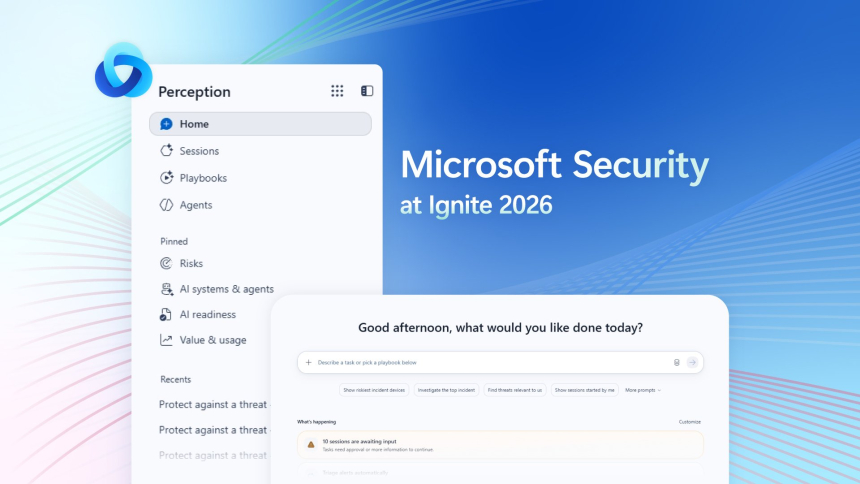
Microsoft Perception is now generally available and brings together AI agents that simulate attacks, investigate alerts, and help remediate vulnerabilities in organizations’ systems. Microsoft introduced the platform at Ignite 2026 as the centerpiece of a new security architecture that combines signals, context, and agents coordinated through workflows called playbooks.
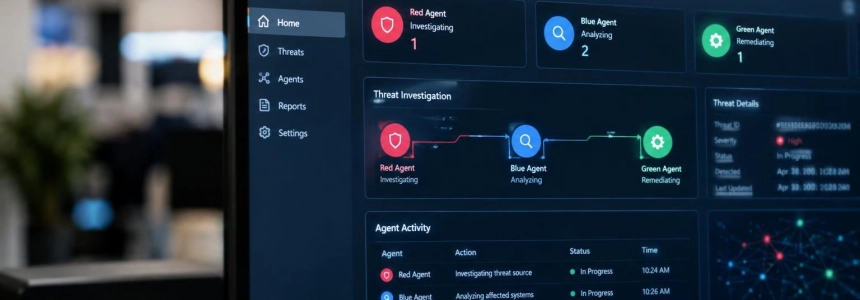
The platform continues Project Perception, announced in July. SecurityWeek reports that the system entered public preview within Microsoft Defender in August. Now, with its general availability, Microsoft groups its capabilities into agent teams with different roles: red takes the attacker’s perspective, blue handles detection and investigation, and green works on remediation.
The announcement comes at a time when, according to Microsoft, AI is accelerating both the discovery and exploitation of vulnerabilities. Aleš Holeček, president and chief architect of Microsoft Security, said that frontier AI models have made significant progress in these tasks over the past 12 months, while similar capabilities are appearing in open-weight models with limited cyber safeguards. The company contrasts this situation with a year ago, when finding a serious, exploitable vulnerability required slow and costly work by specialists.
An architecture of signals, context, and agents
Perception relies on more than 165 trillion signals daily from Microsoft products and other components of the environment, such as the network and operating system. Microsoft’s post lists sensors and actuators from Defender, Entra, Intune, Purview, and Sentinel, as well as the network, operating system, browser, and its hyperscale cloud. The company also says it connects to the ecosystem through more than 500 connectors, and that Microsoft and partner sources jointly produce these signals.
The second layer organizes the signals alongside each customer’s environment to provide real-time context. Specialized agents sit on top of it, working as a team through playbooks and using different AI models depending on the task. Microsoft describes the whole system as an architecture designed to turn signals into coordinated actions, not just isolated alerts.
Red agents simulate attacks before a breach, with the goal of finding weaknesses from the perspective of someone seeking to exploit them. Blue agents detect and classify alerts and investigate attacks; green agents help fix vulnerabilities. According to Microsoft, automation should allow analysts to spend more time on decisions that require their involvement.
The company says security teams remain in control: they define the limits of what agents can do and approve high-impact actions. Automatic triggers launch playbooks when an incident meets the criteria set by the organization. To control spending, Perception includes management dashboards and an estimator that let teams track AI usage, project costs, and relate them to measurable security outcomes.
Available agents and preview features
Microsoft has made four agents from the blue team generally available: Alert Triage Agent, Attack Investigation Agent, Detection Authoring Agent, and Threat Intelligence Agent. Recon Agent, from the red team, has also reached general availability. Web App Pen Test Agent, which tests web applications, remains in preview.
SecurityWeek attributes to Microsoft an estimate that Alert Triage Agent could handle around 80% of the alerts in a typical Defender queue. The figure is based on an analysis of approximately 8 million alerts from the company’s security products; it is not presented as a measurement applicable to all organizations or alert queues.
For remediation work, two green playbooks cover Microsoft, AWS, and Google Cloud environments. Posture Prioritization Agent is now generally available, while Risk Reduction Agent is in public preview. The latter can recommend temporary protection for vulnerable assets when a permanent fix is not yet available.
The temporary vulnerability protection feature is in preview. Microsoft explains that it applies targeted measures to reduce exposure while the organization prepares a permanent patch; in supported scenarios, these may include changes to network accessibility and permissions. It does not replace the permanent fix, but aims to limit risk until the fix is applied.
The agentic code scanner Codename MDASH is expanding its preview. It can now analyze repositories up to 5 GB in size and run in regulated clouds. Its code analyses can also help Web App Pen Test Agent prioritize vulnerabilities and carry their remediation through to the code. Microsoft is adding the MAI Cyber 1.1 Flash and MAI-Cyber-2 models, the latter also in preview.
Security operations and connections to other tools
Alongside Perception, Microsoft introduced Integrated Security Operations Center (ISOC) in Defender. Its core capabilities are generally available and bring together SIEM—security information and event management—user and entity behavior analytics, threat intelligence, and threat protection and response. The full breadth of SIEM capabilities is in preview.
Microsoft says eligible customers with Defender Suite, Microsoft 365 E5, and Microsoft 365 E7 receive Microsoft Sentinel SIEM features, 90-day default retention for Defender data, more than 500 connectors, reduced ingestion rates, and an integrated data lake. These terms apply to the eligible customers identified by the company.
Perception connections to SIEM, SOAR—security orchestration, automation, and response—and IT service management tools are in preview and use MCP or APIs. Microsoft also notes that playbooks can be invoked from Defender and signals from AWS, Okta, and Salesforce can be added; these integrations are also still in preview.
Microsoft considers agents “new insiders”
The company argues that agents should be managed as insiders with privileged access. They operate continuously and can access data, applications, and tools; like any internal user, Microsoft says, they can make mistakes, be manipulated, or be compromised. Its proposal includes assigning them their own identity and limiting their permissions by time and to the task at hand.
Microsoft Agent 365 and Entra Suite capabilities can discover 60 types of local agents, following the addition of 35 more types. The list includes Claude Code, OpenAI Codex, and GitHub Copilot, as well as third-party agents in AWS and Google Cloud. Discovered agents can be assigned a Microsoft Entra Agent ID and made subject to Conditional Access; Intune policies can contain compatible local agents on the device. These capabilities are in preview.
Microsoft also mentions dynamic and temporary permissions through Microsoft Entra ID Governance and Conditional Access controls that adjust when risk changes. These features remain in limited preview. Defender and Microsoft Purview Data Loss Prevention are presented as tools for protecting runtime activity and access to sensitive data, while Dynamic Agent Risk assesses each agent’s exposure, blast radius, and behavior.
With its AI Transparency Initiative, Microsoft aims to develop open standards for auditing what AI systems do and enabling independent verification. The company will expand its participation in NIST’s agentic AI standards initiative and says it is working on the approach with more than 40 organizations, including Accenture, Adobe, KPMG, Mastercard, and Volvo Cars. It plans to apply this work to its AI models and products, including Microsoft Foundry and Copilot.
“Your team sets the security boundaries and approves high-impact actions, while automatic triggers activate playbooks when an incident meets the criteria you have defined.”
— Aleš Holeček, president and chief architect of Microsoft Security
The context: vulnerabilities moving from disclosure to exploitation
Microsoft backs up its argument with the pace of vulnerability disclosure and exploitation. According to its post, more than 96,000 vulnerabilities had been published in the CVE program in 2026, more than double the approximately 40,000 in 2024 and more than 20 times the 2010 level. The company attributes part of the increase to AI-assisted discovery tools.
The same post says that only 26% of the vulnerabilities added to CISA’s Known Exploited Vulnerabilities catalog in 2025 had been fixed. CISA is the United States Cybersecurity and Infrastructure Security Agency. Microsoft describes typical remediation timelines as weeks or months, compared with attackers who can find and exploit vulnerabilities more quickly.
As an example, Microsoft recounts that PHP disclosed two critical remote code execution vulnerabilities during one week in the fall. At the time of disclosure, tens of millions of internet-facing PHP services were running affected versions; almost two weeks later, around 29 million remained vulnerable. The company adds that five other significant issues in the sector were disclosed that same day.
Microsoft argues that turning this kind of vulnerability into a working attack could once have taken a specialized team months. In the case of PHP2Shell, researchers developed a working exploit approximately one day after disclosure, and by the following week the work covered other PHP versions and configurations. The example illustrates the scenario the company seeks to address with coordinated agents, though it does not by itself establish Perception’s performance against such attacks.
The platform is generally available, but several announced capabilities have different statuses: some are in public preview, others in limited preview, and others, such as temporary vulnerability protection, have not yet left preview. Microsoft also announced AI readiness initiatives in Perception for January 2027, with action plans and progress tracking focused on reducing security gaps.
Sources: europapress.es, Microsoft Security Blog, SecurityWeek, Microsoft Security Blog