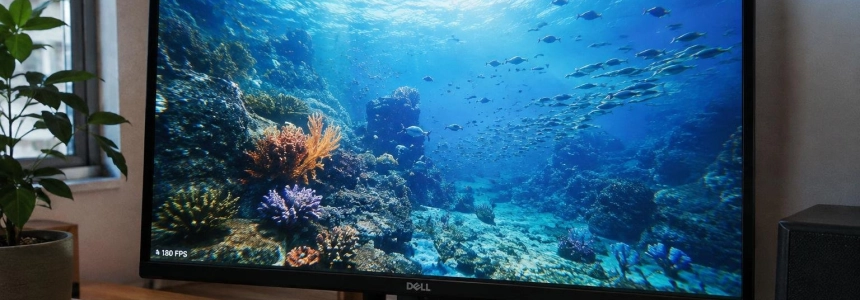
An interactive ocean in a single HTML file: that’s Abyssal Garden, an underwater world created with Claude Fable 5.2 and rendered in the browser using WebGPU. Its developer, Noniv, says it reaches around 180 FPS at 2560 × 1440 with an NVIDIA GeForce RTX 5070 Ti; the project brings together kelp forests, a sunken ship, schools of fish and manta rays, without relying on external images or 3D models.
The demo is not a complete game: it’s a graphical environment you can swim through. Noniv’s GitHub repository presents it as a world generated entirely with code, with real-time synthesized sound and controls for exploring its different corners. Wccftech attributes its creation to Claude Code, Anthropic’s tool, and describes the result as a self-contained HTML page.
A world built when you open the page
Instead of downloading textures, meshes, models or audio files, Abyssal Garden creates the scene through procedural generation. According to the repository description, the graphics card sculpts the seabed when the page is opened and then fills it with nearly two million kelp fronds and other plants, tens of thousands of rocks, and thousands of sponges, corals and fish.
The landscape includes rocky walls, arches and tunnels, as well as a sunken wooden ship, a stone whale tail and a purple grotto with magenta vegetation. Manta rays, schools of fish, bubbles and particles complete the environment. The repository notes that some elements—including the ship, fish and corals—are made from simple mathematical shapes rather than downloaded models.
The lighting is also calculated in the scene: sunbeams pass through the rippling surface, glints appear on the seabed, and the lighting effects have a volumetric look. Audio is synthesized as you listen using the Web Audio API; the repository describes a mix of low hums, distant whale calls, chimes and bubbles. No sound files are needed to reproduce this atmosphere.
The project uses WebGPU directly and does not include a game engine or 3D library, according to GitHub. Wccftech adds that Claude generated the WGSL shaders and that the first version started with a detailed prompt sent to Claude Code. The prompt called for visual quality, procedural generation, a stable frame rate and an output contained in HTML; it also explicitly prohibited engines such as Three.js and Babylon.js.
Performance figures depend on the hardware and detail level
The most striking figure is the performance the creator attributes to the project: around 180 FPS at 2560 × 1440 with an RTX 5070 Ti. GitHub lists this figure and explains that, on slower hardware, the scene tries to maintain 60 FPS by first reducing resolution and then the distance at which plants and rocks are rendered. Wccftech also reports a capture at 248 FPS on a system with an RTX 4090, at 1440p and with the High setting; that figure comes from a different configuration.
The results are not an independent measurement: Wccftech notes that they come from the developer. The difference between systems is also reflected in the figure for mobile devices. According to the repository, a low-end Samsung Galaxy A16 reaches around 20 FPS with the Low setting and a resolution of 670 × 372.
| Hardware or configuration | Reported performance | Details |
|---|---|---|
| RTX 5070 Ti | Around 180 FPS | 2560 × 1440 |
| RTX 4090 | 248 FPS | 1440p, High setting; figure from a capture cited by Wccftech |
| Samsung Galaxy A16 | Around 20 FPS | 670 × 372, Low setting |
The file size is not reported consistently in all descriptions. Wccftech’s headline and the repository’s “About” section say 97 KB, while the GitHub README says the entire world fits in 96 KB. Both figures refer to the HTML file, not a download of additional assets: the repository maintains that no external images, models or audio are needed.
There are three graphics settings: Low, Medium and High. Medium halves the number of fronds, glints and pebbles, and removes shadows from small rocks, sponges and corals. Low leaves a quarter of the fronds, disables antialiasing, simplifies rocks, corals and lighting, and starts at 480p; High displays the complete scene.
The system chooses a starting level based on the device: Medium for phones with 8 GB of memory and Low for other phones and computers with 4 GB of memory or less. If the load closes the tab or the graphics driver fails, the page restarts at a lower level. The browser also remembers the level, resolution and draw distance reached for the next visit.
From an initial prompt to several days of work
The first version was not the end of the process. Wccftech says Noniv later added collision detection, a start menu and controls for the graphics settings. The developer estimates two to three hours of actual Claude processing, spread over about three days because of the subscription’s usage limits.
The prompt also included a way to review the result: an AI subagent was to examine screenshots and point out visual defects, while GPU measurements would assess performance during a guided 60-second run. The repository includes development tools for flying along a one-minute route and running that route as a benchmark, though it notes that these additional tools are not part of the main HTML file.
Exploration uses WASD and the mouse; E and Q let you move up or down, and Shift speeds up swimming. You can switch between six viewpoints using the 1 to 6 keys, open the menu with Esc and toggle sound with M. On touchscreens, the controls are marked as experimental: one finger lets you move forward and turn, while a second is used to speed up.
The repository says you only need to download index.html, open it in Chrome or Edge on a computer and wait a few seconds for the world to be built. It requires a browser with WebGPU, needs no installation and works offline. If a message appears saying the scene needs WebGPU, GitHub recommends updating the browser or switching to Chrome or Edge.
I built a swimmable underwater world in one 97 KB HTML file with Fable 5.2
— Reddit post attributed to Any-Reputation811
What Fable 5.2 brings to the experiment
Anthropic introduced Claude Fable 5.2 on November 9, 2026, alongside Claude Mythos 5.2. The company describes both as models based on the same underlying model, but with differences in access and safeguards: Fable is available to all users, while Mythos is offered to organizations researching beneficial applications in cybersecurity or biomedicine and requesting access through Anthropic programs.
The company says Fable 5.2 improves at programming, reasoning and vision, and that its outputs can be generated up to 30% faster than with Fable 5.1. Anthropic positions it for ambitious, open-ended technical tasks; for most everyday programming and knowledge tasks, it recommends starting with Opus 5.5. Abyssal Garden uses code to build an explorable space and, according to the repository, reduces resolution and draw distance on slower hardware in an attempt to maintain 60 FPS.
In its announcement, Anthropic also says Fable 5.2 helped complete software migrations, designed three functional electronic devices and solved two open problems in black hole physics. In an internal robotics test, the company gave it a score of 64.9% on RoboDojo Sim, compared with 29.8% for GPT-6 Astra. Noniv shared Abyssal Garden on Reddit and published it on GitHub.
The source code is available under the MIT license, which allows it to be used, modified and shared. To rebuild the HTML from the readable source code, the repository requires Node.js 18 or later and documents the installation and build commands. The ready-to-open file, however, is index.html.
Sources: The Decoder, Wccftech, GitHub, Anthropic