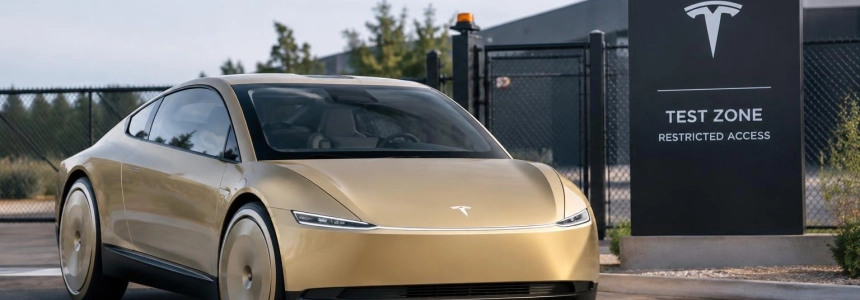
Tesla can change the zones where the Cybercab operates at any time, including reducing or relocating them after the customer has paid $29,990 for the vehicle. The contract also requires a $299 monthly subscription: without it, the car does not operate.
This combination changes what is usually understood by buying a vehicle: the customer pays for the hardware, but their ability to use it depends on a renewable service and rules that Tesla can revise. In the case of the Cybercab, that dependence is not just a limitation on features: the agreement says that the car does not work without the subscription.
The geofence is part of the contract
The subscription agreement, version 20261112, limits driving to the areas Tesla has enabled for Robotaxi. Driving outside them is prohibited and, according to the terms, can be technically blocked. Tesla reserves the right to expand, reduce, or relocate those areas whenever it wants.
Not a Tesla App adds that, for now, the zones are in Texas and that the authorized area does not always have to match Robotaxi service coverage. The restriction matters because it makes the operating map a condition of use, rather than a fixed feature that the buyer can take for granted when purchasing the car.
Electrek says that the actual coverage of the Robotaxi zones it tested was between 59% and 78% of what had been announced, and mentions criticism of parts of the Houston map. Those observations do not change the contract, but they help explain why the ability to move the boundaries can have tangible effects: a published zone does not guarantee access to its entire area.
A purchase tied to future payments
The initial price is $29,990, and the mandatory fee is $299 per month. Tesla can change it with one month’s notice; if the customer keeps the subscription after a change to the terms, they accept the new terms. Not a Tesla App indicates that billing is monthly and that it can be canceled through the Tesla account, although payments are not prorated.
Canceling has a different consequence from stopping payment for an optional feature in a conventional car: the Cybercab is left unable to operate. Electrek calculates that the vehicle and 59 months of subscription add up to $47,631, before insurance, registration, charging, and taxes. Drive Tesla notes that the fee includes Premium Connectivity, roadside assistance, and certain maintenance items, but not insurance; it also says that charging and registration costs are the owner’s responsibility.
| Item | Amount or condition |
|---|---|
| Cybercab price | $29,990 |
| Mandatory monthly subscription | $299 |
| Purchase cost and 59 monthly payments | $47,631 |
| Price change | With one month’s notice |
The fee also does not necessarily appear to be fixed over the long term. Not a Tesla App reports that Musk said $299 was too much and that it should be closer to $115 per month. That is an assessment of the price, not a commitment to reduce it: the terms allow Tesla to change the rate, but do not guarantee that it will lower it.
What the buyer cannot do
The Cybercab is offered for personal, non-commercial use. The owner cannot add it to Tesla’s Robotaxi network or use it with Uber or a delivery or rental platform without written authorization. This limits a potential source of income from the outset: buying the car does not grant permission to operate it as a service.
There are also restrictions on customization. Wrapping the body, tinting the windows, or changing the wheels requires using Tesla or an authorized provider; violating the rule can lead to suspension of the subscription. The agreement also prohibits tampering with or reverse-engineering Tesla software. For companies that want to adapt the fleet to their brand or a specific operation, these terms leave little room to do so without the manufacturer’s approval.
Drive Tesla reports another restriction: the contract would prohibit selling or transferring the Cybercab without Tesla’s written permission. According to the outlet, violating this could result in a penalty of at least $50,000 or the full transaction value if higher. It also says Tesla can buy back the vehicle at a market value determined by the company itself, with the owner responsible for the return costs. These additional terms complicate resale and the valuation of the asset for a company.
Suspensions and remote control
The contract provides for a system of violations or “strikeouts.” Three or more for improper or unsafe use result in a one-week suspension of autonomous driving; during that period, the vehicle may be unable to operate and the fee is not refunded on a prorated basis. According to Not a Tesla App, the penalty can affect both the account holder and people riding in the car.
Tesla can also locate the vehicle remotely, restrict it, control it, or place it in a safe state. Not a Tesla App adds that it can limit driving based on road type or weather, and during investigations or software deployments. According to Electrek, the contract states that these measures do not give the customer any remedies beyond those provided for in its terms.
The data terms mention location information and recordings from exterior cameras, as well as images from the cabin camera. Not a Tesla App indicates that this data is stored by default for 30 days and that audio may be recorded during support calls. The interior camera is included in the data collection, an issue that affects anyone who uses the car, not just the person who signs the contract.
“an endless variable-rate lease with a ridiculous down payment.”
— Mark Valorian, who reviewed the terms on X
The comparison with the Model Y raises another dispute
Electrek argues that the Cybercab and the Model Y robotaxis use the same software and the same AI4 computer, and reports that Ashok Elluswamy, Tesla’s head of AI, said on the 2026 third-quarter earnings call that customer cars could join the network around the second quarter of 2027. The outlet also recalls that Elon Musk described Robotaxi Model Ys as the same ones Tesla currently makes.
This parallel raises a commercial question, but does not prove that the vehicles are equivalent in every respect or explain why Tesla applies different terms. Electrek contrasts the new model with FSD’s history: Tesla began selling the “Full Self-Driving Capability” option in 2016 and eventually charged up to $15,000 for it, but driving still requires supervision. In February, according to the outlet, Tesla stopped selling it as a one-time purchase and switched to a $99 monthly subscription.
The contrast is clear: the Cybercab requires $299 per month and has no steering wheel or pedals, while the FSD described by Electrek requires the driver to supervise the car. The Cybercab’s terms do not automatically apply to the Model Y; they do, however, make the difference more apparent between paying for a driver-assistance feature and depending on a subscription for the vehicle to be able to drive.
A platform subject to the manufacturer’s authorization
For a company considering acquiring several Cybercabs, the contract affects the calculation beyond the purchase price. It cannot take a particular route for granted, freely change the vehicles’ appearance, or put them to work on its own platform without authorization. On top of that are a variable fee and the possibility of suspending the service without prorating the charge.
The situation also has implications for developers who want to create services around these vehicles: the cited terms do not authorize integrating the Cybercab into transportation, delivery, or rental apps at the buyer’s initiative. Commercial activity depends on Tesla’s approval, and access to the car depends on the subscription remaining active. The manufacturer retains control over operational use, even after the sale.
Not a Tesla App expects the first deliveries in the month after its article was published, while Electrek reports that Tesla had already invited selected customers to place orders. For those who receive one, the practical question will not just be how much the Cybercab costs, but which area will be enabled and how much it will cost to keep using it when the next renewal comes around.
Sources: Electrek, Not a Tesla App, Drive Tesla