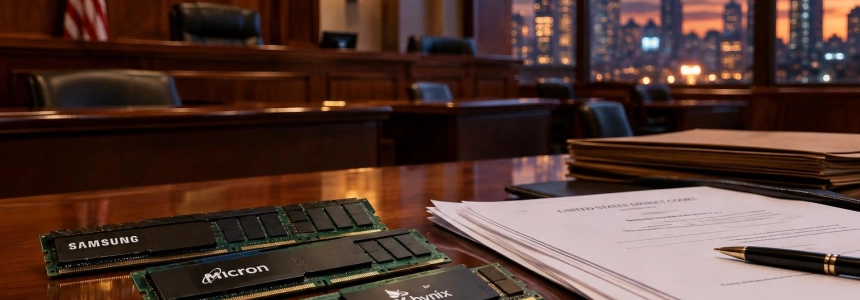
Samsung, Micron and SK hynix will have to respond to a class action accusing them of coordinating cuts to the supply of conventional DRAM memory. On November 14, federal judge Noël Wise rejected the three companies’ motion to dismiss the case in its entirety, finding that the complaint plausibly alleges an agreement in violation of Section 1 of the Sherman Act.
The ruling by the U.S. District Court for the Northern District of California opens the next stage of the litigation; it is not a decision on the merits. The plaintiffs’ allegations are treated as true only for the purpose of deciding whether the lawsuit may proceed; it has not yet been determined that the manufacturers agreed to restrict production or violated the law, LitNews noted.
A complaint about production cuts and the shift to HBM
The 17 plaintiffs—consumers and small businesses from five states—filed the action on June 25, 2026. Their complaint asserts that the three companies accounted for more than 91% of global DRAM revenue in the third quarter of 2025 and began reducing conventional memory production in late 2022. Starting in 2023, it alleges, they shifted capacity to high-bandwidth memory, or HBM, used in artificial intelligence accelerators.
The lawsuit focuses on standardized conventional DRAM, including DDR5 memory for computers. According to the description reported by LitNews, this is memory built to industry specifications and sold for ordinary uses, as opposed to HBM, a specialized product. The complaint alleges that manufacturing HBM consumes three to four times more wafer area per gigabyte than conventional DDR5.
The plaintiffs link this capacity shift to the rising cost of conventional DRAM. They allege that its prices rose 171.8% in the year through the third quarter of 2025 and 697% over an 18-month period. They also contend that none of the three companies expanded or announced plans to significantly increase conventional memory production capacity.
| Fact alleged in the lawsuit | Period or reference |
|---|---|
| More than 91% of global DRAM revenue | Third quarter of 2025 |
| 171.8% increase in conventional DRAM | One year through the third quarter of 2025 |
| 697% increase in conventional DRAM | 18 months |
| 3 to 4 times more wafer area per GB for HBM | Compared with conventional DDR5 |
The price figures are the plaintiffs’ allegations, not a judicial finding about market trends. Wise ruled only that the complaint may proceed; the allegations have not yet been proven.
Why the judge distinguishes this case from DRAM II
Samsung, SK hynix and Micron argued that the lawsuit repeated DRAM II, an earlier case concerning supply restrictions between 2016 and 2018. In 2022, the Ninth Circuit Court of Appeals upheld the dismissal of that case. Wise concluded that the current case is not a repeat: it concerns different conduct and circumstances, including the shift of capacity to HBM and customer evaluation practices alleged to be similar across the three companies.
The court found it plausible that the companies acted in parallel by reducing conventional supply, shifting production from DDR5 to HBM, and phasing out DDR4. Wise also rejected the argument that the gap between the production-cut announcements ruled out that possibility: SK hynix and Micron announced them three weeks apart in late 2022, while Samsung’s announcement came on April 7, 2023, about four and a half months later. That gap, she ruled, was not enough to defeat the allegation at this stage.
The judge also considered whether some decisions could have been so risky for each company individually that they supported the theory of a prior agreement. The shift to HBM alone might not be enough, but Wise assessed the alleged conduct as a whole: long-term contracts to reserve HBM supply, Samsung and SK hynix’s refusals to sign long-term agreements with major conventional DRAM buyers, and the lack of significant expansion despite the alleged record prices.
But Plaintiffs’ allegations go beyond hawks watching each other; their contentions are more akin to hawks flying in formation, an activity that hawks ordinarily do not do.
— Noël Wise, federal judge for the Northern District of California
The remark responded to the companies’ argument at the hearing, which cited an analogy by the late Judge Posner: that competitors in concentrated markets watch one another “like hawks.” Wise found that the allegations went beyond observing rivals’ decisions and described coordinated action. Her comment reflects her reading of the complaint at the preliminary stage; it is not a finding that an agreement existed.
Capacity, DDR4 and the closure of Crucial
Among the facts that weighed in the analysis were alleged delays or interruptions to new DRAM factory projects by Samsung and Micron. Wise compared the decision to build or not build manufacturing capacity to changes in refining capacity, which are not easily reversed, and found that a commitment not to expand production could support an inference of an agreement at the pleading stage.
The complaint also points out that all three companies reduced DDR4 in the same quarter of 2025. The plaintiffs said that this older, slower memory came to cost more per gigabyte than the newer, faster DDR5. The ruling counted this simultaneous phaseout as another factor that could support the lawsuit.
Another issue was Micron’s decision to close Crucial, its consumer memory brand with a 30-year history. Micron announced the closure on December 3, 2025, according to LitNews. Wise found that this measure, together with the HBM contracts and refusals to enter long-term conventional agreements, was difficult to reverse and could be relevant to the coordination theory.
The judge gave particular weight to customer evaluation practices that, according to the complaint, Samsung, SK hynix and Micron adopted in January 2026 and that were nearly identical. The companies attributed their decisions to the surge in demand for artificial intelligence. Wise observed that these practices allegedly began when AI growth and the shift toward HBM were already underway, and concluded that this explanation did not eliminate the plausible inference raised by the plaintiffs.
Arguments that did not persuade the court
The ruling did not accept every element cited by the plaintiffs. Wise gave no weight to investor statements about “supply discipline,” including a reference by Micron in 2022, because she found them too similar to arguments that had already been deemed insufficient in DRAM II. Nor did she find that the market’s concentrated structure proved coordination: she characterized it as neutral to the analysis.
Executives’ meetings at industry conferences were also insufficient. Although the complaint included allegations that went beyond those in the earlier litigation, it did not identify what information was allegedly exchanged or what agreement was allegedly reached at those meetings. LitNews reports that Wise understood the DRAM II precedent to limit the significance of such meetings in the absence of specific details.
By contrast, the court allowed the 1998–2002 DRAM price-fixing episode to be considered. The complaint alleges that the three companies and two other manufacturers formed a criminal cartel at the time. According to LitNews, Samsung paid a $300 million fine, Hynix paid $185 million, and Micron received immunity for cooperating as a whistleblower. Wise rejected the argument that the age of the episode prevented it from being considered at this stage.
Responses in December and a conference in January
The judge ordered Samsung, Micron and SK hynix to file their formal responses to the lawsuit by December 7, 2026. The initial case management conference was set for January 12, 2027, at 9:00 a.m. The court also granted an unopposed administrative request by the companies to postpone preliminary deadlines after the hearing was rescheduled by about three weeks.
TokenPost also reported a forecast cited by Kim Taewoo, executive vice president of Samsung Electronics: on September 29, he said HBM could account for close to 30% of global DRAM wafer capacity in 2027, up from around 20% at the time. This projection provides context for the capacity dispute, but does not resolve the allegations in the case.
The plaintiffs are represented by Bathaee Dunne LLP. Samsung is represented by O’Melveny & Myers LLP; SK hynix by Cleary Gottlieb Steen & Hamilton LLP; and Micron by Gibson, Dunn & Crutcher LLP, according to LitNews. The next scheduled procedural date is December 7, when the three manufacturers must file their responses.