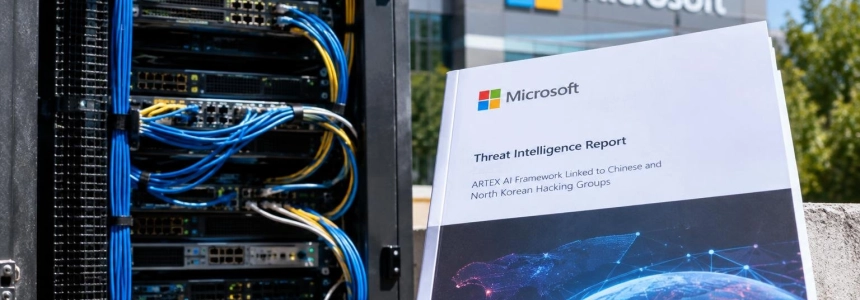
Groups linked to China and North Korea are using ARTEX to automate attacks, according to Microsoft: the AI-powered penetration testing framework can move from reconnaissance to persistent, privileged access in a matter of minutes. Microsoft identified Salt Typhoon and Crystal Typhoon among its users, as well as North Korean groups and financially motivated cybercriminals.
The groups Microsoft associates with ARTEX
In an analysis published on November 25, Microsoft Threat Intelligence said that, as of November 2026, it had observed six groups using ARTEX: Storm-0940, Storm-3358, Onyx Sleet, Pearl Sleet, Crystal Typhoon, and Salt Typhoon. The list includes state actors and financially motivated groups; not all of the names correspond to Chinese or North Korean groups.
Microsoft attributes the use of the framework for network reconnaissance, credential attacks, and web application exploitation to Salt Typhoon and Crystal Typhoon, which are linked to China. The company also reported campaigns that searched for exposed secrets in public repositories, facilitated supply chain attacks, and scanned internet-accessible systems for vulnerabilities.
“ARTEX does not introduce new attack techniques; it uses existing, common penetration testing tools and techniques.”
— Microsoft Threat Intelligence
In North Korea, Microsoft had already identified Onyx Sleet and Pearl Sleet using ARTEX since late October 2026. In a separate analysis, the company described those actors' adoption of AI as a way to expand and accelerate existing operations, not as a change in their objectives. Microsoft assesses that these operations remain human-directed, even when they use automation.
Storm-0940's inclusion also has a specific precedent: Microsoft describes it as a China-aligned state actor, active since 2021, that uses password spraying attacks and the exploitation of exposed applications to gain initial access. In a campaign related to ConnectWise, the company attributes the use of ARTEX to the group to accelerate reconnaissance, those access attempts, and the abuse of OAuth applications.
A framework that coordinates agents and existing tools
ARTEX is an AI agent-based penetration testing framework. Microsoft explains that attackers define objectives and scope; a model then breaks them down into verifiable goals, and a planning agent assigns short tasks to worker agents. These agents execute actions using a shell and offensive tools, update a map of systems and findings, and the planner decides what to do next. A reporting agent documents the results.
The platform does not create new techniques on its own: it automates tools that are already available. Microsoft mentions programs for network reconnaissance and application analysis, as well as automated browsers. Tools incorporated or added by operators include Nmap, sqlmap, and Metasploit. Agents can search for vulnerabilities, test credentials, upload a web shell, read secrets, and, after gaining access, move to other systems.
The configuration can use different language models, including models modified to remove safeguards. An optional feature allows switching models or API keys if a limit is reached, an error occurs, or a credential stops working. Microsoft therefore warns that the activity does not necessarily depend on a single AI provider, nor is it necessarily visible in the telemetry of just one provider.
ARTEX was released as open-source software in July 2026, according to Microsoft. The GitHub user Autumn-27 removed the code in October, but others retained copies and published derivative versions in several languages. In November, Chinese cybersecurity company ThreatBook claimed ownership of the project and began offering commercial access to ARTEX Pro, along with other AI-powered penetration testing frameworks.

From a search to access in minutes
Microsoft described a case in which an agent took five minutes to reach Azure Key Vault after searching GitHub for exposed application secrets. Key Vault is Microsoft's cloud service for storing keys and other secrets. In other intrusions, the company observed some attackers gaining privileged access in less than three hours from the start of an attack.
The Storm-0940 campaign provides more precise figures. Between October 10 and 14, 2026, the group's infrastructure directed an automated password spraying campaign against 327 accounts at eight organizations to access Microsoft 365 and Exchange Online. Microsoft recorded more than 151,000 failed attempts, peaking at 2,900 in one minute on October 11. More than 111,000 were concentrated on a single day, and 48 accounts received more than 1,000 attempts each.
In this specific campaign, Microsoft observed no successful authentications, token issuance, Microsoft Graph calls, or directory changes. The company, however, identified other ARTEX operations in which Storm-0940 gained privileged access to cloud infrastructure. It also said the group attempted to sign in to more than 2,250 tenants after the compromise of ConnectWise applications.
Microsoft linked that subsequent activity to the abuse of applications that already had permission to access customer environments. In several cases, it observed reconnaissance using Microsoft Graph, changes to application credentials, and attempts to modify privileges. The company noted that the presence of an affected application or a successful authentication does not, by itself, prove that data was accessed or exfiltrated.
Useful signals are not just identifiable strings
ARTEX can emit identifiers such as “artex-enrich” and “norma”, but Microsoft warns that operators can modify user agents, IP addresses, and other indicators to evade static rules. They can also route traffic through VPNs, proxy servers, or Tor. Therefore, a known signature can help, but it is not a durable signal on its own.
Microsoft considers behavior more reliable: bursts of high-volume requests from the same source, rapid repetition of variations of a technique, and near-immediate progression to the next stage. ARTEX can execute several attack chains at once and adapt when a route is blocked. The platform does not hide its activity by default, although this feature does not prevent operators from changing specific indicators.
To thwart these agents, Microsoft proposes decoys tailored to autonomous systems. Honeypots divert attacks to fictitious systems; tarpits slow requests and consume time and computing capacity. Honeytokens can generate alerts when someone tries to use decoy credentials. Microsoft also highlights “fake wins”: responses that simulate a successful intrusion and can lead the model to consider the objective achieved and stop the attack.
The ConnectWise precedent and the scope of the threat
In its October investigation, Microsoft said Storm-0940 had attacked hundreds of organizations across different sectors since September 2026. The targets it listed included organizations in aerospace and defense, automotive, energy, financial services, government, manufacturing, media, semiconductors, and technology. Most attempts were unsuccessful, although the group achieved privileged persistence in the cloud environments of several organizations.
ConnectWise published an initial alert on October 16 about unauthorized access related to Cloud Backup and later expanded its containment guidance. Microsoft attributed the compromise of a ConnectWise multi-tenant application's supply chain to Storm-0940. In some customer environments, the agents used application credentials to access Microsoft Graph and performed reconnaissance and changes that could facilitate persistence or privilege escalation.
Microsoft recommended that affected customers preserve logs and evidence, separately review service principal sign-ins, and check for unexpected changes to credentials, permissions, and roles. It also asked them to follow ConnectWise's containment instructions. The company emphasized that the activity was not the result of a vulnerability or a compromise of its own corporate systems, products, or services.
Public accounts of ARTEX's history give different dates: Microsoft places its original release in July 2026, while TechRadar says the framework appeared in the summer of 2025. Microsoft and The Record agree that the code was removed from GitHub in October 2026 and continued to circulate in copies and derivative versions.
Microsoft also recommends reducing internet exposure, protecting credentials and secrets, and limiting lateral movement paths. For Microsoft Defender XDR customers, it points to the option of enabling automatic attack disruption to contain and isolate affected devices. The company leaves an open defensive question: decoys and filters may become less effective if attackers space out their requests or if more capable models recognize artificial environments.
Sources: TechRadar, The Decoder, The Record, Microsoft Security Blog, Microsoft Security Blog, Microsoft Security Blog