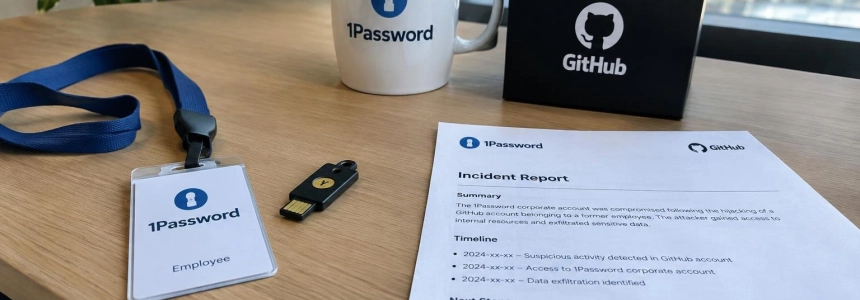
An employee’s corporate GitHub account was the entry point for an attack that allowed the downloading of records belonging to some 1Password users and the copying of internal source code. The company says vaults and their contents were not accessible, but the extracted data included names, email addresses, and tokens from certain invitation and recovery links.
From GitHub to backend services
1Password explained that it began investigating the incident on November 19, 2026, after detecting signs that someone had gained access to an employee’s corporate GitHub account. The intruder used that account to read source code and send malicious code to backend services. Those services then downloaded administrative data related to customers.
The path of the intrusion is known, but it remains unclear how the GitHub account was compromised. The number of users whose records were downloaded has also not been disclosed. The company described the affected group as a subset of users; TechCrunch and BleepingComputer also noted that no total figure had been disclosed.
The incident reached beyond customer records. The attacker copied source code from private repositories and accessed the continuous integration and delivery environment, known as CI/CD, which contains information related to internal infrastructure. 1Password said its source code does not contain user secrets, although the CI/CD environment does store infrastructure credentials needed to run the product.
What data was exposed
The downloaded records included names and email addresses, account and user identifiers, as well as the date and time the account was created and the last time it was used to sign in. They also contained public keys and Secure Remote Password (SRP) protocol parameters. The company maintains that public keys are designed to be public and that SRP parameters do not allow direct access to an account.
The information also included non-secret metadata related to the internal architecture, such as numeric version and file identifiers. The most sensitive items were tokens contained in certain email links for invitations, provisioning, and account recovery. 1Password specified that provisioning is used for SCIM Bridge or Hosted Provisioning.
A token on its own is not enough to complete an invitation or recovery. According to 1Password, the process also requires signing in through SSO or entering a code sent to the registered email address. The company said that a small number of users were in the middle of these processes when the intrusion occurred and that it notified them individually.
SecurityWeek added that a 1Password representative explained in the community forum that authentication data included SRP verifiers derived from account passwords and Secret Keys. Those verifiers cannot be used directly to authenticate; the outlet noted that attempting to crack the passwords would also require the Secret Keys, which 1Password does not store.
Codes go from six digits to ten characters
As a precaution, the company expanded the codes used for invitations and recovery from six numeric digits to ten alphanumeric characters. 1Password says the change makes it practically impossible to guess the code through brute force. In the process described by the company, the code is sent to the registered email address and combined with the link token; the alternative is to complete the process through SSO.
| Item | Status reported by 1Password |
|---|---|
| Verification code | Changed from six numeric digits to ten alphanumeric characters |
| Vaults and saved items | Were not accessed or made available to the attacker |
| Internal credentials potentially exposed | Rotated or revoked |
| Users in the middle of invitation or recovery processes | A small number received individual notifications |
The company said it does not require customers to change their password or Secret Key. It also recommends being wary of unexpected communications that use the breach as a pretext to ask for credentials, secret keys, or recovery codes. Exposure of names and email addresses can help attackers identify real users and prepare messages that appear to come from 1Password.
“We have no evidence that encrypted vaults were downloaded or accessed”
— 1Password community manager, quoted by SecurityWeek
What the company says was not affected
1Password maintains that neither the vaults nor the items stored in them, nor the keys that protect them, were accessed. It also says it does not store users’ account passwords or Secret Keys. Its recovery keys, apps, and browser extensions were also unaffected.
The company says there was no impact on its services, their availability, or product security. In its post, it explains that vault secrets are encrypted with keys held only by the user, meaning the company cannot access them. TechCrunch also reported that the vaults were never available to the attacker.
The response included disabling the compromised GitHub account, revoking the stolen token, and removing the access created by the intruder. 1Password rotated or revoked internal credentials that may have been exposed, strengthened controls for GitHub, CI/CD, and devices, and added detections for this type of attack. BleepingComputer also reported that the company restored clean versions of the affected services.
Review with independent experts
1Password says it found no internal evidence of account takeovers using the exposed tokens. It brought in independent cybersecurity experts to validate its containment and remediation measures. SecurityWeek described the investigation as ongoing; the company said it would update its post if any new information changed what had been reported.
The company advises entering your password and Secret Key only in the official app or on its website, after opening the app or manually typing the address. It says it will never contact users to ask for these credentials and that the Secret Key is needed only the first time you sign in on a new device or browser.
If you receive an unexpected invitation or recovery request, the recommendation is to not follow the link in the message and go directly to the service. The company has also provided the email address [email protected] for reporting suspicious activity; it has not said how many accounts were affected.
Sources: TecnoAndroid, Xataka, Xataka, 1Password, TechCrunch, BleepingComputer, SecurityWeek