A Hisense 55U65QEVS running VIDAA sent advertising company Nexxen a digital fingerprint of the audio it played every 2.7 seconds, according to traffic analysis published by TecnoAndroid and Cyber Security News. The TV did not transmit a voice recording: it converted sound into data that can identify content, and the transmission remained active even when personalized ads were disabled.
The distinction matters: the mechanism does not need to listen to a conversation in the room. According to Cyber Security News, the HamService program captured audio that had already been decoded and was headed to the speakers, while Tech-ish notes that the microphone was not the source of the data sent. Thus, a movie from an internal app and the sound of a connected device can enter the same process, although the effective scope for each input was not verified in every case.
A compact signature, not a recording
In the investigation described by Cyber Security News, HamService transforms audio into a sequence of spectral comparisons. The result sent contains 72 bits per second of audio, grouped into packets transmitted approximately every 2.7 seconds. Tech-ish explains the principle as a series of markers reflecting characteristics of the sound: they cannot reconstruct it as an audio track, but a signature can match that of known content.
The technical investigation details how the program processes overlapping audio windows and compares energy across different frequency bands. Each observed packet grouped ten rows of markers into a 90-byte payload. The system could also skip transmissions when it detected silence, so it was not a continuous transmission of everything coming out of the speakers.
| Observed data | Published details |
|---|---|
| TV analyzed | Hisense 55U65QEVS in the UK |
| System and firmware | VIDAA U09.60, V0000.09.60A.Q0602 |
| Transmission frequency | Approximately every 2.7 seconds |
| Identifier | Persistent UUID associated with the device |
| Fingerprint contents | 72 binary comparisons; 90-byte packets |
The payload did not travel alone. Cyber Security News lists a persistent UUID, a timestamp, the time zone offset, the app name, the input number, and a tuner channel field. That identifier also served as the client name and username for the MQTT connection, allowing successive reports to be associated with the same TV. The connection to Nexxen's servers was protected using TLS, according to the analysis.
To check whether the markers corresponded to the content being played, the researcher compared the captured data with a fingerprint created from Big Buck Bunny. Cyber Security News and Tech-ish report an 88.5% match across twenty messages; unrelated audio signals matched at around 55%. The test supports the conclusion that the system recognizes patterns, although Nexxen did not have a match for that movie in the test described.
The ad setting was not the switch
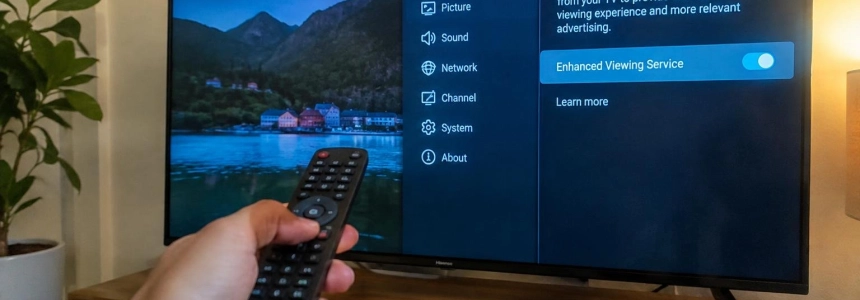
The most practical finding is also the most confusing for someone configuring the TV. Disabling “Personalised Ads” did not stop the observed transmissions. They stopped after “Agree to Enhanced Viewing Service” was withdrawn, a separate option that, according to the researcher, was enabled during initial setup. Tech-ish adds that the default “Select All” option on that screen also selected it.
These controls have different effects: one concerns ad personalization, while the other concerns the content recognition service. The VIDAA privacy policy, cited by Tech-ish, describes matching the sound from the TV and using the service to help Nexxen and its partners select ads for the TV and other devices connected to its IP address. It also mentions adjusting picture and sound settings based on what is being watched.
The difference between the visible label and the technical effect has consequences for consent. If someone believes they have rejected tracking by disabling personalized ads, but audiovisual recognition depends on a separate checkbox, the choice is not clear in the interface. The issue is not just what data is collected: it is also whether the control the user finds corresponds to the processing they intend to stop.
The settings path documented by Tech-ish for the device analyzed is Settings > Support > Disclaimer and Privacy > Data Sharing, Privacy and EULA, where Enhanced Viewing Service is deselected. The same outlet notes that names may vary by firmware and describes a second advanced settings screen for reviewing the options. Cyber Security News says withdrawing consent closed the connection to the server, but the subsequent observation with no traffic lasted 60 seconds and was conducted in a menu, not during playback.
What is known—and what remains to be verified—about HDMI
External inputs require caution. TecnoAndroid says the process covers audio passing through HDMI, including game consoles; Cyber Security News explains that capturing decoded audio would have that architectural scope. However, Tech-ish says Werneck did not capture what is sent during HDMI playback, and Cyber Security News also warns that it did not verify the exact metadata values for HDMI or live TV.
Therefore, the fact that processing occurs after sound is decoded does not, by itself, prove what specific data accompanies each input or what content is recognized in every case. Tech-ish cites VIDAA's policy on connected devices and Nexxen, but does not present a capture of those fields during a console session. The distinction matters for households that use the TV as a display for a console or external player: the mechanism could receive that audio, but the published evidence does not resolve every detail of the report sent.
The analysis is also specific to one unit and one firmware version. Cyber Security News identifies a UK device running VIDAA U09.60; Tech-ish cautions that the result cannot automatically be generalized to all models. A second user observed a similar pattern on the same model, according to TecnoAndroid, but that is not equivalent to checking the entire range or TVs sold in Italy.
Commercial incentives and product responsibility
The relationship between Hisense and Nexxen goes beyond being a one-off destination for the data. TecnoAndroid and Tech-ish report an exclusive agreement to access ACR data—automatic content recognition—until at least the end of 2029. Tech-ish also reports that Nexxen invested in V, Hisense's subsidiary associated with VIDAA software. These ties place the feature within a commercial model of advertising based on what is being played, rather than an isolated connectivity glitch.
For companies that design TVs and platforms, the case highlights a specific tension: recognition can support ad selection and other features described by VIDAA, but users need to understand which option enables it and what data leaves the device. The payload does not contain raw sound, an important limitation compared with a recording, but its persistence, stable identifier, and metadata make it possible to link content observations to a TV over time.
There is also a difference between encrypting transmission and limiting collection. The analysis describes a TLS connection to Nexxen; this encryption protects the data in transit from casual interception, but it does not change the fact that the destination receives the reports. For those maintaining the TV software, consent controls, behavior after a restart, and consistency between the policy and settings are part of the security and privacy surface that must be verified—not just the ad interface.
TecnoAndroid reported that Hisense had not responded to the allegations when it published its article. Tech-ish also found no public response from Hisense, V, or Nexxen. In addition, tests of withdrawing consent had not yet covered video playback after a restart or a firmware update: the observed result is encouraging as a control, but does not by itself confirm that the setting persists in all those scenarios.
On the TV examined, withdrawing consent to Enhanced Viewing Service closed the observed connection; disabling “Personalised Ads” was not enough. The open question is whether this behavior and these settings choices are repeated on other models and versions of VIDAA.
Sources: TecnoAndroid, Cyber Security News, tech-ish, Notebookcheck