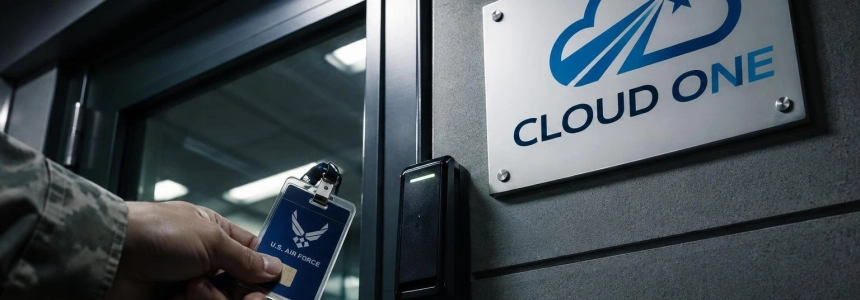
Attackers who broke into Cloud One, the U.S. Air Force’s central cloud, may have had access to systems containing military, logistics, and personnel information. The intrusion was detected during a platform update in the past month; authorities have yet to determine who was responsible or whether any data was extracted.
Cloud One brings together services from Microsoft, Amazon, Oracle, and Alphabet, Google’s parent company. In operation since 2017, it provides infrastructure for applications used by the Air Force and other Department of Defense agencies. Reuters reported the breach; descriptions of its effects and possible access to sensitive systems come from media outlets covering the investigation.
A vulnerability may have exposed the control plane
According to a source cited by Reuters, the attackers exploited an as-yet-unidentified software vulnerability to access Cloud One’s control plane. This layer manages and coordinates cloud resources. It has not been established how far they got into the platform or which systems they may have accessed.
The infrastructure hosts applications for personnel management, payroll, aircraft maintenance, and logistics. It also runs tools linked to military operations, including a system that collects data from North American air defense radars and another that tracks bombs and missiles at more than 200 Air Force locations.
The possible exposure of these services does not confirm that their records were accessed. Digital Trends noted that there is no evidence the intruders reached individual aircraft data, weapons inventories, or other sensitive information. The actual scope of the intrusion remains under investigation.
Published reports differ on how many people familiar with the case provided information to Reuters: Digital Trends says three, while BleepingComputer attributes the technical information to one source. In any case, the attackers’ identities, the extent of their access, and any possible data theft remain unclear.
Migrations and updates halted
The response is already affecting work on the platform. The Air Force paused the migration of new applications to Cloud One and blocked updates to existing ones. The intrusion was detected while engineers were working on a system update, according to Reuters’ reporting cited by BleepingComputer and Digital Trends.
Administrator privileges were also revoked for some users, according to Digital Trends. The Decoder reported that the Air Force blocked updates and removed those permissions as part of its response. It did not specify how many accounts were affected or which applications stopped receiving changes.
US Cyber Command is assessing the damage, according to the reports. The Air Force declined to comment on the security or operational status of the affected systems. BleepingComputer reported that the institution said it takes ongoing measures to protect its information, systems, and mission capabilities.
The breach comes amid other federal incidents
The case adds to a recent series of intrusions and unauthorized access incidents affecting U.S. government agencies. BleepingComputer reported that an intrusion into the FBI’s National Crime Information Center (NCIC) came to light on November 21. Local, state, and federal law enforcement agencies use the national database, which contains information on missing and wanted persons, outstanding arrest warrants, stolen vehicles and weapons, and other criminal justice records.
That incident occurred two months after the extortion group ShinyHunters breached FBI systems through an unpatched Oracle PeopleSoft vulnerability on the FBIJobs.gov recruitment site, according to BleepingComputer. The outlet also reported an intrusion into a CIA open-source intelligence analysis system that affected the Office of the Director of National Intelligence and the National Geospatial-Intelligence Agency.
Hours after the CIA case became public, the Treasury Department’s Financial Crimes Enforcement Network (FinCEN) said it was investigating unauthorized access to its systems. It has not been established whether these incidents are connected to one another or to the attack on Cloud One. The Decoder also referred to six other recent incidents targeting government agencies, without specifying which ones in its summary.
ARTEX’s role remains unclear
The incidents come as authorities warn about the use of AI-assisted attack tools. BleepingComputer reported that the FBI issued an alert about ARTEX, an open-source penetration testing framework that uses AI agents to automate various stages of an attack, from finding and exploiting vulnerabilities to escalating privileges and stealing data.
ARTEX can connect to external models from Anthropic Claude, OpenAI GPT, DeepSeek, and Grok, among others. According to the FBI, some intrusions assisted by the tool went from target selection to gaining privileged access in less than three hours. BleepingComputer added that the FBI said several threat actors had been using it since at least August 2026.
The same outlet described campaigns attributed to the use of ARTEX: an October attack on ConnectWise’s Cloud Backup service, which Microsoft linked to the China-aligned actor Storm-0940; attacks on South Korean financial institutions that exposed the personal information of around 67,000 people; and another South Korean campaign that affected more than 90 organizations and stole around 8.2 million records. It also cited a cyberespionage campaign attributed by CrowdStrike to the Chinese group Vapor Panda: it targeted more than 200 organizations in 14 countries and compromised at least nine.
These precedents do not prove that ARTEX was used against Cloud One. It is unknown whether ARTEX or another AI-powered attack tool was used in the Air Force breach, or in the FBI or FinCEN incidents. In early November, researchers had identified more than 1,600 publicly exposed ARTEX administration consoles, a figure that BleepingComputer said is considered lower than the actual total.
For now, the US Cyber Command assessment must determine which parts of Cloud One were within the intruders’ reach and whether any information was extracted. Meanwhile, application migrations and updates remain halted.
Sources: The Decoder, BleepingComputer, Digital Trends, RTHK / Reuters