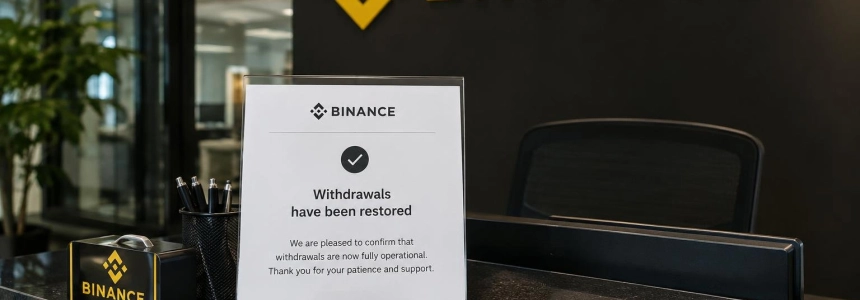
Binance lifted the final withdrawal restrictions on November 26 following the October hack, in which $6.3 billion was stolen. The platform says a 25-day phased recovery is complete and that it covered the affected assets with more than $6.34 billion in its own funds.
The reopening does not mean that every network is operational: Binance has a small number paused for maintenance or planned updates. According to the company, these interruptions are unrelated to the incident and represent a very small share of normal withdrawal traffic. Reuters and CNA also reported the announcement that the recovery was complete, along with the caveat about these networks.
“Our withdrawal recovery work is complete, and the withdrawal suspension due to the October security incident has been fully lifted.”
— Binance
A phased reopening over 25 days
Binance suspended withdrawals after the October 29 breach and began restoring them on November 1. Bitcoin was first; deposits, however, remained available during the suspension, according to crypto.news. The company enabled withdrawals by asset and network rather than reopening them all at once.
The first day saw a significant movement of funds. Between 06:00 and 15:30 UTC on November 1, Binance processed $4.65 billion in withdrawals and received $1.01 billion in deposits, according to company figures reported by TNW and crypto.news. The net balance was an outflow of $3.64 billion. Binance said withdrawal volumes declined after that initial peak.
The first phase included selected assets on 15 networks, including Ether and the USDT and USDC stablecoins on Ethereum, according to crypto.news. Binance said it prioritized the tokens with the highest customer demand during the previous week and conducted security and stability checks before restoring each asset-and-network combination.
In the week ending November 14, the exchange reopened 87 additional networks, including Cardano, Litecoin, and Avalanche. In that update, it aimed to enable the remaining assets and networks by the end of the following week. The November 26 announcement closed the process that began on the 1st. TNW describes the reopening as having been completed in 25 days.
Crypto.news notes that Binance distinguishes deposits from withdrawals in its notices and recommends checking both statuses for the intended asset and network. The platform has also warned that some delays may originate on the network itself. According to Binance, the pauses that remain in effect are for maintenance or scheduled updates, not because the hack recovery is still pending.
Binance says it has covered the stolen assets
Before removing the final restrictions, Binance said it had finished covering the affected assets. The figure it reported was more than $6.34 billion, contributed from company funds. According to crypto.news, the exchange bought affected tokens both on the market and through over-the-counter transactions.
The coverage drew on the corporate treasury, a portion of the Secure Asset Fund for Users — Binance's user protection fund — and part of the futures insurance fund. Crypto.news specifies that Binance used only the amount from the latter that exceeded the level required by its risk management framework. The company committed to restoring the user protection fund to about $1 billion.
Binance published a reserve snapshot covering 198 tokens. According to crypto.news, the reserve snapshot was taken at 00:00 UTC on November 12, and the accompanying cryptographic proof was generated on November 14. The company said it allows users to verify that their assets were backed at a minimum one-to-one ratio.
The exchange also said it would handle the few affected tokens it no longer supports through its delisting process and cover customers who still hold them. The reopening of withdrawals therefore does not eliminate the need to check the status of each asset: residual restrictions may depend on a network or an update, and some tokens remain subject to that delisting process.
Wallets linked to the attack continue moving funds
The operational recovery coincides with new movements of funds attributed to the attackers. Blockchain tracker Onchain Lens reported transfers of $35.52 million in Ether on November 26 from wallets it links to the hack. According to its estimates, the remaining unfrozen funds amounted to about $1.9 billion.
Crypto.news breaks that estimate down into 18,350 bitcoins valued at $1.11 billion and around 462,000 Ether valued at $785.2 million. The same outlet estimates that another $2.6 billion was in frozen stablecoins. These are estimates attributed to the tracker and crypto.news coverage, not a figure for assets recovered by Binance.
TNW reported that U.S. authorities and private companies had frozen more than $2.7 billion in stolen cryptocurrency. It also noted that the U.S. Department of Justice obtained court authorization to seize more than $1.2 billion, according to The Block, on November 12.
Crypto.news reported another action by the Department of Justice: a civil forfeiture complaint seeking more than $1.1 billion in USDC issued by Circle, which prosecutors believe is linked to the theft. The complaint, filed in a federal court in Washington, D.C., covers USDC associated with 36 addresses across 18 blockchains. The department said those stablecoins were already subject to a court restraining order and that U.S. authorities had helped freeze, seize, or return nearly $3 billion in cryptocurrency from various sources since the breach.
Attribution of the attack and how the intruders got in
The FBI attributed the theft to North Korean hackers, according to TNW. Binance described another part of the intrusion: it said the attackers gained access through a fake job interview. The outlet provides no further technical details about the method used and does not identify the people behind the interview.
Days after the attack, Binance said it was in a “very strong” financial position, according to TNW. Now, with withdrawals restored on nearly all networks and the company having declared the assets covered, attention turns to tracking the funds that have not yet been frozen: Onchain Lens put their value at around $1.9 billion on November 26.
Sources: TNW | Data-security, Kitco News, CNA, crypto.news