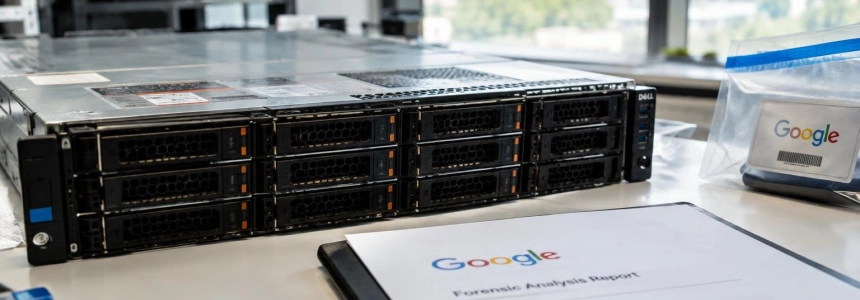
A system called exploit_agent turned patches into exploits and ran them without human intervention, according to Google Threat Intelligence Group (GTIG). Google's threat intelligence division found the multi-agent framework on a test server exposed to the internet; it also contained data stolen from organizations and tools for continuing to operate within compromised networks.
Google presented the finding in an update to its AI threat tracking, published on November 16, 2026. The company describes it as the first time it has detected threat actors fully automating the discovery and exploitation of vulnerabilities without a human in the loop. The system connected to several language models, both advanced and local.
The chain began with the continuous examination of popular web software. exploit_agent compared code before and after a security update, looked for changes that could reveal a vulnerability, prepared an exploit, and could launch it automatically. In practice, the method targets flaws that have already been fixed, known as n-day vulnerabilities: the patched code offers clues about the problem the update addressed.
An exposed server and signs of real-world activity
The discovery was not limited to a tool set up for experimentation. GTIG found information extracted from victim organizations on the server, along with several scripts for tasks after initial access. These programs could help explore internal networks, brute-force passwords, and install webshells, which allow remote access to a system to be maintained.
The inventory also included scripts for removing webshells installed by other attackers. Google therefore described capabilities for investigating the compromised environment and managing persistence within it, although it did not publicly detail which organizations had their data stolen or how much information was taken.
Victim telemetry hosted on the server pointed to a specific interest in French media, entertainment, and education websites. Google could not identify who was behind the campaign. The investigation noted signs of a Russian-speaking operator and Russian comments in configuration files, but those details were not enough to attribute the operation to a specific country or group.
There is also an important distinction regarding the scope of the finding: GTIG confirmed that the framework was used in real-world operations, but did not establish that its autonomous exploitation functions were responsible for stealing the data found. The server contained both stolen information and exploitation and post-compromise tools; the exact relationship between these elements was not determined.
“The one thing that has changed is that the containment and response timeline needs to be faster, to match the speed at which attackers using these frameworks are moving”
— Jonathan Ong, senior analyst at Omdia
The window between patch and attack is shrinking
The operational risk Google describes stems from how quickly an update can be studied and turned into an attack. When a vendor releases a fix, systems that have not yet been updated may remain exposed. An automated differential analysis process reduces the work needed to infer the flaw and prepare an exploit, and can begin shortly after the patch is released.
That interval is not the same for every organization: administrators cannot always apply an update as soon as it appears, and some installations remain unpatched for hours, days, or weeks. Automation makes it possible to attack at scale while that task is still pending, even when a company maintains strict security policies.
GTIG's report places exploit_agent within a broader shift in the offensive use of AI. Actors are moving from asking a model for help with specific tasks to coordinating agents that link several stages of an intrusion. Google and Mandiant describe frameworks capable of recognizing low-complexity vulnerabilities, generating tailored payloads, and adapting their next actions based on what happens during execution.
The report also distinguishes between n-day vulnerabilities and zero-day flaws. The former are already known or have a published patch; comparing code versions can help turn them into exploits quickly. In September 2026, GTIG analyzed statistics showing that disclosures and exploitation nearly doubled between January and August of that year. Zero-day exploits, by contrast, rose from an average of eight per month in 2025 to eleven per month in 2026, before climbing to 22 in August.
Other frameworks and campaigns observed by Google
exploit_agent was not the only multi-agent system to appear in the investigation. GTIG recorded the use of CAIRN and PentAGI in real-world intrusions, as well as experiments with CyberStrikeAI and HexStrike AI. The company also named ARTEX, a penetration testing framework that had previously attracted public attention, and proprietary tools developed by threat actors.
CAIRN was observed in activity targeting, among others, the U.S. aerospace sector. The system organizes specialized agents through an observe, orient, decide, and act cycle, and can progress from an initial parameter—for example, an IP address—to an operational objective. PentAGI, meanwhile, appeared on a custom orchestration platform used between late August and early October 2026 for systematic reconnaissance and vulnerability analysis at organizations in Asia.
Google described CyberStrikeAI as an open-source framework with a Go-written backend API that functions as a command and orchestration server. According to GTIG, it connects commercial and open-weight models with more than 100 security tools, YAML attack recipes, and custom scripts. HexStrike AI integrates model clients with more than 150 offensive tools and coordinates more than 12 specialized subagents.
The report also covers campaigns that show how the time between disclosure and exploitation can be shortened. In late August 2026, actors attacked PaperCut print management servers using two vulnerabilities as zero-days: CVE-2026-81578, an authentication bypass, and CVE-2026-82078, an unsafe dynamic class loading flaw. According to GreyNoise, as cited by Google, an actor likely used AI to develop and test exploits and launched a campaign against hundreds of organizations four days after the initial disclosure.
In another case cited by GTIG, PHP vulnerabilities identified as CVE-2026-109618 and CVE-2026-109619 were analyzed using AI-based tools. Before the official patches were published on October 21, 2026, a proof-of-concept video and early patched code circulated. In the first few days after the update, hundreds of proof-of-concept claims appeared, but they did not work; verifying which ones were valid added work for the security community.
Speed versus stealth
Google warns that autonomous execution can leave traces that are useful for detection. Forensic traffic, recognizable identifiers, and code fingerprints can reveal the use of these frameworks. GTIG believes that, for now, the tools generally gain speed at the expense of stealth, although it maintains that they can still achieve their objectives.
Jonathan Ong, senior analyst at Omdia, told CSO Online that the underlying techniques are not new: they are familiar penetration testing and red teaming methods accelerated by language models. In his view, organizations with properly configured and monitored endpoint detection and response (EDR), extended detection and response (XDR), or managed detection and response (MDR) capabilities can still identify much of this activity.
Keith Prabhu, CEO of Confidis, said there is limited evidence that AI makes each individual attack more effective. The danger, according to his assessment reported by CSO Online, is that attackers can launch more attempts in less time, thereby increasing the number of compromises. Prabhu also pointed to fragmented visibility and response processes that depend on manual decisions.
Google expects actors to continue testing these frameworks in campaigns against organizations around the world. The company anticipates less human intervention and greater stealth as tools and models improve; at the same time, the report acknowledges that current autonomous activity may be easier to detect because of the traces it generates.
Faster response, without automating everything
The recommendations reported by CSO Online focus on shortening response times and maintaining established security practices. Ong suggested strengthening identity and cloud security, using multifactor authentication and strong passwords, and implementing measures to block repeated login attempts. He also said response teams need to adjust their timelines to match the speed of attacks.
Prabhu recommended maintaining a continuous asset inventory, prioritizing vulnerabilities according to risk, and connecting suspicious signals from different parts of the organization. Amit Kumar Jena, head of AI development at Kanerika, proposed treating internet-exposed systems as a separate category, with a fast track for applying patches and virtual patching measures while fixes are tested.
To contain incidents, Prabhu suggested automating known and reversible actions while reserving human approval for decisions with significant operational consequences. Jena cited endpoint isolation and session revocation as possible actions to automate if they are defined in advance. Google, for its part, said Google Security Operations has already deployed behavioral and volume rules to detect ARTEX; Mandiant published a hardening guide and a defense framework for offensive tools based on language models.
Attribution of exploit_agent remains unresolved: Google has not identified the operator, although the signs point to a possible Russian connection. The investigation did document a server containing victim data, post-compromise scripts, and a framework designed to analyze patches and run exploits without supervision.
Sources: Technology, Google Cloud Blog, theregister, CSO Online