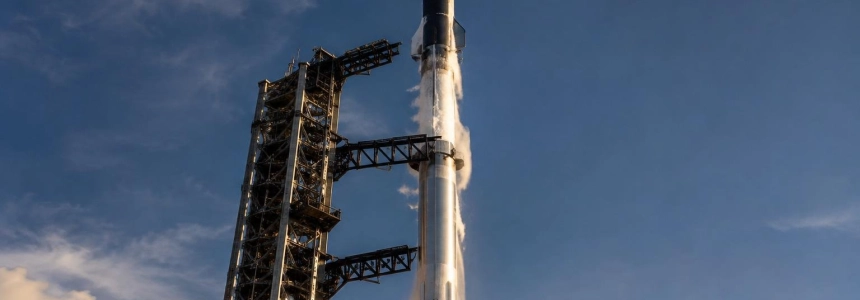
SpaceX will attempt to catch both Starship stages on the same flight for the first time: the Super Heavy booster would return to the tower a few minutes after liftoff, and the Ship spacecraft would return about 22 hours later. Flight 15 is scheduled for November 13 from Starbase in southern Texas; Ship’s recovery has never been attempted.
The launch window opens at 22:45 GMT and lasts 75 minutes. In mainland Spain, that corresponds to 23:45 on Friday; if the flight follows the full plan, Ship is scheduled to be caught at 21:17 GMT on Saturday, November 14. The final time will depend on when liftoff occurs within the window.
Two catches nearly a day apart
Starship consists of the Super Heavy booster and the Ship spacecraft, its upper stage. SpaceX wants both to return to Starbase and be caught by the tower’s arms, known as “chopsticks” because of their shape. The company has already caught Super Heavy on three flights, but has never attempted the maneuver with Ship.
The difference is significant for the recovery plan: Ship flies higher and farther than the booster, making its return more complex and energy-intensive. On Flight 15, the first attempt would come about six and a half minutes after liftoff. The second catch would take place at the end of a mission lasting more than 22 hours, if the control team determines that the spacecraft is fit to return.
The planned sequence calls for Super Heavy to separate during ascent and return to the tower. Meanwhile, Ship will continue toward orbit. The mission guide published by SpaceX, according to Space.com, places the start of orbital insertion at around 26 minutes into the flight and the payload deployment before 90 minutes have elapsed.
The orbital mission and its 26 satellites
The flight plan calls for Ship to complete approximately 14 orbits at an altitude of about 275 kilometers. After deploying 26 Starlink V3 satellites, it would begin its return and deorbit maneuver. The full mission could last a little over 22 hours, unlike previous flights, which did not include an attempt to recover the upper stage.
The goal is not just to recover the booster, which has been caught before, but to test Ship’s return to the launch pad for the first time. SpaceX says recovering the complete system would allow Starship to be reused more quickly. In its mission description, the company called the possible outcome “the first full recovery of an orbital launch system and a breakthrough moment in making Starship a reliable, rapidly reusable rocket”.
The mission also includes alternatives if the team decides Ship should not return to Starbase. Space.com reports that the flight profile includes splashdown zones in the Pacific, off Hawaii and off Chile, as well as a late-stage zone in the Gulf of Mexico. The Gulf is also listed as a contingency zone for Super Heavy if it cannot complete its planned return.
SpaceX will only carry out Ship’s return if the systems needed for reentry, the final landing burn, and the approach to the tower are in good condition. The company has also designed the flight to allow for a passively safe suborbital trajectory or a controlled deorbit over predetermined ocean areas. Therefore, the plan does not guarantee that an attempt to catch the second stage will be made.
Flight 14 paved the way for the test
The immediate precedent is Flight 14, which reached orbit for the first time and deployed another 26 V3 satellites. Space.com notes that the mission, on September 28, ended earlier than planned: Ship remained in orbit for about two hours instead of the planned ten, and the test ended after three hours and two orbits as a precaution.
For Flight 15, SpaceX is planning a longer flight and the possibility of recovering both vehicles. But the recent history also shows that a mission profile can change during flight. The company has ocean zones available to end the flight early if necessary, and the return to the tower is subject to the control team’s assessment.
The booster assigned to the mission is Booster 22, equipped with 33 Raptor engines. SpaceX moved it to the Starbase launch pad on November 10. There, it performed a suspended test at the catch height, with the tower arms holding it, ahead of the flight.
This ground test is part of the preparations for the unprecedented maneuver involving Ship. The tower has already caught Super Heavy three times, but the upper stage presents a different challenge because of its trajectory. Booster 22’s suspended compression test is not equivalent to catching Ship in flight: that part of the plan remains untested.
The schedule planned for November 13 and 14
Space.com has published an estimated timeline that places stage separation just over two minutes after liftoff and the Super Heavy catch at six minutes and 35 seconds. The table lists the main milestones in that schedule; these are times relative to launch, not confirmation that each maneuver will be carried out.
| Time after liftoff | Planned milestone |
|---|---|
| 00:58 | Starship and Super Heavy reach Max Q |
| 02:19 | Super Heavy main engines shut down |
| 02:21 | Hot staging and ignition of Ship’s Raptor engines |
| 06:10 | Super Heavy landing burn begins |
| 06:35 | Burn ends and booster catch is scheduled |
| 26:10 | Ship begins orbital insertion maneuver |
| 35:01–1:17:40 | Planned payload deployment window |
| 21:35:57 | Deorbit maneuver begins |
| 22:10:46 | Ship reentry |
| 22:32:16–22:32:34 | Final landing maneuver and scheduled catch |
With liftoff at the start of the window, Ship’s catch is estimated for 21:17 GMT on Saturday the 14th, or 22:17 in mainland Spain. Space.com warns that if launch takes place at the end of the window, the arrival would shift to 22:32 GMT. The difference is due to the actual liftoff time, not a different mission duration.
An attempt subject to authorization and conditions
Engadget reported that launch approval was still pending from regulators and that the flight also depended on favorable weather. Space.com indicated that SpaceX had not announced official backup dates. If there is a delay, the availability of another opportunity will depend on its cause; no backup schedule has been confirmed.
The recovery attempt is tied to the company’s reuse plans. Space.com notes that SpaceX wants to use Starship to expand the Starlink V3 constellation and its Starmind artificial intelligence data center network. It also reports that Elon Musk has spoken of reaching 10,000 Starship flights a year by 2030. Those are future goals; Flight 15 must first demonstrate whether Ship can return and be caught.
SpaceX plans to livestream the launch on its mission page and X account, with the broadcast scheduled to begin 30 minutes before liftoff. The stream will allow viewers to follow both Super Heavy’s early return and, if conditions give the green light, the attempt to catch Ship the following day.