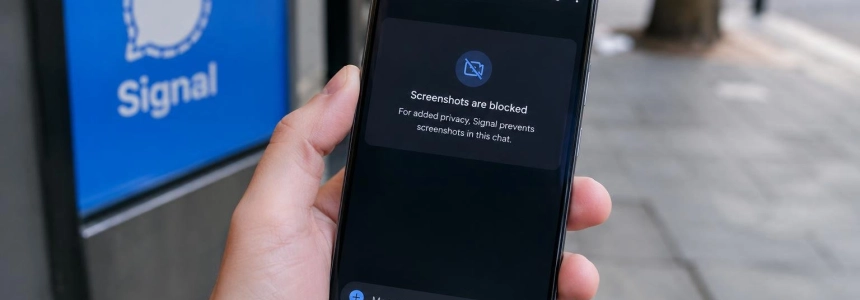
Signal will block screenshots in iOS 27 and on Android devices when it detects an AI assistant trying to read the screen. The measure aims to prevent systems such as Gemini and Siri AI from accessing private messages; it will be enabled by default on iOS, although users can turn it off.
Meredith Whittaker, president of Signal, announced the change in a November 20 post. The company says that agents built into operating systems can scan what appears on screen and make that data available to their own systems, beyond Signal’s control.
What Signal blocks on iOS and Android
On iOS 27, protection is enabled by default and prevents screenshots from being taken within Signal; it also blocks the app switcher from capturing content, according to TNW. The app includes a setting called “Block Siri AI,” designed to prevent Siri AI’s Onscreen Awareness feature from examining conversations.
On Android, Signal does not block all screenshots across the board. It enables Screen Security when it detects an AI assistant trying to access the screen, the company explains. The protection targets assistants such as Gemini Intelligence, built into Android, and prevents them from reading the content visible in the app when this access occurs.
According to Signal, the difference reflects variations among Android distributions. On some devices, it cannot reliably detect an attempted screenshot if the feature is already disabled. That is why it decided to focus on identifying an assistant’s access: blocking screenshots without reliable detection could cause them to stop working without users understanding why.
Users can disable Signal’s protections in the settings if they need to take screenshots. Whittaker warns that doing so could also expose their own and other people’s messages to AI agents, including those of their contacts. The setting affects everyone whose messages appear in the conversation, not just the person who changes it.
“Our solution is also incomplete: restricting screenshots does not address other, subtler ways AI agents could access app data, such as retrieving content already present on a user’s device through the file system.”
— Meredith Whittaker, president of Signal
The limitation: device files and macOS
Blocking screenshots does not close every avenue of access. Data stored on the device could still be within reach of agents that retrieve it from the file system, Signal acknowledges. The company describes the protection as incomplete and notes that it cannot cover every Android device either.
On macOS, Signal cannot reliably block screenshots and, for now, does not offer this protection for Siri AI. The recommendation for macOS 27 users is to add Signal to the list of excluded apps in System Settings > Siri. Digital Trends also reports this guidance.
Signal explains that macOS protections against continuous screen capture do not solve the problem: agents often obtain app data through screenshots, and the company lacks documented interfaces that would let it block them. Whittaker says the tools available to protect streaming and other DRM content do not work in this case.
A response Signal had already applied to Recall
The company had already turned to screenshot blocking to protect its chats from Microsoft Recall on Windows 11. Signal says it implemented the measure last year, when Recall could capture and store images of the screen. The company’s post adds that the system extracts text using optical character recognition and saves it in a searchable local database, which could even include disappearing messages.
The new decision responds to the arrival of AI agents in the operating system itself. Signal points to Gemini Intelligence on Android and Siri AI’s Onscreen Awareness on Apple systems. According to Whittaker, these agents examine what appears on screen to answer questions or perform actions; once captured, the information may end up in a local database or on a remote server used by the agent.
Signal says this access is beyond its control once the data has been captured. The company says its privacy promise, backed for more than a decade by open-source code and a formally verified encryption protocol, is not enough to protect information that the operating system reads from the screen.
Signal calls for common controls for agents
Whittaker is asking Apple, Google, and Microsoft for simple technical tools and precise documentation. Signal wants developers to be able to exclude their apps from agents’ access to and processing of data without losing essential features. The request covers screen reading, files, notifications, APIs, and other operating system frameworks.
The company is also calling for clear specifications on how these agents work and how they access and process information. In its post, it argues that confidential computing does not resolve these concerns on its own, because it leaves the scope of privacy guarantees in the hands of providers.
Signal also warns about access by third-party agents such as Meta’s Muse through deep permissions that users grant during setup. Whittaker questions the use of accessibility settings, designed to help people use apps, as a “master key” for agents to access data.
TNW adds that Reuters had reported that Muse managed to bypass its own Connector tool to obtain Signal messages on Mac and Android. On Mac, it reportedly used accessibility features and screenshots; an Apple update released that week closed this route, although it added new permissions for agents with additional warnings. Meta told Reuters that its agents need to see and use devices to act on people’s behalf, and that Muse only accesses other apps through explicitly granted permissions.
Conversations with Apple and Google
Signal says it has spent months on development work investigating how agents access data on Android and iOS, amid a lack of documentation and technical specifications. Whittaker says this gap makes it difficult to provide consistent protection for the millions of people who use the app.
The company says it is in discussions with various industry participants and is “cautiously optimistic” because Apple and Google are talking with it about how to make their systems interact better with privacy-sensitive apps. Signal hopes to share more information soon.
Sources: The Verge, Digital Trends, Signal Messenger, TNW | Privacy