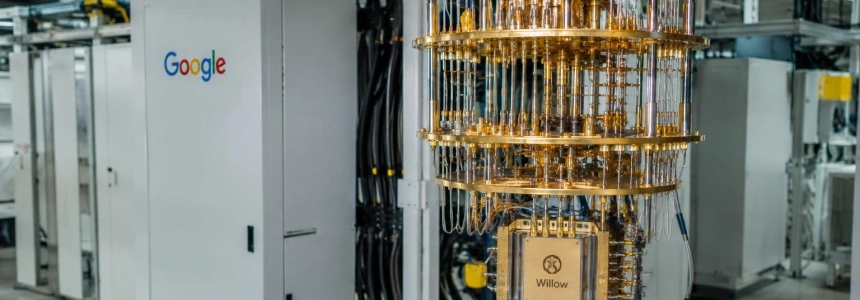
Google’s Willow quantum processor won 98.3% of the rounds of the magic square game, compared with the maximum 88.9% allowed by a classical strategy. The research, published on November 19 on the cover of Science, also found results above classical limits in experiments involving up to 105 qubits.
The result centers on quantum contextuality: the idea that a measurement does not always reveal a value that was already fixed, but may depend on which other compatible measurements are made alongside it. Google Quantum AI argues that this property could underlie some quantum algorithms. Until now, it had been observed mainly in small systems; this work examines whether it persists as processor size increases.
An impossible grid turned into a game
The starting point is a grid of three rows by three columns. Its nine cells must be filled with +1 or −1 so that the product of each row is +1 and the product of each column is −1. The two conditions contradict each other: the rows imply that the grid contains an even number of −1s, while the columns require an odd number.
The game splits the problem between two participants, Alice and Bob. One is assigned a row and the other a column; each responds without communicating with the other, and they win if their values match in the cell where the row and column intersect. A pre-agreed classical strategy amounts to preparing a complete table, which must violate one of the conditions: that is why it can win only eight out of every nine rounds, or 88.89%.
In the experiment, Alice and Bob each had two qubits and two shared Bell pairs. Instead of consulting a table written before the game, their answers arose from measurements tailored to the row or column they had been assigned. In theory, quantum mechanics allows this strategy to win every round; in the actual processor, noise and imperfections prevent this perfect result.
Google ran 100,000 repetitions for each of the nine possible row-and-column combinations. Willow won 98.30% of the games, with a reported uncertainty of ±0.0001, and lost approximately one in 60. The difference from the classical limit is the test’s central result: the coordinated answers surpassed what any pre-established classical table allows.
“By sharing entangled qubits on Willow, the players do not draw their answers from a prewritten list; instead, they generate them by measuring according to the context”
— Rodrigo Cortiñas, researcher affiliated with Google Quantum AI and the Yale Quantum Institute
A direct measure of contextuality
The game shows a difference between strategies, but the team also wanted to quantify the processor’s contextuality. To do so, it applied a Bell-Kochen-Specker inequality, which relates to the question of whether measurement results can be considered predetermined. The test combines several correlations into a value called χ.
In this test, the classical limit is four and the quantum maximum is six. Willow obtained χ = 5.590 ± 0.008, above the first value and 7% below the maximum allowed by quantum theory, according to Google Research. The measurement required observing the rows and columns on the same two qubits without altering them between tests; to do this, the team used an auxiliary qubit to record the results.
Google Research explains that the protocol performed 540 consecutive measurements and repeated the set 1,000 times. Unlike tests that depend on carefully preparing an initial state, the inequality used is state-independent: according to the team’s explanation, this makes it possible to treat contextuality as a property of the processor, not merely of an input chosen for the experiment.

From two qubits to experiments with up to 105
The study went beyond the two-player game. Google Quantum AI also tested a GHZ parity game, in which several players share an entangled state and answer one-bit questions without communicating. They win if the parity of their answers matches the rule set by the questions. Willow maintained a success rate above the best classical strategy up to 71 players, one per qubit.
The advantage decreased as the system grew, because noise increases with every added qubit. Google says the success rate remained above the classical limit at every tested size; it also verified genuine entanglement in 45 qubits. In the GHZ game, the best classical strategy reaches 75% with three participants and approaches 50% as more are added, while the ideal quantum state would always allow a win.
The largest test addressed the hidden linear function problem, which can be solved with constant-depth quantum circuits. A theoretical result from 2018, attributed to Sergey Bravyi, David Gosset, and Robert König by Infobae, established a separation from constant-depth classical circuits for this problem. Google ran the procedure on a grid of up to 105 qubits.
| Test | Reported size | Reported result |
|---|---|---|
| Magic square game | Two qubits per player; nine combinations, 100,000 repetitions each | 98.3% wins; classical limit of 88.9% |
| Bell-Kochen-Specker inequality | Two qubits and one auxiliary qubit | χ = 5.590 ± 0.008; classical limit 4 and quantum limit 6 |
| GHZ parity game | Up to 71 qubits | Above the classical strategy at the tested sizes |
| Hidden linear function | Up to 105 qubits | Success above the classical benchmark used |
For the hidden linear function, Google Research reports that the success probability fell from approximately 1 to 0.6 at the maximum size, but remained above the classical limit the team compares its results against. Infobae specifies that this threshold is a conjecture by Google’s researchers. TNW adds a broader caveat: the work does not demonstrate an unconditional advantage of quantum computers over classical computers in general.
A testbed for finding faults
The team presents the games not as commercial applications, but also as sensitive hardware tests. The tasks require many qubits to coordinate their answers; according to Google Research, this requirement revealed subtle coherent errors that conventional tests using random circuits can average out and conceal. These include small deviations that rotate the quantum state away from its target.
Contextuality also offers a ceiling defined by physics for evaluating results: a χ value of six or a win probability of one, depending on the test. Google proposes comparing processor performance with these maxima, rather than relying solely on a classical benchmark that can change as conventional hardware improves. The company believes these tests could complement current evaluation tools.
Potential future applications are linked to structured tasks, such as simulations of molecules for chemistry and materials science, which Google mentions as areas these tests could help pave the way for. The experiments described did not simulate chemistry or materials, and do not show that Willow has solved a commercial problem that a classical supercomputer cannot solve.
What the experiment demonstrates and what remains to be done
The research appeared in Science on November 19, 2026. TNW and Infobae note that the work had circulated as a preprint in December 2025. Among its authors is Michel Devoret, the 2025 Nobel Prize in Physics laureate, according to Infobae. Google Research credits its Quantum AI team and academic collaborators with the work.
The conclusion is specific: the measurements show contextuality in a superconducting processor and advantages over classical strategies in bounded tasks, up to 105 qubits. They do not prove that quantum computers generally outperform classical ones. They also make clear the engineering challenge that comes with scale: noise reduces the advantage as more qubits are added.
Google Research links contextuality to “magic states,” resources that error-corrected quantum computers need to run complete algorithms, and argues that measuring it in large systems makes it possible to investigate where quantum advantage comes from. For now, the study’s largest-scale result remains the hidden linear function test run in a 105-qubit configuration.
Sources: Computer Hoy, Hardware Upgrade, TNW | Google, Google, Google Research, arXiv, infobae