Google created thousands of simulated websites so its Chrome agents can browse, fill out forms, and complete tasks without touching the public internet. The environment, called Mirror Dimension, reproduces real web addresses inside an isolated sandbox and lets Google evaluate agents in scenarios that include attacks using hidden instructions.
Google introduced the system in a Chrome security blog post on November 19. Its immediate goal is to evaluate the protections in auto browse, Chrome’s agentic browsing feature, across long and varied tasks. The company says it can run thousands of tests a day without risking an agent deleting data, making purchases by mistake, or causing other effects on real services.
A test web that keeps real addresses
Browsing agents must be able to find websites, follow links, scroll through pages, and type into input fields. For example, when asked to search for content on YouTube, a model may infer on its own that it should visit www.youtube.com, even if the user did not provide the address. Google wanted its tests to preserve this behavior, rather than direct the agent to an obviously artificial-looking URL.
An obvious sandbox address can give away that the agent is being evaluated. Google calls this problem “eval awareness”: if the model suspects it is being tested, it may behave differently than it would during a normal task. In addition, using the public web makes evaluations less repeatable because content changes, and creates the possibility of real effects on accounts or services.
Mirror Dimension combines synthetic websites with a local proxy that intercepts browser traffic. The agent uses headless Chrome in gVisor, an isolated environment, and can request normal addresses; the connection does not reach external DNS or the internet, but is instead routed to a local copy of the page. Google says each run starts from a clean baseline, so actions in one test do not affect the next.
Redirecting traffic creates a conflict with Chrome’s own protections: the browser detects connection interception as suspicious and rejects certificates it does not consider valid. To maintain HTTPS without showing errors, the proxy creates TLS certificates on the fly, signed by a custom root certificate authority that Google installs in the sandbox’s Chrome beforehand.
The company emphasizes that this setup depends on its complete control over the test environment. WIRED also reports that the team needed internal privileges to let agents use real Chrome and get past its checks. According to the outlet, Google says the procedure would not be possible against ordinary Chrome users on the open internet.
Agents that build and review websites
The synthetic dimension must include sufficiently varied and interactive pages so that the agent does not detect it is in a simulation. Google describes e-commerce sites, local marketplaces, social networks, and recipe pages; WIRED adds banking dashboards. Functional details include persistent carts, filters, and forms, as well as multistep purchasing flows.
Rather than maintaining each page by hand, Google built a development system with three types of subagents under human supervision. The research agent turns the journeys to be tested into site requirements: it can specify a catalog with filters, cart persistence, or coupon validation. It also proposes the architecture and basic visual assets; Google’s post mentions Nano Banana for creating mockups of interface elements.
Next, the builder agent generates HTML, CSS, and JavaScript and develops responsive layouts and navigation between pages. Critic agents review the result: they check the accessibility of roles and ARIA labels, form validation, JavaScript errors, and how the site appears at different screen sizes. The system can send issues back to the builder and inspect the page again after changes.
For this review, the subagents do not just read the code. Google explains that Chrome DevTools for Agents lets them inspect screenshots, click, type, and navigate the site to observe its behavior. The company presents the process as a build-and-critique cycle in which a fix may introduce another issue, which the agents review before marking the work complete.
Testing for hidden attacks on pages
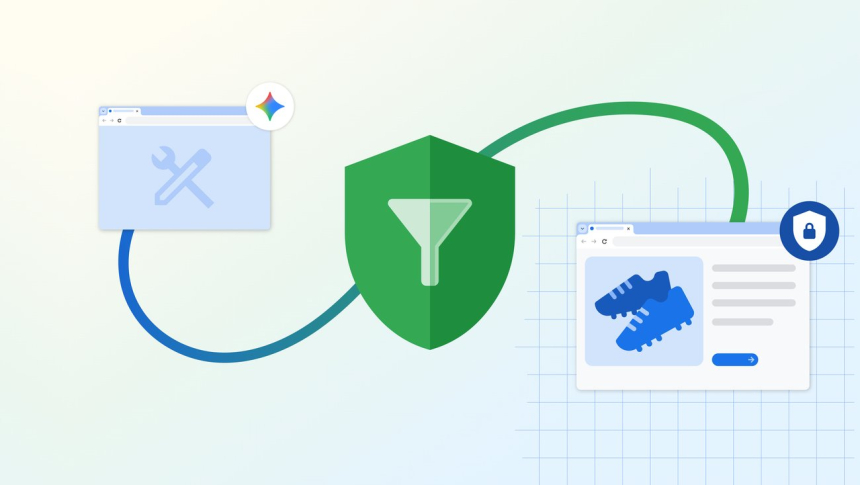
Mirror Dimension is also used to test resilience to indirect prompt injection, a technique that places malicious instructions in untrusted web content to steer an agent toward unauthorized actions. Google notes that these instructions can appear as visible text or images, in DOM elements, ARIA labels, or responses from web tools, among other parts of an interaction.
At first, the system flagged attacks using parameters added to the URL. Google observed that agents could detect these anomalous addresses and suspect they were being tested. To avoid this, it switched to sending attack identifiers in custom HTTP headers, such as X-Sandbox-Injection-Key. The sandbox server filters these headers and serves a modified page, while the URL the agent sees still looks normal.
According to Google, the automated infrastructure can generate and refine more than 1,000 test candidates per day per security engineer. The company compares this volume with more than 30 times what one person could produce manually, or more than a month of manual work in a single day. The figure refers to test candidates; Google did not disclose how many attacks its agents detect or block.
Charles Qian, a software engineer on Chrome’s security team, told WIRED that the variety of possible situations makes it difficult to anticipate everything an agent will encounter. “Any user can ask any prompt on any website, so we really need to explore that space as thoroughly as we can,” Qian said. He added that they have observed the agent developing judgment about what information it needs and when it should ask the user for confirmation.
“Any user can ask any prompt on any website, so we really need to explore that space as thoroughly as we can.”
— Charles Qian, software engineer on Chrome’s security team
Google wants to expand the environment
Google’s post focuses on agents that use the browser through a limited set of actions and tools. The company believes Mirror Dimension’s architecture could also be adapted for coding agents with broader tools, although it has not announced a date or specific rollout for that use.
Doug Turner, Google’s director of engineering, told WIRED that the company wants to make the environment accessible to other Google teams and share the approach with internal and external groups. “This is the first step; there’s going to be continued investment in this approach to train models,” Turner said. Google plans to keep improving the sandbox’s realism and its security tests as agents gain capabilities.
For now, the work described focuses on Chrome browsing and strengthening its defenses against hostile pages. Google presents Mirror Dimension as a controlled space for observing how agents handle long workflows and novel situations without affecting the real web.
Sources: europapress.es, Punto Informatico, Google, WIRED, India Today, Moneycontrol