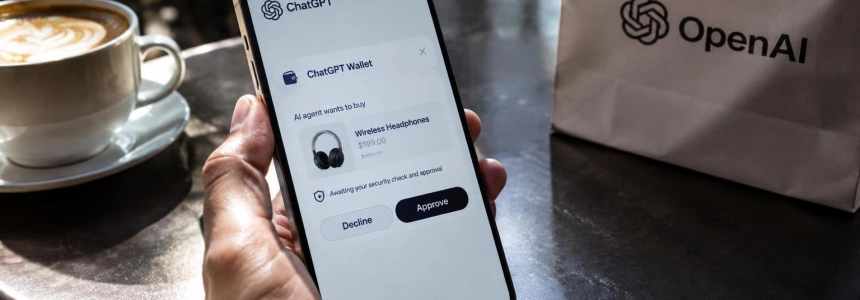
ChatGPT Wallet is now available: it lets OpenAI’s dots agents shop on the user’s behalf without seeing their actual card details. The launch starts with Pro subscribers over 18 in the United States, and every purchase requires reviewing the order and approving it through a security check.
OpenAI introduced the product on November 13, 2026, and developed it alongside American Express, Mastercard and Visa. The company describes Wallet as a way to give its agents payment capabilities without handing them the card number or allowing them to complete transactions on their own.
The process begins when the user adds a card. Before each payment, they review the items, total amount and selected card; they then authorize the transaction with a verification method such as Face ID or a fingerprint scan. According to OpenAI, each approval records what the user allowed to be purchased.
A token replaces the card details
Once the purchase is approved, the payment network provides a payment token with its own credentials: a card number, security code and expiration date. This set of details replaces the actual card information, which, according to OpenAI, is not shared with either the agent or the merchant.
The charge is applied to the card selected by the user. OpenAI says Wallet preserves card rewards and protections applicable to eligible disputes, for example, when a product arrives defective. Merchants, meanwhile, retain control over pricing, delivery, returns and customer service, according to TNW.
“Our goal here is to really focus on merchants and our network partners and start building out a really great foundation that’s safe and easy to use”
— Chaya Nayak, head of monetization and payments product at OpenAI
Nayak made that statement to Ashley Capoot of CNBC, according to TNW. Luke Gebb, head of global innovation at American Express, also argued in favor of starting the rollout on a limited basis: “It just makes sense to watch it, start it in a contained environment, and then keep rolling from there”, he told CNBC.
A rollout restricted to the United States
For now, access is limited to ChatGPT Pro users aged 18 or older in the United States and eligible cards issued there. OpenAI explained that it is starting with limited availability to observe real-world usage and improve compatibility and reliability alongside companies, banks and payment networks.
The feature also does not work on websites that block agents. TNW adds that some risk systems may flag a legitimate purchase made by an agent as fraud, which can result in a rejection or cancellation. OpenAI published a guide for merchants that covers allowing ChatGPT agents through firewalls, uploading product catalogs and setting up business profiles in ChatGPT.
The company is also working in this area with fraud-prevention firms Forter, Riskified, Sardine and Signifyd, and payment providers Adyen, Checkout.com and Stripe, according to TNW. The existence of this collaboration does not remove restrictions imposed by individual stores or guarantee that a transaction will be accepted.
Merchants are already setting limits
The availability coincides with decisions by several merchants and organizations to block automated purchases. United Airlines said Wednesday that it will block agents when they try to book tickets. Amazon prevents them from making purchases on its platform, according to CNBC, while Schwab and JPMorgan block AI agents that try to move customers’ money.
These obstacles affect one of the service’s practical requirements: Wallet can authorize payments, but it cannot force a website to accept an agent’s activity. OpenAI acknowledges that some sites may block these purchases without specifically targeting ChatGPT, and that fraud filters can also trigger rejections.
In its explanation, OpenAI presents user control as central to the design: the person inspects every cart and confirms every payment. Authorization therefore does not mean giving the agent direct access to a card so it can shop freely. TNW notes that, for now, OpenAI does not take a cut of purchases, according to CNBC.
From the “Coming soon” option to launch
The wallet had given signs of its arrival before the announcement. On October 5, PCWorld found an option called Wallet in the Customize menu of the ChatGPT mobile app, marked “Coming soon”. Opening it displayed the message “A little wallet. A world of possibilities. Your Wallet is on its way”. The clue began attracting attention the previous week, but OpenAI had not explained how it would work at the time.
PCWorld also noted that OpenAI’s annual developer conference the previous week had not mentioned shopping capabilities for dots. At that point, the system the wallet would use and its relationship to other financial products were still unknown. The November announcement now clarifies the mechanism: authorization for each transaction and a token generated by the payment network.
The initiative follows an earlier attempt by OpenAI to enable commerce within ChatGPT. TNW reports that the company launched Instant Checkout in the fall of 2025 and quickly moved away from the feature, according to CNBC. Wallet takes a different approach: the agent prepares the purchase, but the user reviews the details and gives final approval.
Autonomous shopping is still further down the road
OpenAI expects that, over time, users will be able to delegate entire purchases to their agents and set limits by spending amount, category or time period. The company is not presenting this mode as part of the initial launch: for now, every transaction requires a security check and explicit approval.
TNW also reports on a Visa test conducted that month with 22 models acting as shoppers. They failed 42.8% of the time. The figure helps explain why reliability and compatibility are among the goals OpenAI says it is pursuing with the limited rollout.
The service therefore starts with two clear limits: the purchase needs the person’s approval, and the merchant must allow the agent’s activity.
Sources: 9to5Mac, TNW | Openai, PCWorld