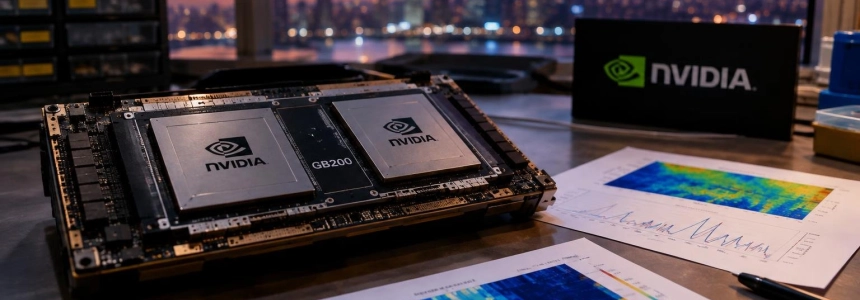
Six models from four Chinese labs carry numerical patterns consistent with Nvidia Blackwell GPUs, according to a forensic analysis by Will DePue, founder of Unemployment Labs. The finding is based on published weights from DeepSeek, Moonshot AI, MiniMax, and Ant Group; it points to access to hardware subject to U.S. export controls, but does not prove where the chips were located or how that access was obtained.
The signal appears in the arrangement of the models’ initial values, not in purchase records or internal testimony. DePue says senior researchers at OpenAI and Anthropic independently verified the method; Unemployment Labs also says it validated it against 24 models whose hardware had been made public.
A fingerprint that survives in the weights
Before training, a model receives billions of pseudorandomly generated initial values. In the software analyzed, the PyTorch framework distributes this task among parallel GPU workers using cuRAND and Philox. Given the same seed and configuration, the generator produces the same numbers, but the number of processing units changes the positions they occupy in the weight matrix.
That is the clue: the examined Hopper GPUs have 132 SM units; Blackwell B200 and B300 have 148; and GB200 and GB300 have 152. Some weight positions—for example, those associated with words or symbols that do not appear during training—retain their initial values almost intact. Others preserve a fainter statistical signal, even though training has modified them.
Unemployment Labs searched for combinations of seeds and layouts that reproduced these patterns. According to DePue, the team reproduced the results for DeepSeek-V4-Flash and Kimi K3 on physical Blackwell chips. The report adds that the search covered around six trillion combinations and that the strongest signals across the six models ranged from 49 to 1,385 sigma; even its weakest individual test reached 20 sigma.
The technique detects the configuration that initialized the weights, not direct proof that every phase of training ran on that same GPU. DePue believes training probably did use those systems. The report identifies AMD MI300X hardware configured to reproduce the pattern as a technical alternative; it says this option was ruled out for DeepSeek-V4-Flash and considers it very unlikely for the other models.
The shift from Hopper to Blackwell
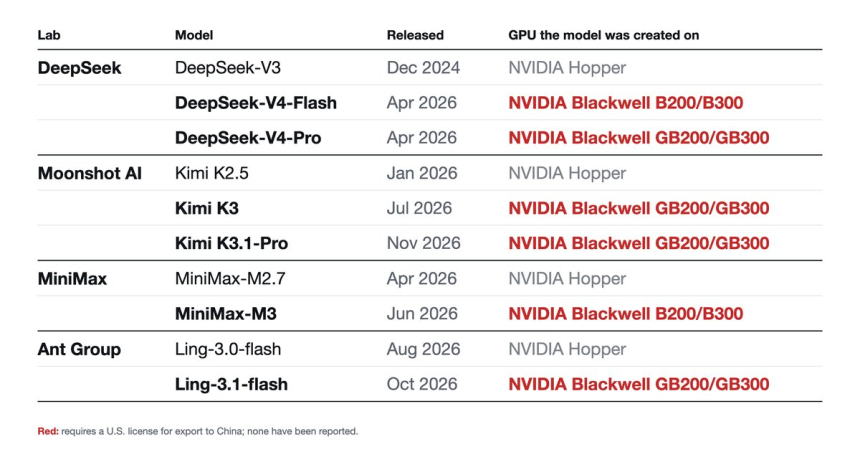
The timeline shows a recent transition. Earlier models from DeepSeek and Moonshot AI showed Hopper patterns; in newer versions, the analysis finds Blackwell configurations. For Hopper matches, the method cannot distinguish between H800, H100, and H200: in those cases, the specific identifications come from statements by the labs, not from the fingerprint alone.
| Lab | Model | Detected fingerprint |
|---|---|---|
| DeepSeek | DeepSeek-V4-Flash | Blackwell B200/B300, 148 SM |
| DeepSeek | DeepSeek-V4-Pro | Blackwell GB200/GB300, 152 SM |
| Moonshot AI | Kimi K3 | Blackwell GB200/GB300, 152 SM |
| Moonshot AI | Kimi K3.1-Pro | Blackwell GB200/GB300, 152 SM |
| MiniMax | MiniMax-M3 | Blackwell B200/B300, 148 SM |
| Ant Group | Ling-3.1-flash | Blackwell GB200/GB300, 152 SM |
The table does not imply that all Chinese models have migrated to Blackwell. The most recent models analyzed from Alibaba, Zhipu, Tencent, Xiaomi, and StepFun still show Hopper fingerprints. Unemployment Labs also found no Nvidia fingerprint in Meituan’s LongCat-2.0; the company says it trained the model on AI ASIC superpods.
There are intermediate cases that complicate a binary reading. Kimi K2.7-Code retains Hopper-generation weights, although a small portion matches B200 or B300. Kimi K3.1-Pro shares a seed with K3 and could be a checkpoint of that model that underwent further post-training, according to the report.
Cluster size, with caveats
By combining model size, estimated data volume, and assumptions about duration and efficiency, Unemployment Labs calculates that five runs used a total of around 12,000 Blackwell GPUs, equivalent in compute to about 30,000 H100s. These are research estimates, not inventories confirmed by the labs.
| Model | Blackwell estimate | Estimated duration |
|---|---|---|
| DeepSeek-V4-Flash | 1,500 (range: 250–5,000) | 50 days |
| DeepSeek-V4-Pro | 3,000 (range: 750–6,500) | 70 days |
| Kimi K3 | 4,500 (range: 1,000–9,500) | 70 days |
| MiniMax-M3 | 1,500 (range: 200–7,000) | 60 days |
| Ling-3.1-flash | 1,500 (range: 400–6,500) | 100 days |
The calculation depends on variables the weights do not reveal: GPU utilization efficiency, the number of tokens processed, and the actual duration of each run. Duration matters especially: halving it would double the estimated number of chips. The report also cautions that its figures cover each model’s final training run, not experiments, earlier runs, or inference.
At an approximate unit cost of $70,000 per GPU, the research puts the larger clusters at around $200–300 million and the five runs combined at more than $500 million. This is a cost extrapolation, not an observed invoice; the report itself revised earlier estimates upward after assuming lower efficiency, in line with disclosed Blackwell training runs.
What can be concluded about the controls
The key distinction for companies and compliance officers is between technical access and physical provenance. The patterns support the conclusion that these models were initialized using Blackwell configurations, but do not indicate whether the GPUs were in China, who owned them, or whether they were accessed through remote rental at a data center in another country. Therefore, the fingerprint does not prove smuggling or a violation of U.S. law.
For developers, the finding shows that published weights can retain details of the compute environment used to initialize a model. This turns an artifact typically distributed for reusing or evaluating systems into a source of clues about their infrastructure. But the interpretation has limits: a Hopper match does not identify the exact chip model, and CPU initialization may leave no GPU fingerprint.
There is also a practical cost to transparency: publishing weights makes it possible to scrutinize a model’s structure, but is not the same as publishing a complete record of its training. The research can infer configurations and estimate compute scale, although its ranges show how much remains beyond direct observation. And a new model can break the trail: Unemployment Labs found no fingerprint in DeepSeek-V4.1-Flash, whose architecture is different.
The technical evidence thus sharpens a question that previously rested on suspicion: several Chinese models appear to have had access to Blackwell. The question the weights cannot answer is where the GPUs were and who controlled them.
Sources: The Decoder, Wccftech, Engadget, Unemployment Labs, Moneycontrol