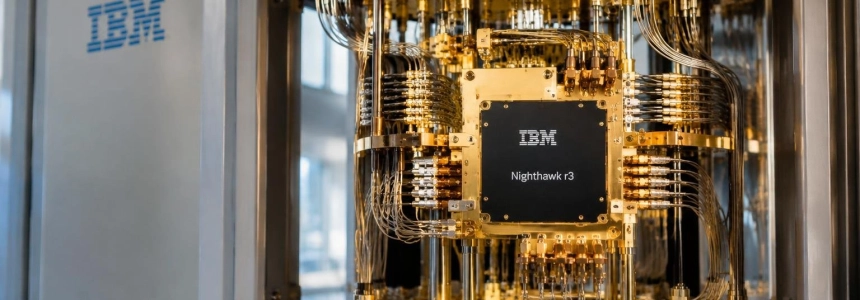
IBM has introduced Nighthawk r3, with 520 programmable qubits, a processor designed to execute 10,000 quantum operations accurately. The company plans to connect two units in 2027 to form a 1,040-qubit system, with the goal of tackling larger computations without sacrificing the speed of the current Nighthawk generation.
IBM’s announcement, dated November 11, presents r3 as the next generation of Nighthawk. The company says the processor retains the speed and quality demonstrated by the current generation while expanding the scale of the hardware. The design maintains r2’s grid connectivity and fast operations, and adds connections for linking processors in larger systems.
There is a discrepancy in the capacity description: IBM specifies 520 programmable qubits, a figure also reported by StorageReview. In the body of its article, Europa Press says r3 is designed for 10,000 operations on 250 qubits, although the headline of that piece mentions 520. IBM also reports that the processor has 2,034 physical qubits.
Ten inter-chip links and a plan to scale
The architectural innovation is 10 inter-chip links, which IBM calls l-couplers. They are designed to link processors and extend the system beyond a single chip. The announced roadmap sets a 2027 target for connecting two Nighthawk r3 processors in a 1,040-qubit machine.
The company had already tested part of this strategy with Nighthawk r1: this year, it connected two processors using four l-couplers. IBM reported an average quantum state transfer fidelity of 99 percent and a best result of 99.3 percent, against a target of 99.9 percent. The test serves as a precedent for modular interconnection, but it is not yet the planned r3 system.
IBM also reported that it connected two cryogenic modules in a single system for the first time. The system reached operating temperature in less than five days and cooled to below 15 millikelvin. The company links these advances—interconnection and modular cooling—to its plan to build larger quantum systems.
| Processor or system | Reported details |
|---|---|
| Nighthawk r2 | 120 programmable qubits, 458 physical qubits, more than 7,500 operations, and up to 100,000 samples per second. |
| Nighthawk r3 | 520 programmable qubits, 2,034 physical qubits, 10,000 operations, and 10 l-couplers. |
| System planned for 2027 | Two connected r3 processors, with a total of 1,040 qubits. |
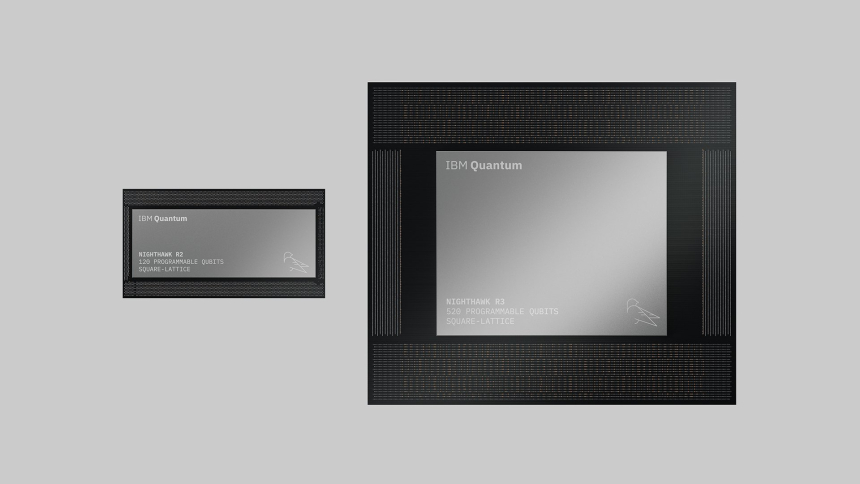
The scale difference between r2 and r3 is significant: the previous model operates with 120 programmable qubits, while the new one, according to IBM, has 520. The company describes r3 as an expansion of r2’s fast architecture, not a change in approach. In these announcements, it has not given an availability date for r3 apart from the plan to connect two units in 2027.
r2’s speed in tests by customers and partners
The immediate predecessor is Nighthawk r2, introduced in September. IBM says it offers up to 100,000 samples per second and supports accurate computations with more than 7,500 operations on 120 qubits. Its fast-reset technology reduces the interval between circuit executions, making it possible to collect the millions or billions of samples some applications require.
According to IBM, E.ON, Algorithmiq, and Q-CTRL have collectively run 34 billion circuits on r2, achieving performance improvements of up to 19 times while maintaining the quality required for scientific computations. The company also cites Quantum Elements and ParityQC among the partners that have reported improvements in their own workloads.
Among the specific results, E.ON reported a 15-fold speedup on a quantum machine learning task for optimizing energy grids. IBM, for its part, achieved a 12-fold improvement in an experiment conducted with Oak Ridge National Laboratory to simulate real magnetic materials; the results were consistent with neutron scattering experiments. Both comparisons were made against earlier work with IBM Quantum Heron.
IBM also says that an Algorithmiq experiment on a heterogeneous quantum material ran eight times faster on r2 than on Heron. To achieve comparable accuracy, classical tensor network methods would require, according to IBM’s estimate, 240 times more memory than in the original implementation. IBM says the circuits and results from the quantum advantage experiments published in July are available for independent testing through Quantum Advantage Tracker, a community-led initiative.
“Useful quantum computing hinges on whether results can be delivered with accuracy and speed, both are fundamental,”
— Jay Gambetta, director of IBM Research and IBM Fellow
IBM integrates classical and quantum computations
The strategy is not limited to the processor. IBM is bringing quantum computing and classical high-performance computing (HPC) together in a managed environment, IBM Quantum Platform. Users can integrate quantum workflows with classical resources ranging from a laptop to a supercomputer, in addition to the HPC and classical resources now offered by the platform.
According to IBM, the integration addresses the needs of workloads that combine quantum error correction and mitigation, noise learning, and classical post-processing. To give researchers greater control, the platform also offers pulse-level features, allowing them to tune operations, reset qubits more quickly, and extract more information from measurements.
IBM shared two examples of using this environment. Its scientists and those at RIKEN ran a sample-based quantum diagonalization workflow approximately five times faster and performed 100 times more computations than in the original study. Cleveland Clinic and RIKEN automatically processed 608 million samples to model biologically relevant structures, 33 times faster than without workflow automation.
The company has also created a co-development platform to research quantum error correction with Oak Ridge National Laboratory and AMD. The system places Nighthawk alongside Umbra, Oak Ridge’s HPC system, equipped with AMD Instinct MI355X GPUs and fifth-generation AMD EPYC CPUs. The stated goal is to design error-correction algorithms that jointly leverage quantum and classical resources.
From Nighthawk to Starling: the 2029 goal
Connecting two r3 processors in 2027 is part of a broader roadmap. IBM expects Starling to arrive in 2029 as its first fault-tolerant quantum computer. The company links the project to circuits with up to 100 million operations and a modular architecture that will need more than 100 l-coupler links working in coordination.
In an IBM Quantum post for its 2026 developer conference, the company described Starling as a system that should run useful circuits in minutes rather than months. The same post details parallel work on components such as memory, decoders, interconnects, cryogenics, and control electronics. In that context, r3 and its inter-chip links are a step in IBM’s proposed transition toward larger machines, not the arrival of a fault-tolerant system.
IBM introduced Nighthawk r3 on November 11 and expects the next scale demonstration to be the connection of two processors in 2027. The announcement does not give an availability date for the individual processor; the dated milestone is the combined 1,040-qubit system.
Sources: europapress.es, IBM Newsroom, IBM Quantum, StorageReview