Public schools in New York, Los Angeles, and Chicago are considering alternatives to Google Search after Google indicated that schools that disable its artificial intelligence features will also lose access to the search engine. The decision has drawn criticism from elected officials and brought districts’ dependence on Google services into focus.
Disabling AI could also cut off access to the search engine
According to The New York Times, starting next year schools will not be able to disable Google Search features based on Gemini while keeping the search engine available. Chris Phillips, Google’s vice president of Education, told the newspaper that «Search and AI are deeply integrated» and that schools that turn off AI features «will not have access to Search».
The reaction was especially strong among elected representatives. New York City Mayor Zohran Mamdani and Senator Bernie Sanders called Google’s stance «extortion». Mamdani recently announced a policy banning the use of AI in the classroom for students in grades 2-K-8.
New York City Schools Chancellor Kamar H. Samuels told the Times that if Google does not reconsider its position, the district «will explore other search options». Chicago Public Schools have also reportedly told Google they will look for other solutions if they cannot access a version of Search without AI.
The issue affects schools that want to limit the use of AI without giving up web search. New York and Chicago have already raised the possibility of alternatives; Los Angeles is among the districts considering leaving Google Search, although no specific statement from its officials is provided.
Google promises controls that are off by default
In a statement to The Verge, Google spokesperson Laura Breen said the company is listening to concerns from families and teachers about students turning to AI to avoid learning work. Google, she said, shares the goal of helping students learn and is testing new features in Search.
The company is preparing Guided Learning, an experience designed to guide students through complex problems step by step instead of providing an immediate answer. Google began testing it in Search in November and, according to Breen, will update school controls next year: Gemini, Gemini Notebook, and Search will be turned off by default until each school decides which services to enable.
Google presents this change as a response to teacher feedback. Breen added that the company is developing these experiences in collaboration with educators and will continue listening to their feedback. The statement does not clarify how the new configuration will work alongside the option to keep Search active while disabling its AI components.

Guided Learning’s educational approach
In a November 3 post, Chris Phillips, Google’s vice president and general manager of Education, described the company’s strategy: integrate Guided Learning into Search and Google Classroom, and review the controls available to schools. The company argues that AI should encourage productive effort, with challenges that keep students engaged without causing them to give up.
In Search, the feature is designed for student accounts. If the systems detect that a student is seeking help with certain types of assignments, the service can guide them through the topic in stages. Google gives examples such as pasting a complex physics problem or asking for help writing a report about a book: rather than going straight to the answer, students would receive prompts to think critically and work through the concepts.
The initial trial is aimed at selected schools in the United States. Google said it would begin later in November to gather feedback from educators before expanding the experience to other districts in the following months. The company did not identify the participating schools.
Google Classroom has offered Guided Learning globally since November 3. When a student starts an assignment set by their teacher, the feature works as an individual study tool linked to the class material. It also provides teachers with real-time information to identify which topics may need additional support.
“Search and AI are deeply integrated.”
— Chris Phillips, Google’s vice president of Education
A change to controls that still needs to be finalized
Google says access to Gemini, Gemini Notebook, Gemini in Classroom, and Google Search will be completely disabled for K-12 student accounts until school administrators explicitly enable it. The company said it will share more details with schools in the coming months, before the changes take effect, so they can prepare.
This announcement expands on what Breen told The Verge: Google’s November 3 statement includes Gemini in Classroom among the products covered by the new controls. The company says each school can decide how to use AI, but it has not yet detailed how the settings will work in practice or whether Search can be separated from its AI capabilities.
The distinction matters to districts that want to keep the search engine while blocking generative tools. New York has made its search for other options conditional on Google reconsidering its position; Chicago has also said it will seek alternative solutions if it does not receive a version of Search without AI.
Dependence on Google makes leaving difficult
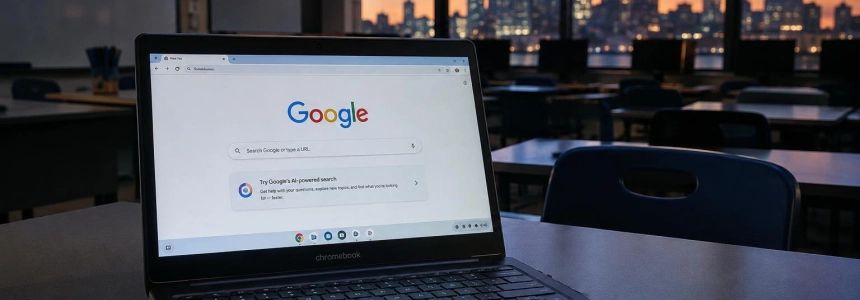
Google has a strong presence in U.S. classrooms: schools use Google Classroom, Chromebooks, and other company services. As a result, leaving the Google ecosystem entirely could prove difficult, even if districts decide to replace Search.
Educators’ concerns are not limited to a product’s settings. They worry that AI could affect students’ critical thinking; some research has shown that people who use AI tend to perform worse on tests. There is also concern about the possible effects on the mental health of children who form relationships with chatbots at an early age.
Google, for its part, argues that Guided Learning can help students solve problems rather than skip the process. In its post, the company says its research shows measurable learning gains with this approach, although the announcement provides no figures or details about those results.
The next steps are the Guided Learning trial in Search and informing schools about the new controls. In the meantime, New York, Los Angeles, and Chicago are weighing alternatives, and Google still needs to clarify how schools will be able to keep access to Search if they want to disable AI.