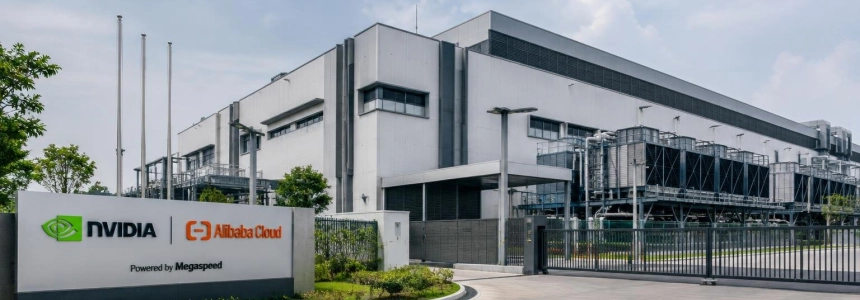
More than $4 billion in Nvidia chips: that is the scale of purchases made by Megaspeed, a Singaporean company that, according to people familiar with the relationship, had Alibaba as its main customer and financial backer. The infrastructure operated in data centers across Southeast Asia, including one in Malaysia, from where Alibaba could access the chips remotely.
The operation relied on a separation between who bought the chips and who used them. Megaspeed acquired servers and computing capacity; regional companies built or managed the facilities, and Alibaba could connect to them from China. That design revealed a way to obtain Nvidia computing power without necessarily moving the equipment into the country.
A chain with several intermediaries
The business began to take shape in 2023, when Alice Huang and her husband, Kang Wei, sought investors in Shanghai for an artificial intelligence company in Southeast Asia. At meetings, Huang spoke about her relationship with Jensen Huang, then Nvidia's CEO, and the possibility of securing a chip supply. Megaspeed was established after those introductions; the report identifies Alibaba as a customer and financier, according to three people familiar with the connection.
The specific route described runs through Speedmatrix, a Megaspeed subsidiary, which operated Nvidia chips at YTL's facilities in Malaysia for Alibaba, according to five people familiar with the project. Computer systems on YTL's network at the center also bore Alibaba's name, according to an infrastructure analysis by Infrawatch. YTL did not respond to requests for comment.
The path taken by the data helps explain the model: from the Malaysian center, fiber-optic cables connected to an internet exchange point in Singapore and, from there, to China via submarine cables. Alibaba and its customers could use the chips remotely once the facilities were operational. People familiar with the development described a sequence in which Alibaba committed to becoming a customer of a regional firm, that relationship helped the firm attract investment, and the capital was then used to buy the chips.
flowchart LR
    A["Alibaba se compromete como cliente"] --> B["Megaspeed obtiene financiación"]
    B --> C["Megaspeed compra chips Nvidia"]
    C --> D["YTL opera el centro en Malasia"]
    D --> E["Conexión por Singapur"]
    E --> F["Acceso remoto desde China"]
The chain did not always end at the data center. Some people cited said that, at times, chips intended for overseas facilities were smuggled into China. The United States is investigating whether Megaspeed took part in this kind of transfer, but the report does not establish that this happened with Alibaba's equipment at YTL.
The line between hosting and access
The distinction between hosting chips outside China and using them from China is central to the case. U.S. restrictions limited the sale of certain Nvidia chips to the country; Megaspeed's model allowed equipment installed in another territory to provide capacity to Chinese customers through remote connections. U.S. authorities recently tightened the rules to prevent companies such as Alibaba from accessing Nvidia chips in this way.
For companies setting up data centers, the model offers a way to attract investment and customers with computing demand. For their customers, it allows them to contract for capacity without directly buying each server. But the structure also distributes responsibility among buyers, operators, equipment suppliers, and end users, making it difficult to determine where cloud services end and who actually controls how the chips are used.
Megaspeed obtains its Nvidia servers from Aivres, the U.S. subsidiary of Inspur, a Chinese technology group described as closely linked to the state. The installation of new equipment and repairs at Megaspeed's data center are also carried out by engineers from another Shanghai company connected to Huang, according to two people familiar with the operations. Chinese ties therefore appear at several links in an infrastructure operating outside China.
The model is not unique to Megaspeed. Public records and people familiar with similar deals indicate that DayOne, Bridge Data Centers, and Aolani provide computing capacity to customers based in China. All three companies have a presence in Southeast Asia; DayOne and Bridge Data Centers did not respond to requests for comment, and Aolani declined to discuss its customers.
The connection to Zhejiang Lab
Washington's concern is not limited to Alibaba's access. The company co-founded Zhejiang Lab, a laboratory linked to the military sphere, in 2017, according to the report. Some of its researchers have worked on topics such as automated cyber defense, vulnerability identification, and information campaigns. A job posting described work on combining artificial intelligence and hacking techniques; a researcher affiliated with the lab co-authored a study on simulations of scenarios involving a foreign carrier strike group.
The lab also has a connection to Nvidia through Wang Jian, its current director, who created Alibaba's cloud unit and served as the company's chief technology officer. Wang and Jensen Huang have a long-standing relationship. In 2025, Huang called Wang “a hero. An incredible hero. A superhero” during an event in Beijing. The report notes that it is unclear whether Huang knew about the lab's military ties.
“Any suggestion that Alibaba provides services to the military is unfounded. Alibaba Cloud's service agreement strictly prohibits the use of our products and services for military purposes.”
— Alibaba spokesperson
The fact that Zhejiang Lab has used Nvidia chips does not prove that it received equipment from Megaspeed. The destination of those chips remains unclear. However, Alibaba won contracts for three stages of a computing center that provincial officials describe as having been built by the lab. State-owned Zhejiang Computility sells computing power to the center and advertises access to Nvidia chips subject to export controls; the specifications of another contract match those of those chips.
The possible connection matters because Zhejiang Lab brings together civilian and military research. Some of its scientists study astronomical phenomena, while others collaborate with Chinese military institutions. A postdoctoral researcher affiliated with the lab published a paper with scientists from an air force academy on war simulations intended to destroy or drive away a foreign carrier strike group.
Controls, exposure, and contingency plans
For Nvidia, the case raises questions about how it vets its customers and their uses when sales go through intermediaries and foreign data centers. A company spokesperson said Nvidia works across the sector to comply with changing rules on cloud services and compete to build U.S. infrastructure in authorized regions. Jensen Huang did not respond to a request for comment sent by email.
Alibaba denies providing services to the military and says its terms of service prohibit military use of its products. In June, it sued the U.S. government after the Pentagon included it on a list of companies that, according to the agency, contribute to the Chinese military. The case remains open. Megaspeed, for its part, said the matter was under independent review and that no conclusions had yet been reached; its CEO, James Tan, said complying with U.S. law was very important to the company.
The investigation also has a visible financial impact: YTL shares fell nearly 20% in two weeks as scrutiny of Megaspeed's operations in Malaysia increased. YTL did not comment on the project. The move shows that regulatory risk can reach infrastructure owners, even when the end customer and use of the chips are in other countries.
Alibaba reportedly planned a contractual exit if Megaspeed failed to meet its obligations. An agreement between an Alibaba subsidiary and Megaspeed stipulates that servers, chips, intellectual property, and other equipment would pass to Alibaba in that event. The clause leaves an open practical question for enforcement of the controls: who would retain the hardware if the company that bought it ceased operations.
.Source: Business Standard