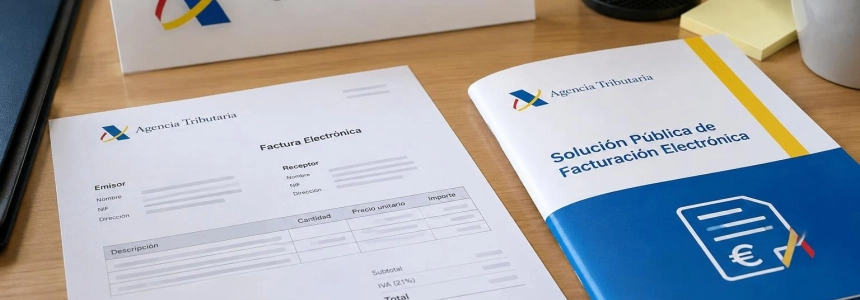
The Tax Agency made a test environment available on November 10 so businesses and self-employed professionals can trial issuing electronic invoices before the requirement takes effect. The environment allows users to start using the Public Electronic Invoicing Solution (SPFE), the free alternative managed by the Tax Agency.
The launch opens a period for those subject to the requirement to learn about and test the system before the legal deadlines. The schedule begins in October 2027 for businesses and professionals with a turnover exceeding 8 million euros; everyone else will have to issue, send, and receive electronic invoices from October 2028.
A phased schedule with different obligations
The reference date set by the regulations is October 6, 2026, the day Order HAC/1028/2026 entered into force. The Tax Agency sets out the deadlines counting from that date: first, operators above the 8-million-euro threshold must adapt; then, the remaining businesses and professionals.
| Date | Who is included | Obligations specified by the AEAT |
|---|---|---|
| October 6, 2027 | Businesses and professionals with a turnover exceeding 8 million euros | Issue, send, and receive electronic invoices; report invoice statuses and payments |
| October 6, 2028 | All other businesses and professionals | Issue, send, and receive electronic invoices |
| October 6, 2028 | Legal entities with a turnover of 8 million euros or less | Also report invoice statuses and payments |
| October 6, 2029 | Individuals and entities under the income attribution regime | Report invoice statuses and payments |
ElEconomista summarizes the first milestone as October 1, 2027, and the next as October 1, 2028. The information published by the Tax Agency gives the specific dates as October 6, counting the deadlines from the order's entry into force. The difference also affects the scope: the second phase does not immediately make all groups subject to the obligation to report payments.
In particular, individuals and entities under the income attribution regime will have until October 6, 2029, to report statuses and payments, according to the official schedule. The electronic invoicing obligation for the remaining businesses and professionals takes effect earlier, in October 2028.
The public alternative and private platforms
Once the system becomes mandatory, businesses will be able to use a private platform or the SPFE. The latter is designed and managed by the State Tax Administration Agency (AEAT) and offers free issuing and receiving services to those who choose it, with a particular focus on SMEs and self-employed professionals.
Choosing a platform does not remove the requirement for information to pass through the public infrastructure. Those issuing invoices through the SPFE will leave them there; those using a private platform must send a faithful electronic copy of each invoice to the public solution at the same time as it is issued. The order stipulates that these copies be sent in UBL syntax and contain information equivalent to the invoice line items, in addition to the minimum content required by invoicing regulations.
The SPFE does more than serve as an invoicing program. The AEAT defines it as a universal, mandatory repository for original electronic invoices or faithful copies of them, and as an interconnection point between private platforms. It also makes invoices and their statuses available to issuers, recipients, and authorized persons for viewing or downloading.
The system uses UBL syntax, which the Tax Agency identifies as the reference for the public solution and as compatible with European standard EN16931. The AEAT states that UBL is one of the syntaxes permitted by Directive 2014/55/EU on electronic invoicing in public procurement and that it can facilitate the interoperability of intra-EU invoices when the VIDA Directive is implemented.
Invoice statuses and payment tracking
The change is not limited to the format in which the document is sent. The recipient will have to electronically report whether an invoice has been rejected and whether it has been paid in full; they will also have to report the statuses provided for in the system. The order also provides for reporting payments and non-payments and allows the issuer to voluntarily report certain statuses.
The stated objective is to obtain reliable data on actual payment periods and help reduce commercial late payments. The Create and Grow Law of 2022 introduced mandatory electronic invoicing in business-to-business relationships; the implementing regulations were set out in Royal Decree 238/2026 of March 25.
In practice, the recipient will have to confirm receipt, validate or reject the invoice, and report the payment date, according to the approach described by ElEconomista. The issuer will be able to check whether the document has been paid in full or in part by the stated date. According to the AEAT, payment information received by the public solution may be used for tax purposes.
Order HAC/1028/2026, published in the BOE on October 5 and in force from the following day, specifies the technical aspects of the SPFE. These include procedures for issuing and interconnecting invoices through web forms or web services, submitting faithful copies, validation processes, and responses from the Administration.
The regulation also establishes a unique code for each invoice, formed from the issuer's NIF, series, number, and issue date, in accordance with UBL syntax. It also regulates identification and representation for accessing the service, reporting statuses and payments, and procedures for correcting rejected invoices or handling technical issues.
Verifactu is delayed, while European regulations remain on the horizon
Mandatory electronic invoicing is not the only change planned for invoicing systems. On October 5, the Tax Agency announced that it would postpone Verifactu again and set October 1, 2028, as its target start date, coinciding with the entry into force of digital invoicing for those with a turnover below 8 million euros, according to ElEconomista.
The decision came after the Spanish Association of Tax Advisers (Aedaf) questioned in June the schedule that had then set the launch of Verifactu for January 2027. The association argued that the system would be obsolete by the time it arrived and proposed coordinating it with electronic invoicing and the VIDA Directive, to prevent businesses and professionals from having to subscribe to different platforms and modify them later.
The VIDA Directive, concerning VAT, is due to begin in 2030 and provides for a uniform invoicing system for the European Union that will also allow intra-EU transactions to be reported. The AEAT presents UBL as one of the syntaxes that will enable the interoperability of these invoices once the directive is implemented.
For now, the immediate step is to test the public service made available on November 10 and bear in mind that the first specific legal deadline is October 6, 2027, for those with a turnover exceeding 8 million euros.
Sources: elEconomista.es, Tax Agency, Tax Agency, Official State Gazette