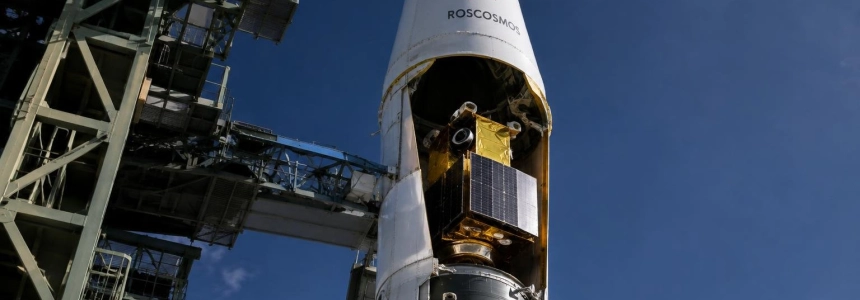
Russia could put a satellite carrying a nuclear warhead into orbit in December, according to assessments by Western intelligence services cited by WDR, NDR, Süddeutsche Zeitung and The Japan Times. The spacecraft, called Sputnik-S, is said to have been stored in the Moscow region for years and, according to alerts distributed in early November, could be launched within the following 60 days.
The reports describe an assessment recently shared among some NATO countries. Those who consider a launch possible include the Bundeswehr, Germany’s armed forces, and Germany’s Federal Intelligence Service (BND). The Bundeswehr Space Command estimates that the satellite could still take off in December.
Early-November alerts mentioned a window of 60 days to put it into space. Once in orbit, Sputnik-S would be ready to act at short notice, according to the reports cited by the media. The Japan Times reports the same forecast, attributing it to people familiar with the assessment who requested anonymity because the information is not public.
Warnings and official responses
The news rekindles a concern Washington raised internally in February 2023: that Russia was working to put a nuclear weapon in space. US lawmakers briefed by intelligence services at the time described it as a “serious national security threat,” according to WDR, NDR and Süddeutsche Zeitung. However, that scenario did not materialize at the time.
In October, the US Defense Intelligence Agency (DIA) published an assessment of the space situation stating: “Russia is developing a satellite designed to carry a nuclear weapon.” The agency said that placing it in orbit would violate the 1967 Outer Space Treaty, which prohibits placing objects carrying nuclear weapons or other weapons of mass destruction in orbit.
The German government responded cautiously. Its spokesperson, Stefan Kornelius, said Berlin takes the reports “very seriously,” but added that there is no immediate threat. He also noted that Germany’s National Security Council discussed a “changing security situation in space” on November 3. The contents of that meeting remain secret, and Kornelius urged people not to become excessively alarmed by speculation.
Chancellor Friedrich Merz called the reports “shocking.” At a joint press conference in Berlin with NATO Secretary General Mark Rutte, he said: “Reports that Russia is also planning to pursue nuclear armament in space are not new. But that does not make them any less shocking. They show the level of escalation Russia is apparently willing to pursue.”
“Reports that Russia is also planning to pursue nuclear armament in space are not new. But that does not make them any less shocking. They show the level of escalation Russia is apparently willing to pursue.”
— Friedrich Merz, Chancellor of Germany
Germany’s Defense Ministry did not respond to specific questions about the plans attributed to Moscow. A spokesperson said details of the assessment were not public and noted that Germany’s space security strategy from the previous year already addressed the nuclear threat from space. Germany’s Foreign Ministry said deploying a nuclear weapon there would constitute a flagrant violation of the 1967 treaty.
Russia, for its part, has repeatedly denied developing a space-based nuclear weapon. The Russian embassy in Germany said it had no information about the events described and rejected the accusations, calling them part of a propaganda campaign. It added that Russian space activities comply with its international obligations and are for peaceful purposes. In February 2024, President Vladimir Putin said Moscow was categorically opposed to deploying nuclear weapons in space.
The potential impact of an orbital detonation
The DIA warned that once in orbit, an armed satellite would be difficult to neutralize and that few effective countermeasures would be available. The risk would not be limited to satellites hit directly: a nuclear explosion could generate a cloud of debris and an electromagnetic pulse capable of affecting technical systems on Earth as well.
Major General Armin Fleischmann of the Bundeswehr Cyber and Information Domain Service warned that the consequences for Germany could include power outages and problems with communications and navigation. Protecting its own systems with radiation-resistant materials would be costly, he said. As an alternative, he proposed developing “counterspace” capabilities to act against enemy satellites, including those armed with nuclear weapons, and neutralize them if possible.
US Space Command Director Stephen Whiting described a possible chain reaction. According to the quote reported by WDR, NDR and Süddeutsche Zeitung, “probably about a third of all satellites in low Earth orbit would fail immediately, within the first hours or days. Over the following months, the remaining satellites would gradually fail.”
Widespread satellite losses would affect civilian and military services. Civilian systems at risk include GPS navigation, banking operations, and power and mobile phone networks. For the armed forces, reconnaissance capabilities and communications between troops and allies would be diminished; some weapons systems could become practically unusable.
Investigations by WDR, NDR and Süddeutsche Zeitung indicate that Western armed forces depend on satellites more than Russian forces do. Western security sources cited by those outlets believe that, in a conflict, an explosion in space could give Russia a short-term military advantage.
Kosmos-2553 under suspicion
Western intelligence services have been monitoring Kosmos-2553 for years, a Russian satellite launched in February 2022, shortly before the start of Russia’s full-scale invasion of Ukraine. Moscow said it would be used to study radiation in space; Western agencies doubt that explanation.
German security sources told WDR, NDR and Süddeutsche Zeitung that they now consider it possible that Kosmos-2553 was a test satellite, or “dummy,” to study how radiation affects other spacecraft and when they suffer serious damage. The hypothesis is that Russia tested flight and maneuvering capabilities there in an intense radiation environment. This interpretation is presented as an assessment by Western services, not as a function acknowledged by Moscow.
Not everyone shares this view. A 2025 analysis by the German Institute for International and Security Affairs concluded that Kosmos-2553 was not an active anti-satellite weapon. Although some observers considered it plausible that Russia was pursuing a nuclear anti-satellite program, the analysis said this had not been proven.
In 2024, scientist Dmitri Stefanovich of the Russian Academy of Sciences identified the Sews (Zeus) project as the closest thing to an anti-satellite weapon. It would be a nuclear-powered spacecraft designed as a tug for lunar missions. Russia’s state news agency RIA Novosti also wrote that it could disable satellites using electromagnetic radiation.
Historical precedents and the next deadline
Current warnings also draw on historical precedents. In 1962, the United States detonated a nuclear bomb in space at an altitude of 400 kilometers over the Pacific as part of the Starfish Prime military project. The explosion produced a visible glow and an electromagnetic pulse that knocked out streetlights, telecommunications systems and other equipment in Hawaii. It also destroyed several satellites, including the first British satellite and the first US civilian satellite.
The scale of the effects would be different today, the media argue, because there are now tens of thousands of satellites. Rutte had already expressed concern in April 2025 over reports of possible Russian plans. He said then that the weapons would be aimed at satellites, not Earth, although falling spacecraft could cause chaos in ground-based systems that depend on them. After meeting with Merz, he limited himself to saying that NATO would defend every inch of its territory, including against threats from space.
Early-November alerts gave a window of 60 days to put Sputnik-S into space. The possibility that the launch could take place in December reflects the Bundeswehr Space Command’s estimate. Germany maintains that there is no immediate threat, while Russia rejects the accusations.
Sources: Tagesschau (WDR/NDR), Süddeutsche.de, The Japan Times