The Department of Justice announced the arrest of Abdulrahman Alfozan, an OpenAI engineer, on a charge related to the interception of oral communications. In the complaint, prosecutors allege that an audio recorder was hidden in the USB port of a television in an OpenAI executive conference room and that a second recorder was later found in the employee’s bag.
The U.S. Department of Justice announced the case on October 13, 2026. Alfozan, 35, a Saudi Arabian national, is charged with using or attempting to use an electronic, mechanical, or other device to intercept oral communications. The charge does not amount to a conviction.
A recorder hidden behind the television
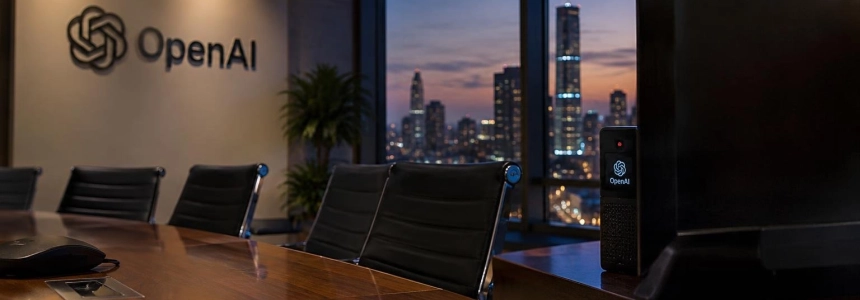
According to the complaint, OpenAI employees discovered the first device on September 30, inserted into a USB port on the back of a television in an executive conference room at one of the company’s buildings in San Francisco. It was hidden inside toilet paper, and its contents were encrypted.
The company determined that the recorder had been installed around September 28. The complaint does not specify which conversations it captured or whether anyone accessed the recordings. It does say that meetings held in the room typically concerned highly confidential technical, business, and strategic matters.
Topics that could be discussed included proprietary research, product plans, and business development opportunities. The meetings also covered nonpublic technical advances, strategic decisions, capabilities, priorities, government contacts, and OpenAI’s business relationships.
Office surveillance footage placed Alfozan near the executive conference room on several dates before the discovery. The complaint states that he was not authorized to access the space or to attend the meetings held there.
“According to the complaint unsealed today, Abdulrahman Alfozan allegedly concealed a covert recording device inside his employer’s executive conference room to secretly capture sensitive communications about the company’s super intelligence technology.”
— Kash Patel, FBI Director
Inquiries about rooms and audio recording
The charge also describes searches that, according to prosecutors, took place before the device was discovered. Alfozan allegedly used a productivity tool to make several inquiries about the addresses of OpenAI buildings, its meeting rooms, the capacity of those rooms, and their schedules. He also allegedly searched for “leadership and exec” locations and meetings with external partners.
Between September 24 and 30, a chatbot account associated with Alfozan’s wife sent instructions and questions related to creating, customizing, installing, testing, concealing, and remotely accessing a device. The complaint says that the account shared several identifiers and attributes with Alfozan’s own chatbot account.
The inquiries cited by prosecutors included building a continuous audio recorder, customizing Wi-Fi connectivity, improving audio and live listening, and encrypting an SD card. Between September 27 and 28, the same account also allegedly sent questions specifically linked to the first recorder, including information about its custom header and unique MAC address.
The complaint presents these details as part of the charge, but the announcement does not establish that Alfozan wrote each inquiry. The account was associated with his wife and, according to prosecutors, shared identifiers and attributes with his account.
The second device was found in a bag
On October 5, according to the complaint, Alfozan entered the executive conference room and appeared to look behind the television where the first recorder had been placed. That same day, he allegedly left a bag unattended in another room in an OpenAI building.
Company security staff found the bag and opened it. Inside were, among other items, Alfozan’s wallet and identification, as well as a second recorder similar to the first. The announcement does not specify whether this device was installed, contained recordings, or was ever used.
The sequence described by prosecutors thus brings together the discovery of a recorder in the room, inquiries about spaces and audio equipment, Alfozan’s presence near the location, and the discovery of another device in a bag containing his belongings. These facts are part of the complaint and will be addressed in the legal proceedings.
Arrest, charges, and potential sentence
Alfozan was arrested on October 9 and made his first appearance in federal court on October 13. The announced charge is the use or attempted use of a device to intercept oral communications. If convicted, he faces a maximum sentence of five years in prison and a $250,000 fine, as well as three years of supervised release.
The FBI is investigating the case. The prosecution is led by Nicolas Parker, Assistant U.S. Attorney for the Northern District of California, with assistance from Kate Tagert, trial attorney in the National Security Division’s Counterintelligence and Export Control Section of the Department of Justice.
Director of National Intelligence Jay Clayton linked the case to the protection of intellectual property and national security. In his statement, he thanked FBI Director Kash Patel and the agency’s partners. Patel, in turn, described the matter as an alleged covert capture of sensitive communications about OpenAI technology.
The investigation is part of a presidential memorandum
The Department of Justice said the proceedings are being brought in support of National Security Presidential Memorandum 11, known as NSPM-11, which aims to support U.S. superiority in superintelligence technology. The announcement also included a statement from Craig H. Missakian, U.S. Attorney for the Northern District of California, who said his office would work with the FBI to pursue alleged attempts to steal technology.
For now, the FBI investigation remains open and the charge is still an allegation. The proceedings will determine whether Alfozan installed or attempted to use the devices to record conversations at OpenAI’s offices.
Source: U.S. Department of Justice