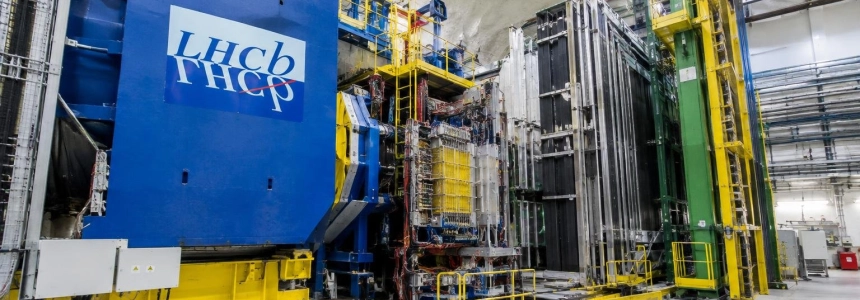
The LHCb collaboration has found hints of a decay that occurs approximately once in every 10 billion decays of beauty particles: the B⁰ meson transforms into two muons. The signal reaches 3.2 standard deviations when data from different periods are combined, a result compatible with the Standard Model, but still below the threshold required to confirm an observation.
The result was presented at a seminar at CERN on November 3, 2026. It is the first time a single experiment has gathered sufficient evidence for this process, following a search that, according to the INFN National Laboratory of Frascati, began in 1984 with CLEO at Cornell University.
A rare signal, compatible with theory
The B⁰ is made up of a beauty quark and a down antiquark. In the decay under study, the particle produces a pair of muons, one positively charged and one negatively charged. Muons resemble electrons, although they have more mass; distinguishing them from a large number of other processes was one of the central challenges of the analysis.
The expected frequency for this channel is very low. The equivalent decay of the B⁰s meson into two muons occurs around three times for every billion decays of beauty particles. According to the Standard Model prediction, the B⁰ decay would be about 30 times less frequent.
These channels are considered “golden channels” for searching for phenomena not described by current theory. Quantum mechanics allows other particles to influence how a meson decays; some could be too heavy to be produced directly in LHC collisions, but leave an indirect trace in the process's frequency. A significant difference from the prediction could point to such an influence.
For now, LHCb's measurements are compatible with the Standard Model. The result does not announce a new particle: according to the LHCb collaboration, it more precisely constrains which models extending the theory remain possible and guides future searches.
From a 2015 hint to the current evidence
The search did not start from scratch. In 2015, a joint analysis by LHCb and CMS observed the B⁰s → μ⁺μ⁻ decay for the first time and reported hints of the rarer B⁰ channel. Subsequent analyses using data collected up to 2018 did not confirm those hints. The current signal is the first evidence obtained by a single experiment.
The history of the B⁰s channel shows the progress of these measurements: LHCb reported hints with a significance of 3.5 standard deviations in November 2012; LHCb and CMS announced the first joint observation, at 6.2, in May 2015; and LHCb reported an individual observation at 7.8 in February 2017. The B⁰ channel remains much harder to identify.
The new signal had a significance of 3.0 standard deviations with data from 2024 and 2025. When these results were combined with records from 2011 to 2018, it rose to 3.2. CERN explains that three standard deviations correspond to a probability of around 0.3% of obtaining an equally or more extreme signal by chance; INFN expresses the combined figure as approximately a one-in-1,500 chance that it is due to a background fluctuation.
To claim a confirmed observation, the particle physics community requires five standard deviations. The signal has not yet reached that threshold. If it does, the B⁰ → μ⁺μ⁻ decay would become the rarest decay observed among beauty particles.
More collisions and more precise identification
The LHCb Upgrade I, carried out in 2022 according to INFN, made it possible to record data at a collision rate five times higher than before. CERN compares the new data-taking rate with the period from 2010 to 2018. The detector also improved its ability to distinguish particle types, while the team applied machine-learning techniques to separate rare signals from background processes.
The experiment records hundreds of millions of proton-proton collisions per second. INFN puts the data flow at four terabytes per second and notes that the detector analyzes more than one hundred million collisions per second. The precision of muon identification is crucial because, without this selection, the background would have obscured the signals being sought.
Marco Santimaria, a researcher at the INFN National Laboratory of Frascati and one of the analysis leads, co-led an international team of 19 physicists, with participants from Italy, the United Kingdom, Germany, Spain, and the Netherlands. LHCb's muon system includes multiwire proportional chambers with a total area of 435 square meters; many were built in Frascati and have been collecting data for more than 15 years.
“Identifying muons amid an enormous background is the real challenge of this measurement, and it is also at the heart of the work carried out by our analysis group in Frascati.”
— Marco Santimaria, researcher at the INFN National Laboratory of Frascati
The combined analysis also produced the most precise measurements of the B⁰s decay into two muons, both for its branching fraction and its effective lifetime. The LHCb collaboration reported an effective lifetime of 1,60 ± 0,16 ± 0,01 picoseconds using data from Run 1, Run 2, and Run 3; the value agrees with the Standard Model prediction.
What the next stage could bring
The collaboration presented the result alongside a paper submitted for publication. The work uses proton-proton collision data from Run 3, corresponding to an integrated luminosity of 18 fb⁻¹ and a center-of-mass energy of 13,6 TeV, recorded between 2024 and 2025 with the LHCb Upgrade I detector. The paper combines these data with the results from Run 1 and Run 2.
Future measurements will aim to raise the significance of the B⁰ channel to five standard deviations. They could also refine the comparison between the two mesons: the ratio of their branching fractions probes models beyond the Standard Model in a different way from measuring the B⁰s alone. Some theories could also alter the effective lifetime of the B⁰s without changing the branching fractions.
CERN expects the HiLumi LHC accelerator to begin operating in 2030. A further increase in LHCb's capabilities is planned for the middle of the following decade; both stages could raise the data collection rate by an order of magnitude. The Italian LHCb community is already working on this upgrade, which should make it possible to study more rare decays and measure them more precisely.
Harry Cliff, LHCb's rare-decays lead and co-director of the analysis, said: “Seeing evidence for this rare decay is incredibly exciting, opening up new possibilities to probe beyond the direct reach of the LHC”. The immediate question is whether the new data will be enough to take the current hint from 3.2 to the five standard deviations needed to confirm the decay.
Sources: TecnoAndroid, CERN, LHCb Collaboration, arXiv / LHCb Collaboration, INFN-LNF, Istituto Nazionale di Fisica Nucleare