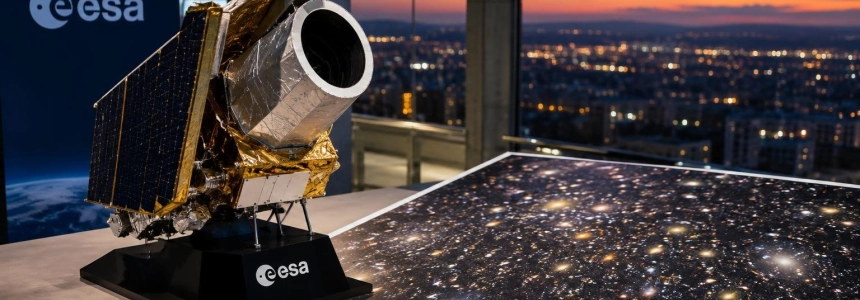
The Euclid space telescope has published a mosaic of the northern sky spanning nearly 500 gigapixels, part of its first major data release, which brings together observations of more than 900 million galaxies. The European Space Agency (ESA) released DR1-Foundation on November 12, 2026: a release that, in addition to images, includes astronomical catalogs and more than 160 million spectra.
The northern image comprises observations obtained in autumn 2024 and spring 2025 as part of the Euclid Wide Survey. According to the ESA, it covers 367 square degrees of sky. The mosaic is one piece of a much larger collection: the DR1-Foundation release spans 1,900 square degrees, around 14% of the area Euclid plans to map during its six-year mission.
A first catalog with hundreds of millions of objects
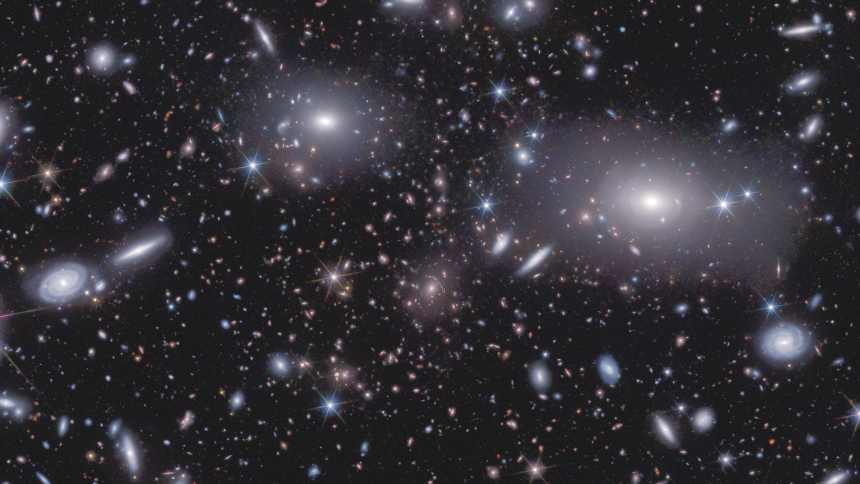
The ESA describes DR1-Foundation as the first part of Euclid’s first major data release. It includes around 10,000 scientific images captured by the VIS and NISP instruments, as well as catalogs of the detected objects. In just over a year of observations, the team cataloged more than 900 million galaxies in the released area.
The figure given in summaries of the release varies depending on the type of object counted. The Guardian reports that the data also include more than 60 million potential quasars, bright objects at the centers of distant galaxies powered by supermassive black holes. Live Science describes this group as 60 million light sources powered by black holes in the early universe.
The release also contains more than 160 million spectra. The NISP instrument disperses the near-infrared light from thousands of objects across its detectors without using individual slits or targeted observations one object at a time. It operates in the 930-to-1,890-nanometer range, according to the Euclid Consortium.
The emission and absorption lines in these spectra make it possible to measure redshift, estimate distances, and study the chemical composition and physical conditions of galaxies. The Consortium says that, combined with the high-resolution images, the data will help investigate star formation, galaxy evolution and internal dynamics, as well as interactions between stars, gas and supermassive black holes.
More than 15,000 gravitational lens candidates
Among the initial results is a catalog of more than 15,000 strong gravitational lens candidates, the largest homogeneous catalog of its kind to date, according to the Euclid Consortium. The phenomenon occurs when a massive foreground galaxy bends and magnifies the light from a more distant object. In images, this distortion can appear as bright arcs or rings.
The gravity of the foreground galaxy curves spacetime and alters the path of background light. Dark matter also plays a role: it increases the galaxy’s mass and, with it, its gravitational pull, amplifying the lensing effect. Studying strong gravitational lenses can help rule out different theories about the nature of dark matter, since the effect depends on how that matter is distributed within a galaxy.
Until now, around 1,000 cases of strong gravitational lensing were known, according to Andy Taylor of the University of Edinburgh, quoted by The Guardian.
The DR1-Foundation candidates were identified by combining artificial intelligence, citizen science and expert validation. The catalog includes unusual configurations with multiple background sources, disk galaxies and lensed quasars. Teams also applied automated models to thousands of candidates to estimate galactic masses and reconstruct distant sources that are difficult to observe directly.
“It is the largest high-resolution image of the universe we have ever had.”
— Andy Taylor, head of the mission’s UK Science Ground Segment
A mission to map a third of the sky
Euclid was launched on July 1, 2023 and began its cosmological survey on February 14, 2024, according to the Euclid Consortium. Its mission is to create the largest three-dimensional map of the universe, covering a third of the sky and more than 10 billion years of cosmic history. The scientific goal is to study dark energy and dark matter, which are estimated to account for approximately 70% and 25% of the universe, respectively.
The new release covers nearly 14% of the total area planned for the map. The Consortium describes it as the largest map of its kind produced from space, with optical and near-infrared images, extensive catalogs and millions of spectra. The mission is led by the ESA in collaboration with the Euclid Consortium and NASA; the Consortium designed and built the instruments and operates the scientific data processing system.
The Consortium brings together more than 2,000 members from over 300 laboratories in 15 European countries, as well as Canada, Japan and the United States. Its work does not end with data capture: teams correct instrumental effects, detect sources, extract spectra and calculate positions, brightnesses and physical properties. The complete processing pipeline is described in 18 technical papers published alongside the release.
Galaxies, satellites and deep fields, too
Some regions were observed repeatedly over extended periods and form the Euclid Deep Fields. These observations make it possible to study galaxies up to 10 billion years old. The release also includes spectroscopy to confirm structures of lensed galaxies, as well as measurements of star formation and galactic motion.
Other results presented alongside DR1-Foundation include 15 stellar systems with very low surface brightness, resolved into stars for the first time. Among them are five discoveries and candidate satellites of the Milky Way. A study of 40 million galaxies found that three-dimensional “puffy” galaxies become less common as the universe ages: over time, many become flat, orderly rotating disks.
The dataset also makes it possible to investigate galaxy clusters, the cosmic web, dwarf galaxies, quasars, active galactic nuclei and transient phenomena. The Consortium notes that data from these observations had already contributed to the discovery of the two most distant known quasars to date, which might have gone unnoticed in smaller surveys.
The next release will include cosmological analyses
Eight scientific papers appeared on arXiv following the November 12 release: four present results on strong gravitational lenses, while others analyze various spectroscopic capabilities of Euclid. DR1-Foundation will serve as the basis for the full DR1 release, which will include the mission’s first cosmological analyses.
Andy Taylor told The Guardian that another data release was expected next summer, with results on the distribution of galaxies and weak gravitational lenses. These are subtler distortions of distant objects caused by foreground dark matter. The pattern will make it possible to create a map of its distribution and compare its statistical properties with different theories.
The ESA presented the northern mosaic as a visualization of nearly 500 gigapixels; the scientific release accompanying DR1-Foundation covers a wider area, with 1,900 square degrees and catalogs of hundreds of millions of galaxies. For Taylor, the amount of data already exceeds what a person can inspect with the naked eye: “No human eye can look at all of Euclid’s data anymore. There is simply too much.”
Sources: ESA: TBD, the Guardian, Live Science, Euclid Consortium