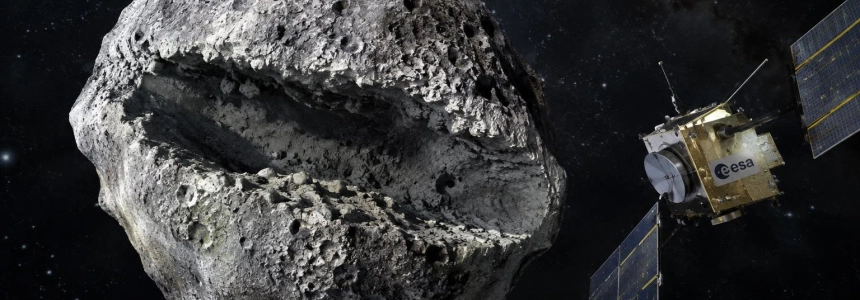
The collision of the DART spacecraft with Dimorphos left a stadium-sized crater that extends across the asteroid's entire width. The first close-up images from Hera, the European Space Agency (ESA) mission, also show that the impact flattened the struck area and left Dimorphos spinning chaotically.
The observations answer a question that remained open after NASA's planetary defense test: not only whether DART could change an asteroid's motion, but also what physical transformation it would cause. The European mission is now examining the Didymos-Dimorphos system to characterize the consequences of the collision.
A flattened side and a chaotic spin
Dimorphos is about 151 meters in diameter and orbits Didymos, which is about 730 meters across. The system is currently about 193.5 million kilometers from Earth. Neither asteroid poses a threat to our planet: they were chosen as the setting for a test.
DART, short for Double Asteroid Redirection Test, deliberately struck Dimorphos on September 26, 2022. ABC News puts the impact speed at about 22,530 kilometers per hour. Measurements made from Earth showed that Dimorphos's orbital period around Didymos decreased by about 33 minutes, a larger change than expected, according to ESA.
Without close-up images, it remained to be determined whether the collision had excavated a crater, reshaped the entire body, or left barely visible changes. Hera's images point to a combination: the struck side was flattened and marked by a crater that spans the full width of Dimorphos, while the other regions show no major changes.
Much to our surprise, the answer turns out to be all three at once.
— Patrick Michel, Hera principal investigator and research director at CNRS / Observatoire de la Côte d'Azur
The boulder fields across the rest of the asteroid look similar to those in DART's images during its approach in 2022, according to ESA. The most obvious transformation is therefore concentrated in the impact zone. Hera has also observed Dimorphos tumbling chaotically as it travels in its orbit around Didymos.
The orbital effect had already been measured after the impact; Hera's work adds information about the shape the asteroid was left in. The University of Turku notes that knowing how much of DART's energy went into deforming Dimorphos, ejecting fragments, and changing its orbit will help estimate the overall effectiveness of the deflection.
Rocks in orbit and slow maneuvers
Hera has also found hundreds of boulders a few meters across around the two asteroids. The presence of so many objects surprised the team and will affect the coming weeks of operations as the spacecraft approaches to take higher-resolution images.
The probe is currently observing the system from a distance of between 25 and 30 kilometers. To move through this very low-gravity environment, it uses its thrusters and follows trajectories described as rectangular; its average speed is just 12 centimeters per second, according to ESA.
During this first characterization phase, Hera is using three instruments: a monochrome Asteroid Framing Camera, the Hyperscout H multispectral instrument, which can observe 25 color bands at once, and the TIRI thermal camera, developed by the Japanese space agency JAXA to measure surface temperatures.
The mission is not limited to photographing the crater. The images and measurements should help reconstruct what happened during the impact and link the orbital change to the deformation and ejected fragments. This information will make it possible to better assess how Dimorphos responded to DART's energy transfer.
Hera will move closer in December
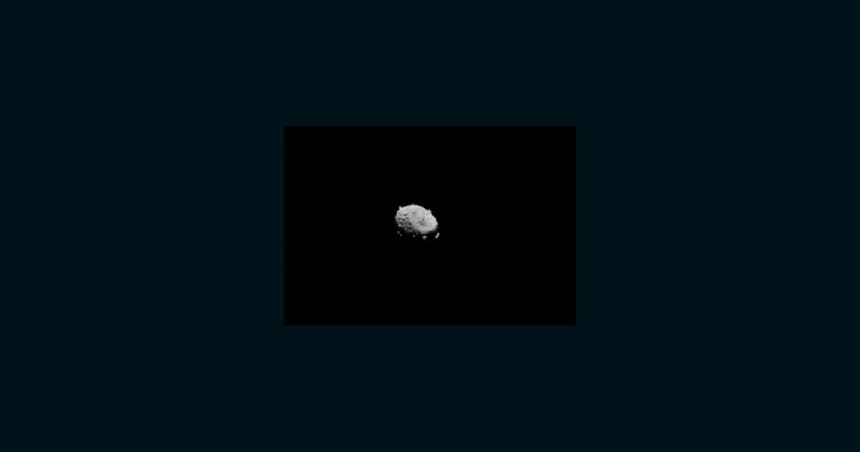
The next planned maneuver will take Hera to about 13 kilometers from the system in December, to obtain progressively more detailed images. The team will need to account for the rocks orbiting around the pair as the spacecraft approaches.
In January 2027, Hera is scheduled to deploy two shoebox-sized CubeSats: Juventas and Milani. They will fly closer to the asteroids and collect complementary data, extending the investigation beyond what the main spacecraft can observe.
The Juventas CubeSat, led by a team from Luxembourg, will use a low-frequency radar to investigate Dimorphos's interior and then attempt to land on its surface. Milani, led from Italy, will study the materials and dust in the surrounding environment. The University of Turku says its ASPECT hyperspectral camera will map the composition and surface alterations of both asteroids; its deployment is scheduled for January 30, 2027.
One of the scientific objectives is to measure Dimorphos's mass. Combined with the orbital change recorded after the impact, this measurement will help calculate more precisely how much momentum DART transferred to the asteroid and improve predictions for future deflection maneuvers.
From a test to a defense tool
DART demonstrated that a spacecraft could alter an asteroid's orbit; Hera is now studying the physical details of that intervention. ESA presents both missions as complementary parts of the same effort: to verify that the technique works and determine the conditions under which it could be reliable if an object threatened Earth.
The University of Turku notes that Finnish researchers are participating in the analysis of Hera's first data. Tomáš Kohout, from Pori Space Lab, is part of the mission's science team and leads the team responsible for ASPECT; researchers from that laboratory are planning observations and processing data. Antti Penttilä, from the University of Helsinki, is working on simulations of the instrument's performance and image corrections.
ESA also links Hera with Ramses, a mission it is developing in cooperation with JAXA to observe the asteroid Apophis during its safe close approach to Earth on April 13, 2029. Hera will study the consequences of striking an asteroid; Ramses will observe how one responds to a planet's gravitational influence.
For now, Hera's next milestone is to approach the system in December. After that, deploying Juventas and Milani will make it possible to investigate the interior, surface, and material surrounding Dimorphos and Didymos.
Sources: Engadget, theregister, Technology, ESA, ABC News, University of Turku