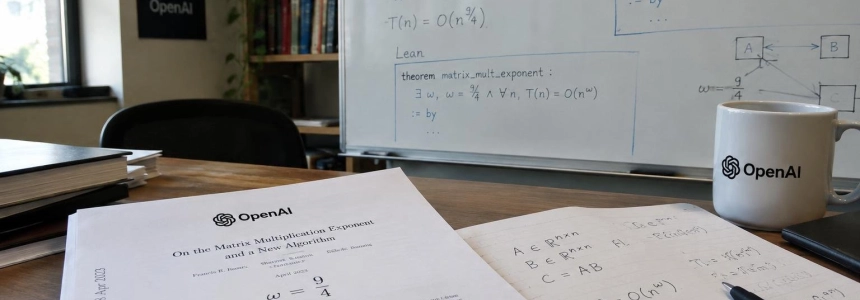
OpenAI claims that multiplying square matrices has a minimum asymptotic cost with an exponent of 9/4, or 2.25. Its preprint, titled «The matrix multiplication exponent is nine fourths», appeared on November 24 in the public openai/math repository and argues that the bound holds over any field. If the proof withstands mathematical scrutiny, it would settle a theoretical question that has remained open for decades.
The exponent, represented by ω, describes how the number of arithmetic operations grows as the size of the matrices increases. The conventional method requires on the order of n³ operations for n×n matrices; a lower power would imply fewer operations in the limit. The novelty is not just proposing a faster multiplication method, but claiming that no method with an exponent below 2.25 exists.
From an upper bound to an exact limit
The November claim completes an earlier result from OpenAI. According to Interesting Engineering, a paper published on October 2 had established an upper bound of 2.25 over the complex numbers. Put simply, it showed that this exponent could be achieved in that setting; it had not yet proved that doing better was impossible.
The new preprint provides the missing lower bound and extends the claim to all fields, that is, the different number systems considered by the paper. By combining both sides, OpenAI says the exponent is fixed exactly at 9/4. OfficeChai explains that mathematicians picked up the October result and extended an important step to other cases before the new manuscript.
“raw research data”
— OpenAI, description of its manuscripts according to OfficeChai
The scale of the change is clearer when viewed against the historical progression described in the publications. In 1969, Volker Strassen showed that two 2×2 matrices could be multiplied using seven multiplications instead of the eight required by the conventional method; according to Interesting Engineering, his recursive approach reduced the exponent from 3 to approximately 2.807. Subsequent research lowered the best-known upper bound to around 2.371, according to OfficeChai.
The lower end was much less well defined. The need to read and write n² values prevents ω from falling below 2, but, according to OfficeChai, no stronger lower bound had been proved for the general problem. The possibility that ω might be 2 fueled the expectation that multiplication could approach, asymptotically, the cost of handling the data itself.
What the work proves and how it attempts to prove it
The distinction between an upper bound and a lower bound is central to assessing the significance of the news. Finding a fast algorithm establishes how far one can go; proving a lower bound requires ruling out any even faster algorithm, including ones that have not yet been conceived. OpenAI’s paper claims to do this using results about arithmetic circuits and tensors.
OfficeChai describes a proof by contradiction: if an algorithm existed that beat 9/4 by a fixed amount, it would allow certain tensor networks to be compressed too much, making it cheaper than possible to check whether all the elements in lists of binary strings are distinct. The geometric connection, developed in an accompanying manuscript on the asymptotic spectrum of tensors, relates 9/4 to a three-armed figure. This is a mathematical proof, not a measurement of processor run times.
The manuscript also presents concrete bounds for each matrix size. According to OfficeChai, for n≥2 any arithmetic circuit that multiplies n×n matrices would need at least ⌈n^(9/4)/2⌉ multiplication or division gates, even if additions were free; a bilinear algorithm would need at least ⌈n^(9/4)⌉ products. For 1,024×1,024 matrices, that second bound amounts to about 5.9 million products, compared with roughly one million for the trivial bound and about 1.07 billion for the conventional method.
The result also extends to rectangular matrices. OfficeChai notes that the paper places the dual exponent α between 1/2 and 2/3, while an accompanying Lean scope document goes further and claims that α is exactly 1/2, along with a formula for the exponent of each rectangular shape. This difference between the manuscript and the formalized document matters: not every associated claim should be treated as having identical scope.
Lean helps check the proof, but does not replace review
OpenAI added selected formalizations in Lean alongside the manuscripts, according to its repository history. Lean is a system for expressing proofs in a way that allows a checker to verify the formalized steps. It is a concrete way to detect errors in what has been translated into the system, but it does not automatically verify every claim in the mathematical text.
OfficeChai points to a difference in scope: the formalization covers circuits without divisions that compute formal polynomial identities, while the paper’s main theorem also considers circuits with divisions. The same outlet notes that a 1973 result by Strassen makes it possible to eliminate divisions in problems of this kind, but the formal proof and the written claim do not have identical scope.
Independent review by the mathematical community is also still pending. Interesting Engineering describes the work as a preprint awaiting scrutiny, and OfficeChai notes the caution that AI-assisted proofs can conceal subtle errors even when they appear flawless. OpenAI’s history shows that the repository has recorded withdrawals and corrections of other manuscripts; this does not invalidate this result, but it makes following its versions and revisions especially important.
A theoretical limit, not an immediate improvement for GPUs
For companies training models or running inference, the immediate practical takeaway is modest. Matrix multiplication appears in neural network computations, but the exponent describes the theoretical growth in the number of operations, not the execution time on a particular chip. OfficeChai notes that current GPUs still rely on the conventional method or a few stages of Strassen-like techniques, because algorithms with better asymptotic bounds only pay off at astronomical sizes.
That is why the result will not make training faster tomorrow. It does not, by itself, offer a new GPU kernel, a production-ready implementation, or a measured reduction in compute costs. For those designing systems today, its effect is to constrain a theoretical possibility, not to change hardware or deployment decisions based on real-world performance.
The long-term consequence is more conceptual. If the bound is correct, the hope of reaching ω=2 is ruled out, and analyses of algorithms that depend on fast multiplication will have a more precise lower bound. OfficeChai mentions graph problems and lattice sieving methods related to post-quantum cryptography among the areas whose running times may inherit this exponent; the paper does not imply that all these systems will immediately change in practical cost.
The outstanding question is whether the written proof, its formalizations, and its rectangular extensions pass independent review. Until then, OpenAI has published a far-reaching mathematical claim—ω=9/4 over every field—not a new speed available to data centers.
Sources: GitHub, OfficeChai, Interesting Engineering