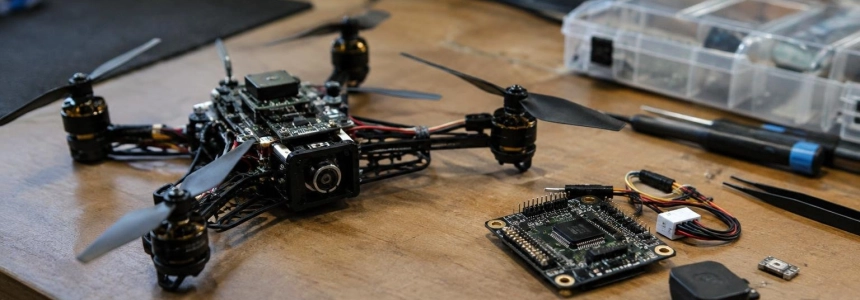
Yaroslav Sheiko, an 11th-grade student in Poltava, built an artificial intelligence autopilot so a drone can head to a destination without relying on GPS signals. Ukrainian President Volodymyr Zelenskyy awarded him the presidential distinction “The Future of Ukraine” for this work, according to Tom’s Hardware and The Times of India.
The proposal addresses a specific problem on the front line: jamming can degrade or disrupt satellite navigation. Sheiko’s idea is for the aircraft to maintain a route to a point selected by its operator even when those signals are unavailable. The system does not need GPS to guide its flight, but that does not mean it is immune to all electronic interference.
A route to the destination without satellite signals
Published reports describe an autonomous guidance system that directs an unmanned aerial vehicle (UAV) to a location chosen by the operator. According to The Times of India, it can do so while flying relatively close to the ground. Tom’s Hardware summarizes the function as reaching the destination without relying on GPS signals.
Sheiko’s work also includes an electro-optical stabilization system. The Times of India says it uses artificial intelligence to improve the drone’s control and navigation, and can help keep observations stable. It has not been explained precisely how this equipment integrates with the autopilot or which sensors it uses.
The problem it aims to address is not just the loss of a signal in the abstract. The Times of India notes that GPS jamming and spoofing can disrupt conventional navigation systems and make it difficult for a drone to determine its position. Yahoo Tech adds that if an aircraft relies on that data, it can veer off course or trigger an automatic return, risking failure to complete its mission.
The capability described is limited to navigation. It does not demonstrate general resilience to electronic warfare: a drone that does not use satellites for guidance could still rely on other links that are vulnerable to interference. Yahoo Tech distinguishes between knowing where the aircraft is and maintaining communication with those controlling it; Sheiko’s project primarily addresses the former.
GPS and communications are different problems
Yahoo Tech’s coverage also distinguishes Sheiko’s system from Starlink. That service is used primarily for communications and data connectivity, not as a navigation system. Therefore, doing without GPS does not by itself solve the loss of contact between a drone and its operators, nor does it replace a communications link.
The Times of India mentions that Ukraine is exploring alternatives to Starlink to maintain drone communications when satellite connectivity is lost. These include, it says, a combination of airborne relay systems and Israeli-Italian satellite communications technology. According to the outlet, those solutions aim to maintain contact with operators; Sheiko’s invention is intended to guide the flight without GPS positioning.
Yahoo Tech lists other approaches that, according to its coverage, are part of Ukraine’s work in this area: encrypted radio links, LTE and 5G connections, ground beacons, optical communications, and other onboard AI systems. The publication presents the student’s project as one contribution among several alternatives, not as a single solution for drone navigation or communications.
A record of national and international awards
The presidential recognition adds to several other awards. Tom’s Hardware and The Times of India report that Sheiko has received two presidential scholarships for his academic performance and contributions to science or scientific research. The Times of India adds that he won first place twice in national competitions held by the Junior Academy of Sciences of Ukraine, in the aerospace and defense technology category.
Internationally, Tom’s Hardware and The Times of India credit him with a gold medal at the INOVA 2025 International Inventions Show and a silver medal at a 2025 hackathon. Yahoo Tech also mentions the gold at INOVA 2025, held in Croatia, but identifies the silver medal as an award at Engineering HackFest. The publications do not agree on the name of that second competition.
The presidential award is called “The Future of Ukraine” and was presented by Volodymyr Zelenskyy. Tom’s Hardware places Sheiko in Poltava, about 190 miles west of Kyiv, and says the award recognizes several technical achievements, including the autopilot and electro-optical stabilization. The Times of India attributes information about his work to details released by Poltava’s municipal education department.
Performance and frontline use have not been detailed
The outlets do not identify the sensors, algorithms, or computing hardware installed in the system. They also have not published verified figures for navigation accuracy, range, or maximum altitude. The Times of India adds that details of field tests and performance under different environmental conditions have not been disclosed.
The absence of these data makes it impossible to assess how accurately it can follow a route or how it performs under active jamming. Yahoo Tech says it has also not been publicly confirmed whether the project has progressed from prototype to operational use or mass production. The presidential distinction recognizes the engineering work, but does not in itself confirm deployment in combat.
For now, what is known is the intended function: guiding a UAV to a point selected by the operator without conventional satellite navigation, with the help of AI-based control and an electro-optical stabilization system. Its actual performance in field conditions has not been made public.
Sources: Tom's Hardware, Yahoo Tech, The Times Of India