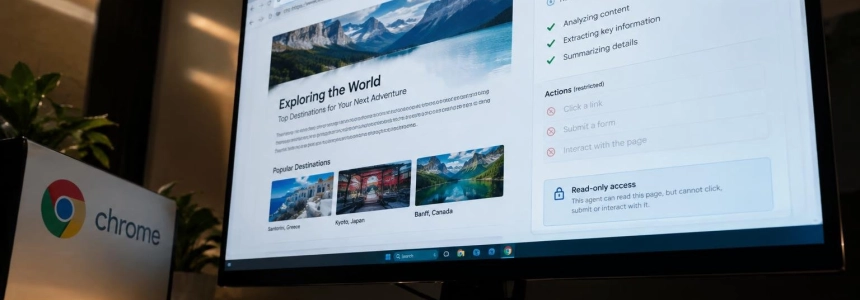
An AI agent could read a page without being able to click its buttons if Google moves forward with a permissions proposal for Chrome. The idea would separate which sites an assistant can visit from the actions it can perform on them: for example, comparing products in a store, but not entering a payment website or completing a purchase.
The proposal aims to have the browser, not just the software developed for each agent, enforce the limits. This way, an AI could gather information without being granted permission to type into forms, sign in, or submit data. The plan is at an experimental stage: it has not been confirmed that it will become a Chrome feature.
Separate permissions for browsing and taking action
The approach starts with a simple distinction: accessing a website would not mean being able to interact with it. A user could allow the agent to visit a page and read its content while keeping clicks and typing in text fields blocked. In that mode, the assistant could look up information, but not sign in or submit a form.
The distinction could also help limit movement between sites. Someone could authorize the agent to browse a store and compare products, but prevent it from proceeding to an external payment domain. The task would be limited to the approved site and operations, rather than granting general authorization to browse and act without distinction.
Under the model described, the agent would start with restricted permissions and request access to specific pages or functions. The user or the browser itself would decide what to authorize. The goal is to tailor permissions to the task: checking prices would not necessarily require enabling the purchase process.
Control would not be limited to the initial authorization. The proposal considers allowing users to interrupt an active session and revoke access if they change their minds while the agent is browsing. Chrome could also visually indicate which tabs are under the assistant's control, so the person can follow its actions.
Chrome as an additional safeguard
Today, developers can set restrictions within their own agent tools. Google's proposal adds another control point: Chrome would enforce permissions at the browser level, rather than leaving the entire decision to the agent and its creator.
This change matters because browser rules could remain in effect even if the agent has no safeguards of its own. If the AI thinks it can perform an operation that was not authorized, the browser would block it anyway. The limit would not depend solely on the assistant correctly interpreting instructions or following its internal controls.
The initiative is proposed as an extension of WebDriver BiDi, a protocol for automating browsers, for example, when testing websites. Google proposes also accounting for agents that browse on a person's behalf. Company engineers published an intent to create a prototype in Chromium, a step that places the idea in the experimental phase.
Google also proposes that the work could later be incorporated into the WebDriver BiDi standard. If the protocol moved in that direction, other browsers could adopt similar mechanisms. For now, that possible extension is a goal of the proposal, not a confirmed feature for other products.
Permissions do not distinguish what each button is meant to do
Separating pages from actions would not resolve every risk. Allowing clicks is not the same as distinguishing their intent: if an agent is authorized to click buttons on a page, the system might not distinguish between moving a task forward and activating an option that deletes information.
Therefore, authorizing a category of action does not guarantee that every operation is safe or correct. The proposal describes general controls over pages and actions, but it does not yet detail how finely each permission can be configured or how authorization requests will be presented.
The interface through which a person would grant or withdraw permissions has also not been defined. These aspects would need to be worked out during the development and testing of the prototype. Chrome could visually indicate which tabs are under the agent's control, so the person can follow its actions.
No date for Chrome and no guarantee of a launch
The intent to create a prototype in Chromium does not confirm that the feature will come to Chrome. Google has not announced a launch date or confirmed whether the system will be incorporated into the browser. Its current status is that of an experimental proposal, with development and testing still ahead.
Any eventual adoption by other browsers would also depend on the work being integrated into WebDriver BiDi and on how that standard evolves. There is no confirmation that other products will implement the system.
,就Sources: TecnoAndroid, infobae, SondeAR