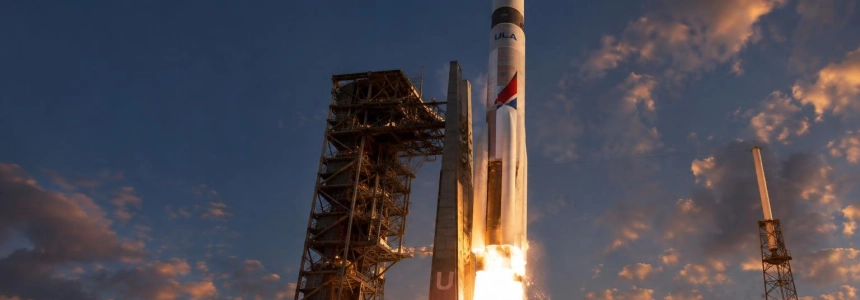
United Launch Alliance’s (ULA) Vulcan failed to place 40 Amazon Leo satellites into orbit after suffering an anomaly about ten minutes after liftoff on Sunday, November 15, from Cape Canaveral, Florida. It was Vulcan’s first mission for Amazon’s internet constellation and the rocket’s return to flight after months out of service.
The rocket lifted off at 12:40 p.m. Eastern time from Space Launch Complex 41 at Cape Canaveral Space Force Station. ULA confirmed that the vehicle suffered an in-flight anomaly and that the mission did not achieve its objective. The company had not publicly identified the cause.
The flight went awry after a normal first phase
Vulcan flew in the VC6L configuration, with six side boosters and a Centaur V upper stage optimized to carry payloads to low Earth orbit. The first moments appeared to go as planned: ULA reported that the GEM 63XL solid rocket boosters had burned out and separated, while the BE-4 main engines continued accelerating the rocket.
Reports place the anomaly about ten minutes after launch. The Register reported that Vulcan had reached an altitude of about 150 kilometers and that, around six minutes after liftoff, the main booster and payload fairing separated. Centaur V’s engines then ignited to begin the planned maneuvers toward orbit.
Via Satellite described a broadcast that was still showing the mission underway in its latest update, at around nine and a half minutes. The feed ended before the failure was announced. The next planned milestone was Centaur’s first main engine cutoff, at around the 17-minute mark.
ULA said information received by its launch director confirmed that the vehicle had suffered an anomaly and had not delivered Amazon’s payload to orbit. The company added that it did not yet have specific data to explain what had happened and would work with Amazon and other organizations to find the cause, define corrective actions, and fly again.
“ULA has been a trusted partner for Amazon, and we believe they will learn from this mission and deliver on their long-term plans for Vulcan.”
— Amazon
A record payload for Amazon Leo’s debut
The 40 satellites made LV-01 Amazon Leo’s largest launch to date, according to Via Satellite. It was also the first time Amazon had used Vulcan to deploy its constellation. To date, ULA had launched Amazon Leo satellites on eight Atlas V missions.
The mission kicked off an agreement for 38 Vulcan flights for Amazon. Amazon had planned to launch more than 1,500 first-generation satellites on those flights, more than the company had allocated to any other rocket in its program. The company had said it would test new hardware on the first flights with this configuration and was already preparing larger configurations for subsequent missions.
Before the launch, Amazon had said that its investment in Cape Canaveral infrastructure would allow LV-02 to fly just a few weeks after LV-01. Following the failure, The Register noted that this schedule and the next flight would probably be put on hold. Amazon had not said whether it would change its deployment targets.
Amazon’s satellite internet service aims to compete with SpaceX’s Starlink network. Engadget reported that Amazon had around 390 satellites in service and was required to have 1,600 in orbit by July 31, 2026, under a requirement from the U.S. Federal Communications Commission. The company also maintained its goal of reaching 3,232 satellites by July 2029.
A delayed return with a history of issues
LV-01 was also Vulcan’s first flight since February, when a problem was detected in a nozzle on the GEM 63XL solid rocket boosters manufactured by Northrop Grumman. The February mission, contracted by the U.S. Space Force, was completed successfully, but the Space Force suspended Vulcan flights under the National Security Space Launch program while the incident was investigated.
ULA recently said that, following an investigation with Northrop Grumman, the Space Force, and government agencies, the nozzle had been modified and the changes tested. Northrop Grumman said preliminary data indicated that the GEM 63XL boosters had performed as expected and separated correctly before the LV-01 anomaly.
Sunday’s launch also came after two postponements. Friday’s attempt was canceled due to an electrical outage at Air Liquide’s gaseous nitrogen plant, which took its high-pressure pumps out of service. On Saturday, a network communication problem between the ground equipment and the rocket required the system to be reconfigured, a task that would have extended beyond the launch window.
On Sunday, the countdown was stopped and resumed at T-7 minutes. ULA rescheduled liftoff for 12:40 p.m., at the end of a window that had opened at 12:11. Once in flight, the company confirmed the solid rocket boosters’ burnout and separation.
The cause remains undetermined
ULA had not published a technical explanation for the failure. Hardware Upgrade noted that initial speculation had pointed to Centaur, but that early data and comments shifted attention to the first stage. The same outlet cautioned that it was still unconfirmed whether the problem could be related to the BE-4 engines, the propellant management system, or another component.
Eric Berger, a journalist at Ars Technica, wrote that several sources placed the anomaly in the booster stage, rather than in Centaur V or the solid rocket boosters. Berger said he still did not know whether the cause was a BE-4 engine, the propellant management system, or another problem. ULA had not confirmed this hypothesis.
Hardware Upgrade described a slight rotation of the rocket about its horizontal axis shortly before the two BE-4 engines shut down and again a few seconds later, before the second stage separated. This behavior could have left Centaur V with incorrect thrust and attitude, but the cause of the anomaly remained under investigation.
Two launch networks under pressure
The failure is a setback for ULA, the alliance formed by Boeing and Lockheed Martin in 2006. Engadget called it the company’s first complete launch failure, as it had previously maintained a reliability record associated with Atlas V. Vulcan, a more powerful and complex rocket, is now subject to review and could remain grounded while the incident is investigated.
Amazon is also facing delays with its alternative launch providers. Engadget reported that Blue Origin had 24 flights of its New Glenn rocket booked for the constellation, but that vehicle suffered a setback in May when it exploded on the pad. Hardware Upgrade added that New Glenn was not expected to fly again before the start of next year.
The company still had one Ariane 6 launch with Arianespace scheduled before the end of 2026, although Hardware Upgrade noted that a turbopump problem had reduced the number of flights available. In July, Amazon had said that simultaneous delays across all three heavy-lift launch programs had used up the schedule margins planned for Leo.
Amazon maintains that it trusts ULA and expects the company to learn from LV-01. ULA, for its part, said its customers would have visibility into the investigation and that it would provide further updates when more data became available. The next step is to determine what caused the anomaly before setting a date for Vulcan’s return to the launch pad.
Sources: Hardware Upgrade, Engadget, theregister, Via Satellite, The Space Coast Wire, Amazon News