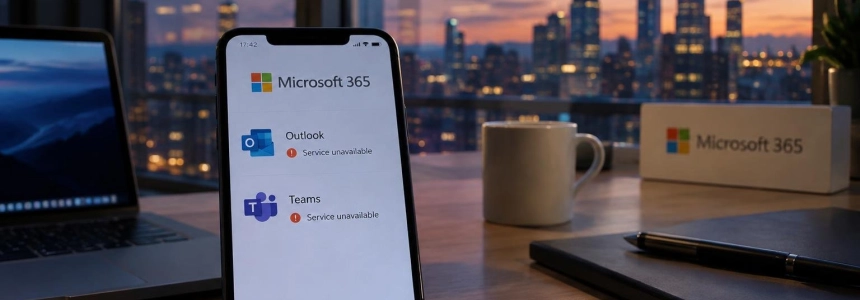
For nearly 24 hours, the outage of Outlook and Teams in 74 countries left millions of users without their usual communication and work tools. The failure coincided with a European Union summit on artificial intelligence in Dublin, where leaders and industry representatives were debating the continent’s digital autonomy.
The incident was not presented as a cyberattack. Microsoft attributed the problem to a technical issue linked to network changes and a capacity update; the company said it was gradually restoring services. But its scale gave force to a debate that goes beyond the availability of an application: how much room Europe has to keep operating when an essential piece of technology depends on a foreign company.
A technical failure with knock-on effects
Outlook, Teams, and Copilot were among the affected services, along with other Microsoft 365 tools. RTÉ reported problems with Exchange Online, the cloud email and calendar service, and noted that organizations hosting Microsoft services on their own servers were less affected. The outage also affected connectors used by OpenAI and Anthropic.
The effects were tangible: Ireland’s health service reported problems with Healthmail that affected email transmission, and recommended using paper prescriptions under the GMS scheme. In the United Kingdom, some local health services turned to alternative systems or paper records; London’s Metropolitan Police had difficulty receiving some crime reports online, although its ability to respond to calls was unaffected.
There were also consequences beyond public services. RTÉ reported that stock exchange operator Euronext experienced email disruptions, insurer Aviva activated backups for its earnings presentations, and Maersk warned of delays in customer updates. In Taiwan, a financial firm cancelled a bond buyback transaction and another resorted to fax to confirm trades, according to sources cited by Reuters.
The scale was reflected in user reports: Downdetector recorded more than 7.4 million reports worldwide, peaking at nearly 20,000 per minute, according to its parent company Ookla. Euronews cautioned that these reports do not amount to a count of the people affected. The impact, however, was visible across different sectors and countries, from public administrations to airlines and businesses.
Sovereignty is also measured by continuity
In Dublin, Mistral CEO Arthur Mensch said that only 20% of European digital services run on European infrastructure, according to Politico Europe. Emmanuel Macron argued on X that independence must be built in Europe. German social democrat Johannes Schätzl proposed an operational criterion for assessing sovereignty:
“Digital sovereignty must be measured by whether we can remain operational even during outages like this,”
— Johannes Schätzl, German social democrat MEP
The idea shifts the discussion from a commercial label to a practical test: continuing to provide the service during an outage. An administration can contract a solution presented as sovereign and still depend on external technologies, companies, or legal frameworks. Francesca Bria, an economist and promoter of EuroStack, told la Repubblica that services from US companies remain subject to the US Cloud Act, which allows US authorities to request data even when servers are in Europe.
Bria also said that three major US technology companies manage 70% of Europe’s cloud and that 80% of the digital technology used in Europe is imported. These are figures she presented in the interview, and they broaden the diagnosis: dependence is not limited to email or file hosting, but spans the layers of the technology chain she described as the infrastructure of modern power.
The problem for an organization is not only that a provider might suffer a failure. It also matters who can interrupt a service and under which law, and how long it would take to exit a contract. Bria suggested that buyers ask these questions before signing. In her interview, she cited the case of the International Criminal Court: after US sanctions, its chief prosecutor lost access to his Microsoft email, although the company denied suspending services; the Court switched providers.
The European alternative requires procurement and transition
The response proposed in the European debate is not to replace all US tools overnight. Bria described a contract-by-contract transition and estimated that building alternatives will take the next ten years. She cited the European Commission’s procurement of European cloud providers and the move by some public bodies in France, Germany, Denmark, and Italy to open-source software as examples.
In her analysis, Europe already has capabilities that can form part of this infrastructure: Mistral in artificial intelligence, ASML in chips, and 19 AI Factory, public supercomputers for AI, including a facility in Bologna with Leonardo. She also mentioned the Cloud and AI Development Act and the Chips Act 2.0, presented by the Commission in June, as well as a proposed €300 billion European fund over ten years for technological sovereignty.
According to Bria, the obstacle is not only technological. The European Union spends €2.6 trillion a year on public procurement, and less than 10% of digital spending goes to European solutions, she said. She proposed a European procurement commitment reaching 50% by 2030. This approach would turn public tenders into a lever for creating demand and helping local providers scale, although the interview does not detail how the target would be implemented or which products it would include.
There is an opportunity cost in both directions. Keeping the current provider avoids an immediate migration, but maintains exposure to a concentrated outage and makes it harder to develop alternatives. Switching platforms, in turn, requires resources and may mean that services integrated over many years have to be replaced in stages. RTÉ reported that some analysts doubt outages alone will drive customers to competitors, precisely because of the high costs of switching tools deeply embedded in operations.
What companies and technical teams should check
The outage makes more tangible an obligation that does not disappear when systems are outsourced. Brian Honan, a technology consultant cited by RTÉ, said a company remains responsible for maintaining its services even when it delegates the solution to a third party. In Honan’s words, using a single provider concentrates risk: if that provider fails, the impact spreads across the entire organization.
For technical teams and procurement managers, the immediate takeaway is to review which processes depend on a single platform and which alternatives can be used during an outage. Euronews reported Tommaso Valletti, a professor at Imperial Business School, recommending that organizations ask whether there is a genuine contingency plan for a day without email or communications. The difference lies in whether the backup can actually be used, not merely whether it appears in a document.
The incident also showed that a provider failure can affect services built on top of it: Euronews noted that thousands of services from other companies can go down when a major cloud platform fails. For developers of products connected to Microsoft 365, this makes it important to identify which functions depend on its connectors and which operations could be blocked if they stop responding. This does not mean all components fail equally: RTÉ reported that some applications not connected to Exchange Online continued to work.
The exact cause had not yet been determined in Euronews’ coverage: Microsoft had not published a definitive explanation for the failure that took so many servers offline. The Irish Times reported that the company promised a post-incident report, without setting a timeframe. Until then, European organizations face a concrete test: knowing which services they cannot afford to lose and how long it would take to restore them without relying on a single provider.
Sources: TNW | Artificial-intelligence, la Repubblica, RTÉ, The Irish Times, euronews