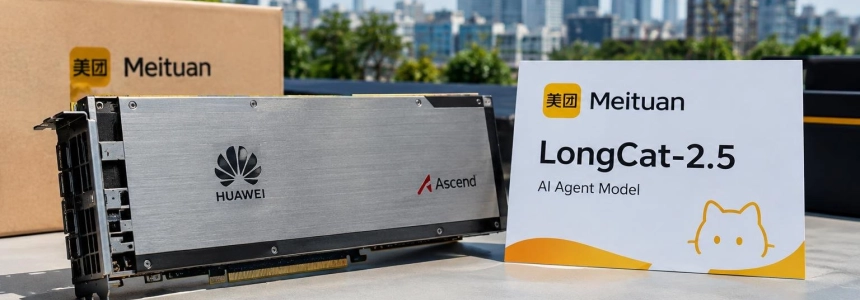
Meituan has released the weights of LongCat-2.5, with 1.6 trillion parameters, an artificial intelligence model for agents trained entirely on Chinese hardware and without Nvidia GPUs. The company presents the system as a tool for long-running, multi-step tasks, especially programming, and offers the weights under the MIT license.
The weights were released after the model's official unveiling. Caixin Global reported its launch on November 3; VentureBeat dates the release of the weights on Hugging Face to November 9, a week after the unveiling. LongCat, Meituan's team behind the model, also offers a chat interface and an API.
A large model that activates only some of its parameters
LongCat-2.5 uses a mixture-of-experts architecture: to process each token, it draws on a subset of its specialized networks rather than activating all its parameters. Of the 1.6 trillion total parameters, around 48 billion are activated per token, according to Meituan.
The API supports contexts of up to one million tokens and responses of up to 128,000 tokens. The model accepts text, images and video, but responds in text. It also lets users turn reasoning mode on or off, an option LongCat describes as a way to prioritize performance or reduce token consumption.
Visual capability is built into the model from the outset: LongCat converts images into tokens and processes them alongside text. Meituan says this approach builds on its LongCat-Next research model and aims to strengthen visual programming, design and 3D content creation tasks. The previous version, LongCat-2.0, did not include image understanding.
In the project repository, Meituan describes the system as a native multimodal model for long-running agent tasks, codebase development and full-project builds. The company also highlights training with multiple teacher models specialized in agents, reasoning and interaction.
Training on real-world tasks and safeguards against shortcuts
For reinforcement learning, the team used software tasks drawn from real GitHub change requests and recreated agent failures. According to Meituan, it isolated training environments from the internet, removed Git history and cached files, and used a language model to review solutions for shortcuts.
The stated goal is for the agent to complete its assigned work without relying on external searches or traces of previous solutions. According to the project's technical report, training combined these tasks with rollout methods and safeguards against reward manipulation.
Meituan also quantized the experts' weights and activations to four bits (W4A4), a format that Chinese accelerators can process natively. In load tests, the company measured a 43.3% increase in request-processing throughput and a 42.77% increase in response generation compared with an eight-bit version. It says accuracy remains comparable to that of the uncompressed model.
The technical repository adds other figures for this comparison: 15.91% less time to the first token and 19.72% less time per output token. It also reports that Grouped GEMM kernels achieve an average speedup of 1.73 times over the W8A8 baseline. These are results reported by Meituan in its own tests, not an independent comparison.
A deployment guide using 194 Huawei accelerators
The self-hosting guide describes a configuration with 194 Huawei Ascend accelerators from the Atlas A2 series. Of these, two are assigned to image processing, 64 to request ingestion and 128 to generating responses. The documentation does not include instructions for Nvidia GPUs; Meituan's repository points to SGLang-FluentLLM for deployment on NPU platforms.
Meituan had previously cited experience with domestic hardware: according to The Decoder, it trained LongCat-2.0 in late June on a cluster of more than 50,000 Chinese AI chips. Before its public unveiling, that model reportedly appeared anonymously on OpenRouter under the name “Owl Alpha.”
The broader context is a push to develop models on domestic accelerators. Caixin Global described LongCat-2.5 as part of Chinese technology companies' growing reliance on local chips and their strategy of integrating AI into existing businesses. Meituan is a Chinese delivery and e-commerce company.
Results depend on the benchmark
In the evaluations published by Meituan, LongCat-2.5 scored 88.4 on Terminal Bench v2.1, a command-line task benchmark. It came close to Claude Opus 5, at 89.1, and GPT-5.6 Sol, at 88.8; DeepSeek-V4.1-Flash topped the table with 90.6.
| Benchmark | LongCat-2.5 | Reported comparisons |
|---|---|---|
| Terminal Bench v2.1 | 88.4 | Claude Opus 5: 89.1; GPT-5.6 Sol: 88.8; DeepSeek-V4.1-Flash: 90.6 |
| Terminal Bench v4.0 | 38.5 | GPT-5.6 Sol: 37.3; Claude Opus 5: 53.9 |
| DeepSWE v1.1 | 64.6 | GPT-5.6 Sol: 72.7; DeepSeek-V4.1-Flash: 74.2 |
| BrowseComp | 91.9 | Claude Opus 5: 90.8; DeepSeek-V4.1-Flash: 91.5 |
| 3DCodeBench | 55.4 | Claude Opus 5: 54.3; GPT-5.6 Sol: 52.3 |
On Terminal Bench v4.0, a more difficult variant, LongCat-2.5 scored 38.5: it surpassed GPT-5.6 Sol's 37.3 but fell short of Claude Opus 5's 53.9. On DeepSWE v1.1, which evaluates bug fixing in real-world repositories, it scored 64.6. The previous version scored 9.7; DeepSeek-V4.1-Flash led the comparison with 74.2.
The model scored 91.9 on BrowseComp, the highest score in Meituan's table for this web-search benchmark. The Decoder notes that the company ran it in its own environment. On 3DCodeBench, it scored 55.4, ahead of the comparisons listed in the table, although on visual tasks such as Vision2Web its score was 78.6, compared with 80.2 for Claude Opus 5.
The Hugging Face model card notes that scores marked with an asterisk come from technical reports, publications or public leaderboards; the others were measured internally and are indicative. Therefore, the figures do not in every case represent tests conducted under identical conditions. Meituan's table also omits results for the newer models mentioned by The Decoder, Claude Opus 5.5 and GPT-6.1 Sol.
MIT weights, API and promotional pricing
The MIT license allows users to use, modify and redistribute the weights, subject to the license terms. Meituan clarifies that it does not grant rights to its trademarks or patents. The API accepts OpenAI and Anthropic formats, and LongCat says it is compatible with agent environments such as Claude Code, Codex and Hermes.
For the hosted service, VentureBeat reports a limited promotional rate of $0.30 per million uncached input tokens and $1.20 per million output tokens. The Decoder gives these amounts as approximately €0.27 and €1.07, respectively. VentureBeat also lists $0.006 per million cached input tokens.
Access through the API is not the same as running the model on your own infrastructure: the latter requires deploying the model and maintaining the hardware and serving environment. Meituan also offers a chat interface at LongCat.ai. The promotional rate's end date does not appear in the details published by the sources.
The release broadens access to a large-scale model designed to combine vision and programming, but the benchmarks show uneven performance across tasks. LongCat-2.5 is now available on Hugging Face under the MIT license; its deployment guide documents a configuration with Huawei accelerators, not Nvidia GPUs.
Sources: The Decoder, Meituan LongCat / Hugging Face, Caixin Global, Venturebeat, LongCat / Meituan