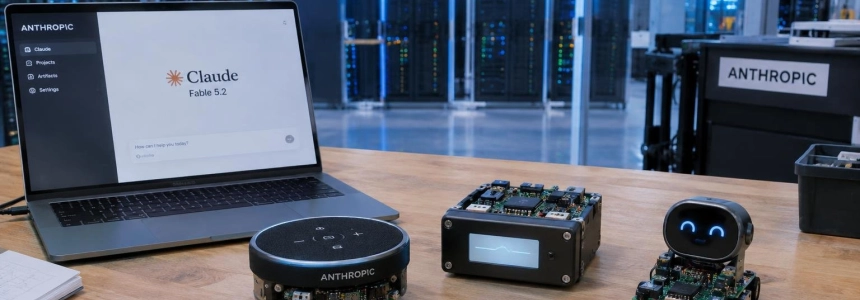
Three functional prototypes—a USB speakerphone, a home voice assistant hub, and a portable virtual pet—were designed by Claude Fable 5.2 and built by Diode Computers from the model’s files. Anthropic says the boards worked without circuit corrections and that the devices are still operational; the speakerphone, moreover, continued working after weeks of use.
The test, published by Anthropic on November 9, 2026, covered electronic and mechanical design, component selection and placement, copper trace routing, 3D-printable enclosure creation, bill of materials preparation, and firmware programming. Diode’s human engineers assembled the boards and ran the firmware under Claude’s direction. Anthropic cautions that these are early prototypes, not products ready for sale.
From a brief instruction to a manufacturable board
Anthropic began testing Claude on electronic design a little over a year earlier, together with Diode, a company that designs and manufactures circuit boards. At that stage, models could learn narrowly defined tasks, such as reading a chip’s datasheet and determining which components it needed to work, but they could not reliably design a complete board or combine its parts well.
For the new evaluation, the team again worked with Diode and asked Claude Fable 5.2 to build three devices. The speakerphone brief described it as “a disc that connects to a computer via USB-C and includes microphones and a speaker, with Bluetooth via a PCB antenna.” From brief instructions of this kind, Claude developed specifications, visual schematics, component layouts, copper connections, an enclosure, firmware, and a bill of materials.
According to Anthropic, the model worked with little human guidance: it received short instructions such as “clean up the schematic” and “continue.” One of the few follow-up questions came when Diode asked whether the portable pet would work without a battery. Claude consulted the charger’s datasheet and replied that the device could be powered over USB, though it predicted that the charging light would blink because the charger would try to recharge a small capacitor instead of a battery.
Anthropic has a commercial relationship with Diode. The company manufactured all three boards directly from the design files, without back-and-forth requests for changes. According to Anthropic, the Diode team was surprised that it did not have to go through the usual rounds of manufacturing adjustments.
Better component placement and trace routing
The leap Anthropic highlights compared with its earlier tests is in geometric reasoning: deciding where to place components and how to connect their terminals without creating impractical routes. Earlier models, it explains, could leave support components too far from the corresponding chip or place connectors in the wrong orientation. Fable 5.2 produced more compact, practical layouts and prioritized connections sensitive to high-speed signals, high currents, or interference.
In the voice hub, for example, it started with the USB and Ethernet connections. Each uses pairs of traces, thin strips of copper that carry signals; the model routed them one at a time, keeping the same length and spacing between each pair. It also added small zigzags to adjust trace lengths so signals would arrive at the same time, and rearranged power supply components to improve efficiency.
Diode measured this capability with PCB Gym, an internal evaluation that scores how models reposition components and route connections on boards whose original design has been removed. Claude Fable 5.2 scored 69% on PCB Gym, compared with 25% for Fable 5. On BenchCAD 2.1, a public test of reconstructing 3D parts, assemblies, and boards from engineering drawings and rendered images, it scored 83.5%, nearly twice Claude Fable 5.1’s result.
Fable 5.2’s launch page provides more context on BenchCAD 2.1: with tools and at the maximum effort level, it credits the model with 83.5 points out of 100, compared with 65.3 for Opus 5.5 and 44.4 for Fable 5.1. The post about the prototypes, by contrast, focuses on the comparison with its predecessor.
The model also independently revised designs that could not be completed correctly. On the speakerphone’s four-layer board, it reassigned signals to different pins on two chips so that the traces beneath the touch controls would fit on a single layer and not cross. Later, when the back side became crowded, it swapped signals between equivalent pins and rerouted an entire corner instead of adding layer jumps to patch the problem.
“I should just rip these traces [tracks] and start fresh.”
— Claude
The phrase appeared while Claude was working on the voice hub: when it saw that the copper connections were becoming too tangled to follow visually, it decided to erase and reroute the traces. It repeated this process dozens of times until it found a functional layout. Elsewhere on the same board, it corrected a microphone’s power routing to clear the ground ring and avoid a route it considered risky beneath a bottom-port MEMS microphone.
It also wrote a router and checked the assembly
To draw the traces, Claude started with KiCad, the board design software Diode provided. Its built-in router connected two points at a time, but the voice hub had long routes from a 100-pin connector. Claude estimated that progressing connection by connection would require too many instructions, so it wrote its own router: an algorithm that divides the board into a grid and searches for a clear path for each trace.
Anthropic says Claude had a first version ready in about half an hour and that it could route each long connection in about a second. After detecting that an audio clock trace passed too close to the Ethernet traces, it modified the algorithm to reserve more space around sensitive signals.
The work was not limited to the board. Claude modeled the enclosures in CAD and wrote code to check that each circuit would fit without its components colliding with the structure. On the speakerphone, it found that the board could not be inserted vertically because the mute button’s knob hit the back wall. The solution was to tilt it about 25 degrees during installation and then rotate it until it lay flat; Claude checked the movement in the 3D model and added the step to the assembly instructions.
For the voice assistant enclosure, it calculated that a 25-millimeter microphone duct would resonate near 3.4 kHz, within the voice band. It proposed a wedge shape, taller at the back and lower at the front, which reduced the ducts to about 10 millimeters and raised the resonant frequency to approximately 8.9 kHz, at the upper end of the range used for speech.
The firmware also took electrical limits into account: on the speakerphone, Claude programmed the LED light ring to dim as audio volume increased, keeping the device within the board’s specified current limit.
Manufacturing checks, with limitations still to address
Anthropic says Claude ran design-for-manufacturing and component-availability checks. On the voice hub board, the analysis flagged six narrow solder mask areas that might be too thin to manufacture. The model fixed the problem by widening the openings without moving components. It also ignored an alert about a connection between two grounds, reasoning that the automated checker had not recognized it was intentional and that it would not affect operation.
The post credits these checks with helping prepare the files sent to Diode, but draws a clear line between designing and validating a product. The three devices have not undergone electrical validation, antenna tuning, thermal testing, or certification. Nor were they designed for mass production. Claude was not connected to measurement equipment or to the machines that manufacture and assemble boards; that work was handled by Diode’s engineers.
So the fact that the prototypes work does not yet demonstrate how they will hold up to prolonged use or whether they could pass commercial certification. Anthropic says the speakerphone lasted for weeks of use and that the other two devices also remained in good condition, but those later tests are still outstanding.
The next test: more complex boards
Anthropic places the result within a year of improvements in component placement and routing, and argues that Claude can now design electronics with minimal human guidance and help build prototypes. It also mentions that OpenAI had recently published work on designing a wearable device with its models; the post provides no further details about that initiative.
Anthropic’s announced next step is to investigate whether Claude can tackle denser, faster, and more complex boards, check them through simulation, and learn from measurements taken on finished devices. For now, the tangible result is three prototypes manufactured from its files, pending the electrical, thermal, and antenna tests that have yet to be carried out.