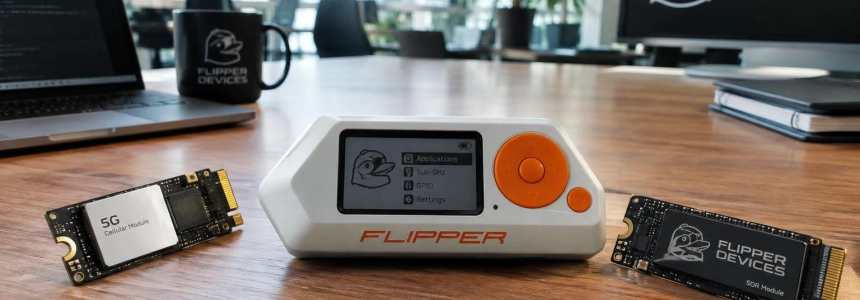
Flipper One will have an M.2 slot for adding a cellular modem or a software-defined radio (SDR) module, along with a Linux platform based on the Rockchip RK3576 processor. Flipper Devices is developing the device as a laptop focused on networking and experimentation, not as a new generation of Flipper Zero.
The company has confirmed that the Kickstarter campaign has passed verification, though it has not announced when it will begin. The device is still in development, and Flipper Devices warns that the final specifications could change. Meanwhile, LinuxGizmos reports that the product can already be reserved on the company’s website for $449 during a limited-time offer.
The price does not yet match an estimate published earlier. In May, TechCrunch reported that the base configuration, without cellular modules, would probably cost less than $350. These figures were reported at different times and are not equivalent: the first is for a current reservation, while the second was a forecast for the future base configuration.
A Linux computer, not a more powerful Flipper Zero
Flipper Devices presents One as an independent project. In a post in May, Pavel Zhovner explained that the two devices address different areas: Flipper Zero focuses on access protocols and short-range communications, while One is designed for IP networks, computing, and higher-performance peripherals.
The device combines two processors. The main one is an eight-core Rockchip RK3576, with four Arm Cortex-A72 cores and four Cortex-A53 cores running at up to 2.2 GHz. It integrates a Mali-G52 MC3 GPU and a neural processing unit (NPU) rated at 6 TOPS. It is paired with 8 GB of LPDDR5 memory and 64 GB of UFS 2.2 storage.
The second chip, a Raspberry Pi RP2350B, handles the 256 × 144-pixel monochrome LCD, physical controls, status indicators, and power. Its architecture integrates two Arm Cortex-M33 cores and two RISC-V Hazard3 cores, along with 520 KB of SRAM and 16 MB of external flash memory.
This separation provides access to essential controls even when Linux is off or has not finished booting. The microcontroller can operate the screen and buttons and control startup parameters for the main processor. The connection between the two uses SPI to send the image to the screen, I²C for commands and button and touchpad events, and UART alongside GPIO lines to control startup.
Honestly? We're genuinely terrified, and we need your help.
— Pavel Zhovner
Zhovner wrote that when introducing the project and asking the community for help. Flipper Devices frames development as an open process: its public portal brings together documentation, tasks, and work areas covering hardware, mechanics, Linux, microcontroller firmware, the interface, testing, and documentation.
M.2 for modems, SDR, and other modules
The expansion slot is under a removable rear cover. The connector is M.2 Key-B and supports 2242, 3042, and 3052 modules; 2230 modules require an extender. Flipper’s documentation specifies compatibility with double-sided modules up to D3 thickness.
The port provides PCIe 2.1 ×1, USB 2.0, USB 3.1, SATA3, UART, I²C, serial audio, and SIM and eSIM connections. Depending on the module category, this combination can add cellular or satellite connectivity, SDR radio, GNSS positioning, storage, or AI acceleration. Wi-Fi cards using adapters are also supported.
For mobile connectivity, the company says an M.2 4G or 5G modem would allow the device to be used with a SIM or eSIM. Flipper One includes an eSIM and a Nano SIM slot. The official page says the eSIM comes provisioned with a Flipper SIM data plan, but using it requires installing a 5G modem in the slot. Flipper Devices describes Flipper SIM as an experimental project and says it will share more details later.
The documentation also includes a satellite option: NTN modems, a satellite communication technology included in 5G and LTE specifications. The company says it is looking for a partner such as Skylo to add compatibility with a network and select an M.2 NTN module it can officially support. Satellite connectivity is therefore a goal, not a feature already confirmed for a specific module.
SDR expansion also requires checking each card’s physical and electrical compatibility. The documentation gives Wavelet Lab’s sSDR as an example: revision 3 uses an M key and does not fit Flipper One’s Key-B slot. Revision 2, with a B+M key, can physically fit, but the device only connects one PCIe lane; the card might work with less bandwidth or fail to establish a link if it needs both lanes. USB 2.0 can be used on both revisions via the corresponding contacts.
Flipper Devices is designing an open mounting system with interchangeable rear covers and antenna configurations. The design includes parts for securing modules and SMA antennas, and the company says it will open-source the necessary mechanical components so the community can design its own mounting, cooling, and antenna solutions.
Wi-Fi 6E and networking connections
Built-in connectivity includes two Gigabit Ethernet ports and Wi-Fi 6E 2×2 MIMO, compatible with the 2.4, 5, and 6 GHz bands. LinuxGizmos identifies the wireless chip as MediaTek MT7921AUN; Flipper’s page lists it as MT7921U. Both descriptions indicate support for Bluetooth 5.2 and the open-source mt7921u driver for Linux.
The company wants Wi-Fi to support network analysis, including monitor mode and packet injection. Monitor mode is listed as supported; Flipper Devices says it is still testing the chipset and that packet injection capability is being evaluated. It does not present this as a finalized feature.
The two Ethernet ports use Realtek RTL8211F-CG transceivers. Planned networking uses include discovering devices, scanning ports and services, configuring firewalls and VPNs, and operating with multiple outgoing links. The official page describes a multi-WAN feature supporting up to five connections, with dynamic routing, failover, and load balancing. It also proposes using the device simultaneously as a Wi-Fi client and access point.
The list of physical connections includes two USB-C ports, one USB-A port, full-size HDMI 2.1, a 3.5 mm audio jack, and a microSD reader. The main USB-C port supports USB Power Delivery, DisplayPort 1.4 Alt Mode, and USB networking. Flipper specifies video output via HDMI and DisplayPort at up to 4K at 120 Hz.
The device also has a touchpad, directional controls, programmable application buttons, a microphone, and a push-to-talk button. The built-in battery is rated at 24 Wh, but LinuxGizmos warns that both the final capacity and weight are still subject to change.
Mainline Linux and software still under development
Flipper Devices is working with Collabora to bring RK3576 support to the mainline Linux kernel. The stated goal is to avoid manufacturer-specific board support packages (BSPs) and proprietary firmware components. According to Collabora, much of the chip’s basic support is already available in the mainline kernel, but power management, video decoding, and NPU compatibility tasks remain. A proprietary component for initializing RAM during startup also remains.
The company wants to pair the hardware with Flipper OS, a layer on top of a Debian-based system that would allow profiles with different packages and settings to boot. The idea is to clone a profile, try changes, and return to a clean configuration without reinstalling the system. Zhovner acknowledges that the design is still at the prototype stage and that its architecture has not yet been worked out.
Another conceptual project is FlipCTL, an interface framework for small screens and directional controls. Its purpose is to present Linux utilities—such as ping, nmap, or traceroute—through menus adapted to the LCD, instead of relying on a conventional desktop environment. Flipper Devices is also considering offering a separate board with a screen and buttons for other Linux devices, but that proposal remains at the concept stage.
The commercial scope is also not finalized. In May, TechCrunch described the announcement as an introduction to the project and its roadmap, with software components still pending, including mainline NPU support and video decoding. LinuxGizmos later reported on Kickstarter verification and $449 reservations, with no launch date announced. Flipper Devices plans to ship to the United States, the European Union, the United Kingdom, Canada, and Australia.
Sources: LinuxGizmos.com, Flipper, Flipper Blog, GitHub, TechCrunch, Tom's Hardware