An operating system that boots on a laptop, with a kernel, drivers, persistent storage, windows, and an installer: that is the prototype Anthropic attributes to more than 1,000 agents coordinated by Claude Fable 5.2 over eight days. The experiment started with an empty directory; the agents wrote, tested, and reviewed the code without interruption, according to the company.
Anthropic introduced Fable 5.2 and Claude Mythos 5.2 on November 9. The operating system demonstration is one of several tests the company uses to describe the capabilities of its new models for extended technical work. It also says Fable 5.2 formalized Fermat’s Last Theorem in 30 hours and that both models have improved at programming, reasoning, and vision.
The company does specify that it can boot on a laptop and lists its components, but its presentation provides no specifications for the hardware used or the size of the code.
From an empty directory to a system that boots
The test began when an Anthropic engineer asked Fable 5.2 to design a prototype operating system. The model coordinated more than 1,000 subagents that spent eight days writing, testing, and reviewing code. The company puts the team at more than 1,000 agents and the duration at eight days.
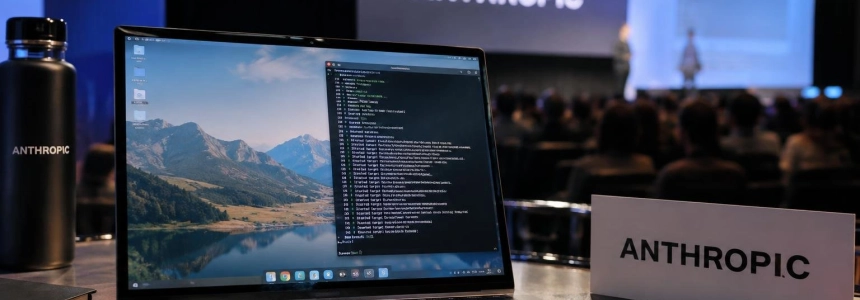
The resulting system includes a kernel that runs the machine and drivers for the disk, keyboard, and network. It also includes persistent file storage, a windowed interface, a login screen, and an installer. Anthropic adds an integrated Claude feature. The available demonstration shows the system booting on a laptop, although the presentation does not specify the machine or detail its level of compatibility with other devices.
The test illustrates the kind of task Anthropic positions Fable 5.2 for: broad engineering problems with loosely defined goals and work that can stretch over hours or days. AWS describes the model as being able to operate for hours and even days without direct supervision, work on problems spread across repositories and monorepos, and test its own results as it goes. In Anthropic’s tests, it also coordinated hundreds of subagents as the lead agent and flagged results that could not be reproduced.
The company maintains that the model can challenge inherited conclusions and find root causes that previous versions of Claude overlooked. It credits Fable 5.2 with fixing persistent bugs in minutes, optimizing performance in its services, and undertaking projects that would previously have been too slow or costly to attempt. Anthropic also says that more than 90% of changes incorporated into its core code are written by Claude, with human guidance.
Faster programming and lower prices
Anthropic says Fable 5.2 and Mythos 5.2 generate responses up to 30% faster than their predecessors, Fable 5.1 and Mythos 5.1. The published standard price is $8 per million input tokens and $40 per million output tokens; Computerworld notes that the previous rates were $10 and $50, respectively, representing a 20% reduction.
Both models also offer an optional fast mode that accelerates generation by up to 2.5 times. In this mode, the cost rises to $16 per million input tokens and $80 per million output tokens. Anthropic recommends, however, starting with Opus 5.5 for most everyday programming and knowledge tasks, and reserving Fable or Mythos for more ambitious and complex assignments. Fable can also act as an advisor to smaller models or as an orchestrator that delegates simpler tasks to them.

On FrontierCode 2.0, a test that evaluates whether open-source project maintainers would accept changes proposed by a model, Fable 5.2 scored 49.1% at the Xhigh effort level. Fable 5.1 scored 32.4%; Opus 5.5, 45.5%; and GPT-6 Astra, 42.8%. Anthropic says that at High, Fable 5.2 achieved a result similar to Opus 5.5’s best—45.3% versus 45.5%—at approximately half the cost per task. At Xhigh, its result was the highest among the published models the company had tested.
The model also scored 69.9% on FrontierSWE v2, compared with 56.3% for Fable 5.1 and 62.3% for Opus 5.5. In the OSWorld 2.1 computer-use test, on a partial offline set, it scored 89.3%; Fable 5.1 scored 83.5% and Opus 5.5, 87.2%. In robotics, Anthropic reports a score of 64.9% for Fable 5.2 on RoboDojo Sim, compared with 27.6% for Fable 5.1 and 39.4% for Opus 5.5; the company specifies that this evaluation was run internally.
The figures depend on the effort level and the conditions of each test. Anthropic notes that its scores correspond to the highest available effort level unless otherwise indicated, and that Fable’s results were measured with safeguards enabled unless stated otherwise. In an agent search test, WANDR, the company says Fable 5.2 matched Opus 5.5’s best score at medium effort for around 40% of the cost per task.
Mythos is reserved for verified use
Fable and Mythos share the same underlying model, but have different safeguards. Fable incorporates cybersecurity and biology protections that allow it to be offered generally; Anthropic says it blocks most requests related to cyber tasks. Mythos retains broader capabilities in those areas and is limited to organizations verified through the Cyber Verification and Life Sciences Verification programs.
The difference matters in safety tests. Anthropic presents Mythos 5.2 as its most capable model for cybersecurity engineering and says it finds, reproduces, and helps fix more vulnerabilities than its earlier versions. In the internal CVE Rediscovery evaluation, conducted on 1,829 disclosed vulnerabilities, Mythos 5.2 identified 89.6%, compared with 78.3% for Mythos 5.1. The company says the test set uses copies of projects from before each flaw was fixed.
In another internal measurement, Anthropic says Mythos found 10.2% more vulnerabilities than Opus 5.5 and 14.4% more than Mythos 5.1. According to Anthropic, a security company that tested it observed that one in six confirmed bugs found by Mythos had not appeared in any of the other frontier models evaluated. The company also says a user found that earlier models overstated the severity of approximately one in 20 findings, whereas Mythos 5.2 overstated none in that test.
Direct access to Mythos is restricted, but Anthropic says Claude Enterprise customers can use its vulnerability detection capabilities through Claude Security without joining the verification program. A recent update to the product makes it possible to monitor repositories as code changes, track findings to verify they are resolved, incorporate additional context, and connect to tools through API and MCP.
Computerworld reports cautions about deployment. Lian Jye Su, chief analyst at Omdia, said enterprise autonomy will depend on resolving persistent operational limitations:
“Reliability remains an issue without human supervision,”
— Lian Jye Su, chief analyst at Omdia
Su also pointed to difficulties coordinating agents with tools and internal teams. Pareekh Jain, CEO of Pareekh Consulting, noted that complex legacy systems and business requirements may limit how much development can be delegated. Jain also warned that faster vulnerability detection could benefit attackers as well as defenders. Su described the potential effect in controlled enterprise environments as shifting the balance toward defenders.
Mathematics, physics, and scientific design
Anthropic says a team of 1,000 Fable 5.2 agents formalized Fermat’s Last Theorem in 30 hours with minimal human intervention. Formalizing means translating a proof into a language that a computer can verify step by step. The company compares the result with an earlier attempt by an unpublished research version of Claude: that one took 11 days, a specially prepared system, and guidance from a human researcher.
This time, according to Anthropic, Fable started from minimal instructions, created its own coordination mechanisms, and did not consult mathematical references. It used a list of intermediate statements to measure progress. The company says the work consumed one-third of the action tokens used in the previous attempt and produced a proof seven times shorter. With the same configuration of 1,000 agents, Opus 5.5 completed 26% of the formalization in 18 hours and made little progress afterward, according to Anthropic’s comparison.

The company also credits Fable 5.2 with solving two open problems in theoretical physics related to black holes and the relationship between relativity and quantum mechanics. In one, the model completed a calculation posed in 2003 to determine whether the abrupt formation of black holes observed in large universes also occurred in very small universes. Anthropic says it found that the transition is also abrupt. In the other, it determined the exact limit of a technique used for more than 15 years to rule out candidate theories of quantum gravity in a simplified universe.
In hardware engineering, Anthropic reports a score of 83.5 out of 100 for Fable 5.2 on BenchCAD 2.1, a test that compares designs with reference geometries and circuits. The score was obtained using tools and maximum effort; Opus 5.5 scored 65.3 and Fable 5.1, 44.4. In biology, by contrast, the application described involves Mythos: Anthropic says it combined two open protein-folding models and known symmetries to predict complete viral capsids. In its tests, it correctly modeled 28 of the 34 natural and designed capsids it attempted.
Availability and terms of use
Fable 5.2 is available on Claude Platform and AWS. AWS provides access through Amazon Bedrock and Claude Platform on AWS. Anthropic also lists Google Cloud and Amazon Azure among the available platforms in its announcement, although the specific terms may vary by channel and account. Mythos, by contrast, can be requested through the cybersecurity or life sciences verification programs.
The platform documentation specifies a context window of one million tokens and a maximum output of 128,000. Adaptive reasoning is always enabled and cannot be disabled; its depth is controlled through the effort parameter. The same documentation sets a 30-day data retention period for Fable 5.2 and notes that it is not available with zero retention unless Anthropic explicitly authorizes it.
AWS clarifies that the models are subject to retention for safety monitoring, but says eligible customers can use Fable 5.2 with zero retention until Enterprise Frontier Safeguards is available. Computerworld also reports that Anthropic offers this option to eligible customers and that other customers are subject to 30-day retention. The difference therefore depends on eligibility and the terms applicable to each deployment.
Anthropic’s presentation combines a striking demonstration—a system built by agents that is capable of booting—with results in programming, science, and mathematics. Access to Mythos will remain limited to verified organizations; Fable 5.2, by contrast, can already be subscribed to on the platforms listed by Anthropic and AWS.
Sources: Punto Informatico, Anthropic, Claude Platform Docs, Amazon Web Services, Inc., Computerworld, The Economic Times