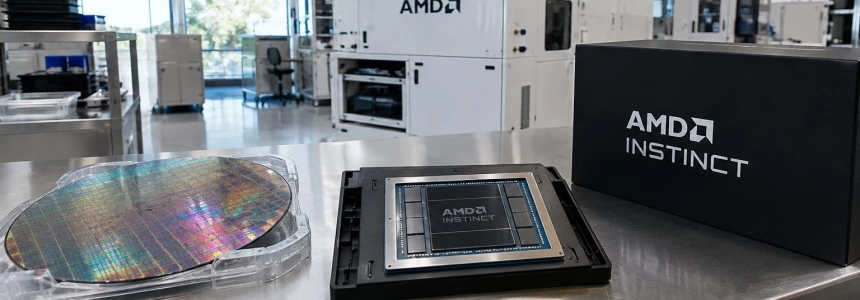
OpenAI credits its models with improvements of up to 14% in the power, performance, and area of AMD flagship GPU designs. The company says it achieved these results in less than five months and that some of the changes are already included in a design AMD sent to fabrication.
The result concerns PPA, short for power, performance, and area: three measures that chip designers must balance. According to OpenAI, the progress is equivalent to approximately one year of progress on designs that AMD engineers had already spent years optimizing. The Decoder also reports that the collaboration focused on AMD flagship GPU intellectual property.
The company did not present the 14% as a uniform improvement across each of those three dimensions. TNW describes it as a gain of up to that percentage in PPA; the figure corresponds to the result OpenAI reported for the designs it worked on, not to a detailed specification for each metric.
The model modifies circuits and checks the changes
The system rewrote the code that describes the chip's circuits. To check that the modifications still worked, OpenAI used Synopsys software, from a company specializing in electronic design tools. The sequence matters: the model proposed changes and the tools were used to verify them, rather than leaving the modifications unchecked.
According to OpenAI, AMD confirmed single-digit improvements in important parts of its next flagship CPU. The description does not identify which specific parts changed or provide a more precise percentage. It also does not specify when that processor will reach the market.
| Design or test | Reported result | Reported status |
|---|---|---|
| AMD flagship GPU | Up to 14% improvement in PPA | Some changes are in a design sent to fabrication |
| Next AMD flagship CPU | Single-digit improvements in key parts | OpenAI attributes the confirmation to AMD |
| OpenAI Jalapeño chip | Reductions of about 13% and 10% in two blocks | The changes worked in the finished silicon |
| Open processors | GPT-6.2 Astra achieved the best results among five generations tested | Tests of design improvement and creation from written requirements |
Jalapeño went from design to fabrication in nine months
OpenAI applied the same approach to Jalapeño, its first in-house chip, intended for inference according to The Decoder. The design reached fabrication in nine months. The modifications proposed by the models reduced the size of two important parts by approximately 13% and 10%, and OpenAI says the reductions held up in the manufactured chip.
The company also compared five generations of its models on the design of two small open-source processors. GPT-6.2 Astra topped both tests: both the task of improving existing designs and that of building a processor from written requirements.
OpenAI cautioned that the second test was simpler. Starting from requirements, the models could omit features found in the original processors; therefore, the result is not equivalent to a direct comparison with optimizing a complete, existing design.
OpenAI is training GPT-Synopsys with Synopsys
The next announced step is GPT-Synopsys, a model that OpenAI is training with Synopsys to use the design tools engineers already work with. The Decoder describes the project as an attempt to extend AI-assisted chip design. No availability date was announced, and the specific tools it will cover were not detailed.
The progress comes with caution from within OpenAI itself. TNW reported that Richard Ho, the company's head of chips, said the previous month that he still does not fully trust AI-generated design changes and that every modification is reviewed. That oversight is consistent with the method described for AMD: the proposals were checked using Synopsys software.
Interest in applying models to this task is not limited to OpenAI. The Decoder reported that Anthropic used its Mythos model to process prompts from a model on an AMD MI355X GPU in three days, compared with the six to twelve months Anthropic says the task usually takes. It also noted that the company runs Claude on four chip families to optimize cost and performance per dollar.
Among startups, TNW mentioned Architect Labs, which raised $24 million in June to help companies design custom chips with AI. The publication does not specify the year of that funding.
For now, the most tangible result of the collaboration between OpenAI and AMD is that some changes have already made it into a design sent to fabrication. It remains to be seen which GPU will incorporate them and when their effects will appear in a commercial product.
Sources: TNW | Artificial-intelligence, The Decoder