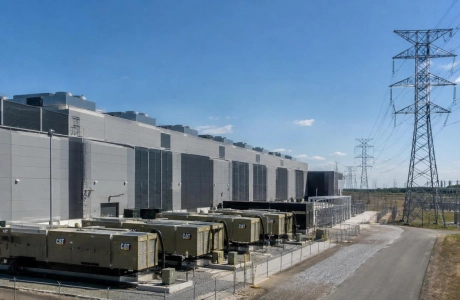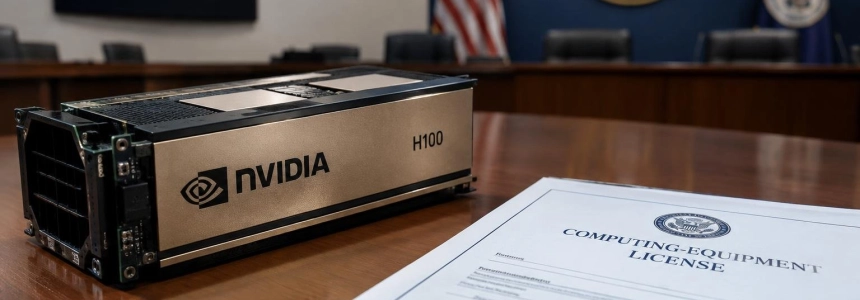
The U.S. will require licenses to export, reexport, or transfer AI chips and servers to data centers in any country when they could provide computing capacity to companies in China or other restricted countries. The Commerce Department’s interim rule aims to prevent those companies from evading U.S. controls through remote access to infrastructure located outside the country.
The change extends restrictions that already require chip companies to obtain authorization before shipping AI semiconductors to companies based in restricted countries or owned by companies from those countries. The new rule shifts some of that oversight to where computing capacity is offered and to the companies that may use it.
Remote access falls under export controls
The provision targets companies in countries in the U.S. embargo group D:5. These include China, Russia, Iran, and North Korea, along with 18 other countries. According to the text of the rule, the restrictions aim to prevent companies based in those locations from using advanced U.S. “Super Intelligence” (SI) semiconductors to train advanced SI models.
“This new control is a logical extension of existing controls”
— Interim rule
The threshold is set at more than 12 million TPP, a U.S. export-control metric for measuring processing capacity. That figure is roughly equivalent to the maximum power of about 750 Nvidia H100 or H200 chips. The rule covers both data centers and any network capable of supplying that level of computing power.
The scope is not limited to direct agreements between a company and a provider. It also includes access through intermediaries or brokers. Exporters and data center operators will have to monitor their customers’ ownership structures and activities to check that they are not managed by people belonging to group D:5.
The rule does not apply to commercial recommendation systems, such as those used in e-commerce or social networks. This exception distinguishes those services from computing that can be used to train or run advanced SI models.
Five countries face new chip requirements
In addition to the rules on data centers, the Commerce Department is introducing new licensing requirements for exporting, reexporting, or transferring advanced semiconductors to Malaysia, Singapore, Indonesia, Thailand, and Brazil. The department justified including these countries by citing their “higher-than-normal risk of diversion.”
There is an exception for these five destinations: the requirement will not apply to chips intended for companies based in the U.S. The rule also sets a deadline for those already providing data center services covered by the new conditions: they must obtain licenses within 90 days after the rule takes effect.
The announcement does not specify the exact effective date. Therefore, the 90-day period begins at that point, not when information about the rule is published.
Megaspeed and concerns about renting computing power
The measure comes after Reuters reported that Chinese AI companies were stepping up their search for computing capacity abroad amid fears of new U.S. restrictions. The case of Megaspeed, an Nvidia customer, is also part of the backdrop: the U.S. government reportedly wanted to add the company to a special entity list.
According to published reports, the government suspects that Megaspeed bought thousands of Nvidia chips to provide computing capacity to Chinese companies and circumvent existing controls. The new provision addresses precisely the risk that access to the chips could be provided remotely, even if the data center is in another country.
The announcement also comes days after Jensen Huang, Nvidia’s co-founder, resigned amid a scandal involving an alleged Chinese spy linked to one of the chipmaker’s customers. The report provides no further details about the resignation or the relationship between that episode and the drafting of the rule.
The Biden rule is revoked
The interim provision rescinds the Biden administration’s AI diffusion rule, published in January 2025. That framework sought to impose country-based limits on exports of advanced AI chips and restrict the transfer of certain high-capability models.
In May, the Trump administration announced that it would scrap the system, saying it imposed unnecessary restrictions on U.S. companies and their allies. The new rule replaces that approach with requirements tied to computing capacity and who can access it.
The text argues that certain facilities and levels of computing power can be used to train or run advanced models capable of supporting military and intelligence activities that threaten U.S. national security or foreign policy interests. For companies already providing services covered by the rule, the next concrete step will be to determine whether they need a license and apply for one within the specified period once the rule takes effect.
Source: TechCrunch