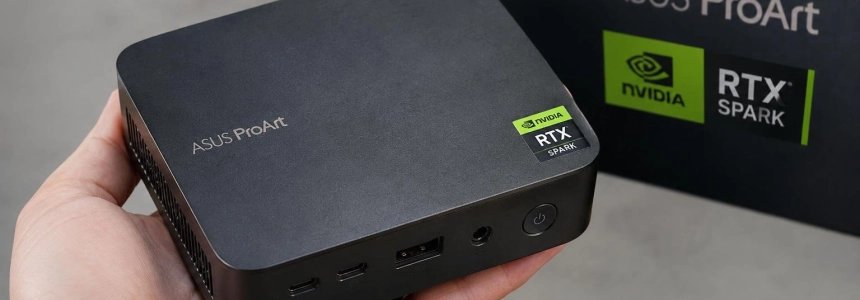
The first mini PCs with the Nvidia RTX Spark N1X chip are now on sale, with models from Asus, Dell, and MSI. They are designed to run AI models and agents on Windows without always relying on cloud services: the machines combine a 20-core Nvidia Grace CPU, a 6,144-core Blackwell RTX GPU, and up to 128 GB of unified memory.
The price reflects the fact that these are not general-purpose mini PCs: the Asus ProArt GR1X starts at $4,499 with 64 GB of memory and 1 TB of storage, according to The Verge. TNW puts the MSI EdgeMesa N AI+ at $4,399 for 64 GB, and $7,499 for the 128 GB version. Prices for other Dell models are not included in the published details.
Compact models for local AI workloads
Nvidia presents these systems as Windows computers dedicated to local models and agents that can run continuously. The company describes them as a “dedicated Windows PC for local models and always-on agents”. The focus also includes RTX-accelerated creative tools and development tasks, not just AI inference.
“dedicated Windows PC for local models and always-on agents”
— NVIDIA
The desktop configuration of the RTX Spark N1X combines 20 Grace cores and 6,144 CUDA cores in the Blackwell RTX GPU. Nvidia's specifications table lists up to 128 GB of unified LPDDR5X memory, a 140 W TDP, and a peak AI performance of one petaflop. It also lists support for Windows 11, CUDA, and Nvidia's AI stack.
| System or configuration | Published price | Listed memory and storage |
|---|---|---|
| MSI EdgeMesa N AI+ | $4,399 | 64 GB; 1 TB |
| MSI EdgeMesa N AI+ | $7,499 | 128 GB; 4 TB |
| Asus ProArt GR1X | Starting at $4,499 | 64 GB; 1 TB in the entry configuration cited by The Verge |
MSI's prices reflect a discount reported by Notebookcheck: the 64 GB model dropped from $4,699 to $4,399, a $300 reduction that puts the system $100 below the Asus. The publication says MSI also cut $500 from the 128 GB model, bringing it to $7,499. That configuration includes a 4 TB SSD, but Notebookcheck found it out of stock at Micro Center and on MSI's website.
There is a difference in the launch timeline. The Verge and TNW describe the availability of Asus, Dell, and MSI systems as a launch today, November 18. Notebookcheck says the EdgeMesa N AI+ came out on November 11 and was the first mini PC with Nvidia's Arm chipset. The published information therefore places the announcement and availability of all three manufacturers on the 18th, but dates MSI's initial arrival a week earlier.
What the memory and chip promise
Nvidia says the systems can run language models with up to 120 billion parameters locally. The company also mentions real-time rendering of 3D scenes larger than 90 GB and smooth 4:2:2 video editing. 80lv cites these capabilities as use cases for artists and developers, while Nvidia includes them among the workloads the hardware is designed for.
Unified memory is one of the differences Nvidia and manufacturers highlight compared with configurations that have dedicated graphics memory. Asus specifies up to 128 GB of LPDDR5X-9400 and bandwidth of up to 300 GB/s in the ProArt GR1X; it also offers a 64 GB option. The system's page lists two M.2 NVMe PCIe 5.0/4.0 slots, each supporting up to 4 TB, although the entry configuration cited by The Verge includes 1 TB.
The ProArt measures 150 × 150 × 51 millimeters, with a volume of 1.1 liters, and Asus says its cooling is designed to sustain up to 140 W TDP. Connectivity specifications include 10 Gb Ethernet, Wi-Fi 7, Bluetooth 5.4, HDMI 2.1, and three USB-C ports with DisplayPort mode. Asus says it can connect up to four displays.
The potential savings from running models on the system itself are also part of the sales pitch. Nvidia and TNW note that compatible tasks can avoid per-token API charges and keep files and code processed on the computer. That does not mean every workflow runs locally: Nvidia explains that Switchyard, integrated into Hermes, can route tasks between local and cloud models.
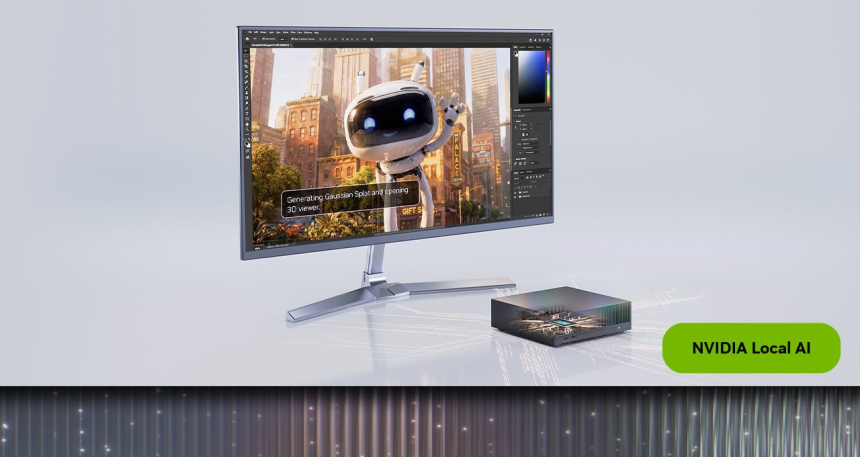
Windows, CUDA, and creative applications
For development, the mini PCs include CUDA natively and access to Linux tools through Windows Subsystem for Linux. Nvidia also mentions Hermes Agent and NemoClaw blueprints for configuring agents, as well as Unsloth for fine-tuning compatible models. The idea is for the system to function as an always-available machine for scheduled tasks, asset generation, or processes that continue while the user works on another device.
The hardware launch is accompanied by creative applications adapted to the Arm chip. Nvidia and TNW say that Illustrator and InDesign already have native versions for Windows on Arm on RTX Spark. According to Nvidia, Illustrator delivers up to 30% more performance than its emulated version. Substance 3D Painter 12.2 is available as a native public beta for Arm.
In Premiere, TensorRT-RTX accelerates features such as Enhance Speech, Object Mask, Scene Edit Detection, and Auto Reframe, as well as Film Impact transitions and effects. Nvidia says the improvements can deliver more than a 50% reduction in export time for typical H.264 video work. The expanded format list includes Canon RAW, RED RAW, ARRI RAW, ARRICORE, ARRI HDE, ProRes RAW, long-GOP video, and H.264 and HEVC in MXF.
Photoshop adds TensorRT-RTX acceleration for the Remove tool and native Camera Raw support. At Adobe MAX, Adobe showed an image-processing engine with GPU acceleration that includes interactive Gaussian Blur and Light Leaks filters. Blender 5.3, meanwhile, adds DLSS 4.5 Ray Reconstruction in the Cycles viewport, for previewing lighting, reflections, and materials with ray tracing; Nvidia says Blender 5.3 and the latest Game Ready or Studio driver are required.
The competition for the RTX Spark desktop
The mini PCs expand a family that already includes RTX Spark laptops. TNW dates their market arrival to October, starting at $2,599, while The Verge notes that the first laptops launched earlier in the year. TNW identifies Microsoft's Surface Laptop Ultra among them; 80lv lists laptops from Asus, Dell, HP, Lenovo, Microsoft, and MSI.
The desktop systems coming later are from Acer, GIGABYTE, and HP. Microsoft is also preparing the Surface RTX Spark Dev Box, which is expected to ship this month, according to The Verge. No specific date has been given for the other manufacturers.
The price positions these machines against high-end compact alternatives, rather than as a purchase aimed primarily at gaming. The Verge compares them with the Mac Mini or Mac Studio for developers working with local models and RTX-accelerated software. It also notes that Windows on Arm has improved its game compatibility, but considers gaming an unrealistic reason to choose them at these prices for now.
TNW cites a Windows Central comparison of the Asus laptop: its graphics performance was up to 22% higher than the laptop chip, with CPU speeds around 5% faster. That measurement refers to the reviewed laptop, not a comparative test of these mini PCs; the stated reason was higher power and improved cooling.
For now, Asus, Dell, and MSI make up the first group of manufacturers with RTX Spark desktops on sale. Expansion will depend on the arrival of Acer, GIGABYTE, and HP and the start of shipments of the Surface RTX Spark Dev Box, expected in November.
Sources: The Verge, TNW | Artificial-intelligence, 80lv, NVIDIA Blog, NVIDIA, ASUS USA, Notebookcheck