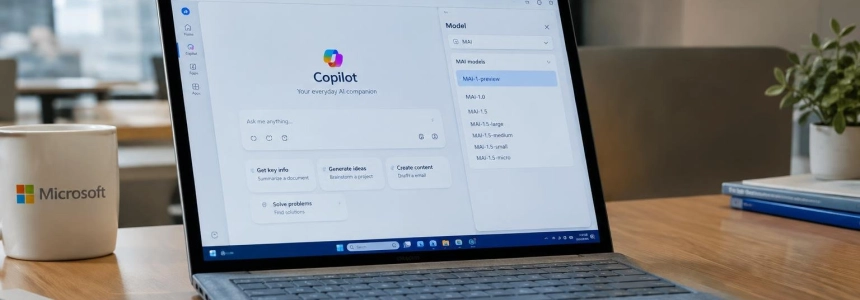
At Ignite, Microsoft introduced seven MAI models for business tasks, spanning programming and cybersecurity to image editing, voice, and model selection. The move is not about abruptly retiring OpenAI and Anthropic systems: Microsoft wants to handle more work with its own alternatives, especially when usage volume makes the cost of each query an operational factor.
The important news for businesses is not just that Microsoft has added models to its catalog. It is placing them in products where AI is already in use: GitHub Copilot, Microsoft 365, Fabric IQ, and its security services. At the same time, it offers a way to adapt MAI models to business data and run them on Azure. The change is gradual, but points to Microsoft taking control of a larger share of the technology and costs that currently depend on external providers.
The cost of agents is the central argument
Microsoft justifies the new family by pointing to the growing token spend of customers who want to keep agents running 24 hours a day. The company designed several models for frequent tasks, not to compete on every kind of problem: MAI Code 2 is not tuned for fundamental scientific research or very long-running agentic workflows, according to the company itself.
Across four coding tests, Microsoft says MAI Code 2 delivers 98% of GPT-6.1 Sol's performance at 40% of the cost; compared with Claude Opus 5.5, it delivers 96% of the performance at 5% of the cost. The results refer to DeepSWE 1.1, Terminal Bench 2.1, SWE-Atlas, and FrontierCode v1.1. Three tests were run on the internal MSBench platform with GitHub Copilot CLI and no subagents; MAI Code 2 pricing includes a 50% promotional discount.
That caveat matters when assessing the savings. Performance depends on the task, configuration, and reasoning effort, and the promotional rate is not permanent. In GitHub Copilot, MAI Code 2 costs $0.50 per million input tokens and $2.50 per million output tokens until May 17, 2027; afterward, the rates rise to $1 and $5. Code 2 Flash, intended for bounded edits, explanations, and routine fixes, has an even lower promotional rate.
| Model and service | Input | Output | Stated condition |
|---|---|---|---|
| MAI Code 2 in GitHub Copilot | $0.50/million | $2.50/million | Until May 17, 2027; afterward, $1 and $5 |
| MAI Code 2 Flash in GitHub Copilot | $0.05/million | $0.25/million | Until May 17, 2027; afterward, $0.10 and $0.50 |
| MAI Cyber 2 Flash | $0.10/million | $0.50/million | GPT-6 Astra is listed at $10 and $50 |
Microsoft is also seeking savings within productivity applications. It says MAI Work Flash, derived from Code 2 Flash, matches GPT-6 Luna in internal Excel and PowerPoint tests. In Word, it achieves similar results to GPT-6.1 Sol using around 42% fewer input tokens; in Teams, according to the company, it outperforms GPT-6 Luna in tracking decisions, identifying knowledge gaps, and adapting to custom instructions.
Specialized models, not a single replacement
The family divides the work among systems with different goals. MAI Cyber 2 Flash is designed to detect vulnerabilities; MAI Image 2.7 edits images; MAI Realtime 1 processes voice-to-voice conversations; Decision 1.1 classifies and routes requests. Microsoft also introduced Microsoft-Retriever-1 for Foundry IQ, a model that searches business documents for information on behalf of agents. The offering therefore combines models that generate content with others that decide what to do or what information to retrieve.
In cybersecurity, Microsoft reports that Cyber 2 Flash solved 92.3% of CyberGym-E2E, compared with 91.5% for GPT-6 Astra, at less than 2% of the cost per task. The company found that around 10% of the benchmark's roughly 900 tasks shared open-source projects and vulnerability reports with parts of its training data. Although it says the reference solutions were not included in training, it removed those tasks for all models and scored the remainder.
The comparison still has specific limitations: Microsoft did not present a comparison with GPT-6 Cyber at the time, and the model was available only to selected customers. The company said it would publish results from agentic tests with tools in the following weeks, subject to additional safeguards. For teams evaluating the model, that pending evidence may matter more than a small difference on an isolated test.
For image editing, Microsoft says MAI Image 2.7 ranks first in editing on Artificial Analysis, with 1,215 Elo points and 5,478 votes, four points ahead of GPT Image 2.6 Sunburst (max), at one-fifth of the cost. For text-to-image generation, it ranks fourth. The Flash variant costs about $10 per 1,000 images, and the company puts the cost of 1,000 images with the main model at around $35.
MAI Realtime 1, Microsoft's first model for voice-to-voice conversation, costs one cent per minute of audio; tasks that need a more powerful reasoning engine are charged separately by token. It is compatible with the OpenAI Realtime API, a decision that reduces the technical friction of testing the model in existing voice applications. Agoda and Reservations.ai are evaluating it, according to Microsoft.
Routing and customization to maintain control
Decision 1.1 addresses a less visible part of spending: choosing which model receives each request. It can classify and prioritize requests and select among developer-approved actions; if it detects uncertainty, the application can escalate the task or abstain. In Copilot, it decides whether a request goes to Copilot or Cowork. Microsoft says it runs 2.2 times faster and costs 4.4 times less than a large language model for this use; in its general announcement, Microsoft compares Decision 1.1 with GPT-6.1 Sol and says it is 50 times faster and 79 times cheaper.
It is based on Gemma 4 26B A4B, Google's mixture-of-experts model, fine-tuned by Microsoft using supervised training and reinforcement learning. This is a significant detail: an in-house strategy does not mean doing away with all external technology. Microsoft develops and operates the decision model, but starts from a Google base; it also announces voice compatibility with the OpenAI API and continues to make third-party models available in its products.
The other offering for business customers is MAI Licensed Weights. It will let customers fine-tune selected weights with their own data and run the model in their Azure environment. Microsoft says the data and adaptations remain with the company and will be used to train its own models only with explicit consent. The offering does not yet have a published launch date or price; Microsoft asks interested companies to contact its account team.
AT&T is cited as an example of customization: Microsoft says a model adapted to analyze 5G network operations outperformed GPT-6.1 Sol on standard tasks at close to one-fiftieth of the cost. It is a specific business case, but not a guarantee that the same savings will apply to other workloads. For companies, the appeal of keeping data and adaptations in their own environment will have to be weighed against the cost of fine-tuning and operating a separate solution.
“No one wants to pour their IQ into someone else’s model.”
— Microsoft AI
Less dependence, but no break with OpenAI
The move makes more sense in the context of the relationship between Microsoft and OpenAI. In April 2026, the two companies amended their agreement: OpenAI can distribute its products through any cloud provider, while Azure remains its primary partner. Microsoft retains a non-exclusive license to OpenAI models and products through 2032. Building MAI expands Microsoft's options, but the current terms do not describe a separation.
Replacement is already happening in some areas and remains limited in others. Code 2 and Code 2 Flash are available in GitHub Copilot; Cyber 2 Flash is reserved for Microsoft's security products and, starting in mid-December, will automatically replace the existing model in the MDASH MAI profile for eligible customers. Dragon Copilot Transcribe, based on MAI Transcribe 2, already processes all doctor-patient conversation transcripts in that product: Microsoft puts usage at 10 million encounters per month and says errors in multilingual workflows have been cut in half.
For developers, the change offers an alternative with defined pricing and use cases, and in some cases an easy transition, such as Realtime 1's compatibility with the OpenAI API. For businesses, the decision is not simply about comparing percentages: it also means checking whether the model handles their actual work, what it costs after the promotion ends, and what terms apply to customization. Microsoft is bringing its own models to more products, but its catalog still combines MAI, partner systems, and external components.
Sources: The Decoder, la Repubblica, Microsoft AI, Microsoft AI