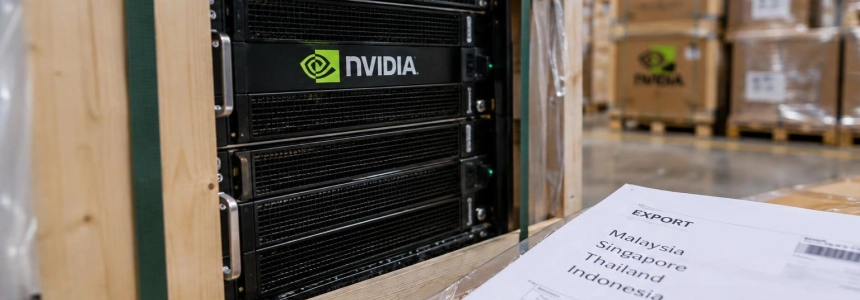
Nvidia reportedly told its partners to halt shipments of servers containing its chips to Malaysia, Singapore, Thailand, and Indonesia. Dell and Supermicro told buyers in those countries that the company would not allow their orders to be shipped, according to people cited by the Financial Times and reported by several media outlets.
The pause comes after new U.S. restrictions on exports of advanced artificial intelligence chips took effect. It is unclear whether Nvidia will halt shipments only while its partners adapt their procedures or whether the measure will have a broader scope. Nvidia, Dell, and Supermicro did not immediately respond to requests for comment cited by Reuters; CNA said Nvidia declined to comment.
Licenses to export advanced chips
U.S. rules require a license to ship advanced AI chips to Indonesia, Malaysia, Singapore, Thailand, and Brazil, according to TNW. The controls took effect on November 19. Washington's goal, according to media reports, is to close routes that Chinese companies could use to access restricted chips, whether by moving servers through the region or renting computing capacity in data centers.
Buyers in the four Asian countries received the notice through server manufacturers that incorporate Nvidia processors. The Financial Times attributed the information to three people familiar with the matter. The Business Times and CNA also cited three people with knowledge of the issue when describing uncertainty over how long the suspension would last.
The restriction affects a region that has become a destination for Chinese AI developers seeking access to Nvidia's most advanced chips, according to CNA. Companies can turn to cloud providers that buy the servers and rent access to their computing capacity, a practice the new U.S. measures aim to control.
The U.S. Department of Commerce set a 90-day deadline for cloud providers, which must obtain a license and demonstrate that their end users do not include restricted entities, CNA reported. CNA said the Department of Commerce introduced the new rules the week before the news broke; The Business Times said the rule was published a few days after Jensen Huang's resignation and that the board reinstated him as CEO on November 23.
“There is this new rule, but no instructions on how to implement it. Nobody knows how to apply for this license while the 90-day deadline is still running. It is causing absolute chaos in the region.”
— A cloud provider executive, quoted by CNA
A region with major investments in data centers
Southeast Asia is an important market for Nvidia. The company recorded $104 billion in revenue through its Singapore subsidiary in 2025, up 72% from the previous year, according to company accounts cited by CNA and TNW. CNA adds that some of Nvidia's revenue from Taiwan and China is also booked through that subsidiary.
Demand from Chinese technology companies has driven the expansion of data centers, particularly in Malaysia and Indonesia. CNA says billions of dollars have been invested in AI infrastructure in those countries and that the new restrictions put some of these projects at risk. TNW also reported that Malaysian customs authorities seized AI servers at Kuala Lumpur's main airport earlier this year.
Governments in the region have begun to respond. Singapore has said it wants to establish a trusted pathway for its companies to continue buying advanced chips, while Malaysia's trade minister has urged the country's data center operators to comply with U.S. rules, according to TNW.
Aolani and ByteDance deal in doubt
The disruption already threatens a specific plan: Aolani, a Singapore-based cloud company, had expected to offer advanced computing capacity to ByteDance, the Chinese company that owns TikTok, through rental agreements. CNA attributes this information to two of the people familiar with the matter.
Some banks that had agreed to finance the project have stopped issuing credit worth approximately $500 million, according to CNA. The outlet adds that ByteDance could abandon the deal, though it does not say that it has canceled it. ByteDance and Aolani did not respond to requests for comment cited by CNA.
The possible suspension comes as Chinese companies continue to rely on Nvidia processors to develop their flagship models, especially during the early, compute-intensive stages of training. CNA notes that this is happening despite Beijing's efforts to promote domestic alternatives.
Nvidia's crisis and Huang's return
The U.S. rule emerged amid weeks of turmoil at Nvidia. Jensen Huang left the CEO position on November 12, following reports of an extramarital relationship with Alice Huang, a former executive at Megaspeed, a Singapore cloud company. TNW said U.S. officials suspect Alice Huang is a Chinese spy; China has denied this.
Megaspeed, which rents computing capacity in its data centers, is under criminal investigation in the United States over the possible diversion of chips to China, according to TNW. The company denies wrongdoing. The Business Times also reported that Megaspeed has come under scrutiny over the possible illegal transfer of advanced AI chips to China.
Nvidia's board reinstated Huang as CEO on November 23. According to TNW, it said it was satisfied with his candor and his ability to lead the company. CNA says some had expected his return to lead to a less strict application of the new rules, but people cited by the outlet see little indication that Nvidia will stop enforcing them.
Reports about Huang's relationship also complicated his public stance in favor of the United States continuing to sell Nvidia chips to Chinese companies to increase their dependence on U.S. technology, according to CNA. The scale of that debate now contrasts with the decision attributed to the company to halt shipments to four regional markets.
The duration of the halt remains unresolved
For now, the practical question is how long the pause will last and how Nvidia and its partners will apply the licensing requirements. The cloud executive cited by CNA described the lack of guidance on submitting applications while the 90-day deadline is running. The suspension of orders shows that compliance is already affecting shipments, although it has not yet been clarified whether the measure will be temporary.
The restrictions name five destinations, but media reports about orders refer to four: Malaysia, Singapore, Thailand, and Indonesia. Brazil is among the countries subject to licensing, according to TNW, but it is not among the destinations where Dell and Supermicro reportedly told buyers Nvidia would block shipments.
The outcome will also determine the fate of Aolani's project with ByteDance: banks have halted part of the planned financing, and the deal could fall through. Meanwhile, Nvidia and its partners must decide how to process shipments under the new rules, while cloud providers face the deadline to obtain licenses.
Sources: TNW | Nvidia, CNA, The Business Times