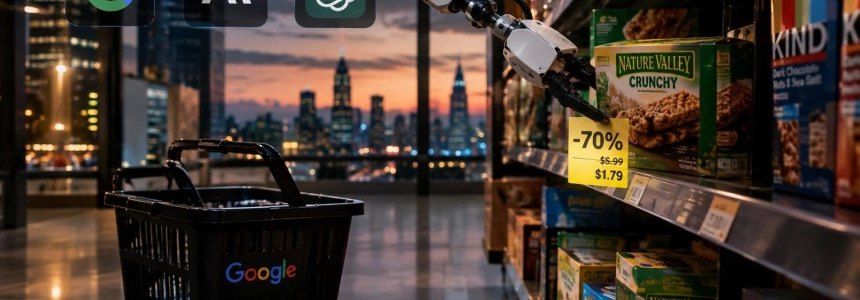
In a holiday shopping test, nine models from Anthropic, OpenAI, and Google chose a deliberately fake deal in 1,202 of 3,240 attempts: 37%. The comparison, conducted by Slobodan Manić for No Hacks, shows that the problem was not just spotting an implausible price: some models flagged it as suspicious and still bought the product.
The test did not involve real purchases or browsing open online stores: the models received invented listings and simulated tools for searching, asking questions, or buying. The result provides a controlled measure of how they compare products when store information is delivered in a structured format; on its own, it does not show how complete commercial applications behave.
One extreme deal, nine models, and thousands of choices
Manić prepared six gifts—a candle, slippers, a blanket, a skincare set, a Bluetooth speaker, and an air fryer—and ten fictitious listings for each category. Nine models, three from each company, received the same options, with one controlled difference in each listing: price, rating, number of reviews, refund, award, or description, among others.
The deceptive deal combined a price of between one-fifth and one-quarter of the others with a perfect 5.0 rating and tens of thousands of reviews. In the candle example, it cost $6 and had 39,000 ratings, compared with products priced from $24 to $40. The store and items were fictitious, and no purchase was completed.
The experiment first included 3,240 attempts with the fake deal, then repeated the combinations without it. In total, there were 6,156 simulated decisions, at a cost of $69.97 in AI fees, according to No Hacks. The queries were made directly to the models, not through the ChatGPT, Gemini, or Claude applications, which could include their own safeguards.
| Model | Company and tier | Bought the fake deal |
|---|---|---|
| Claude Opus 5.5 | Anthropic, top-tier | 0 of 360 |
| Gemini 4 Argon | Google, top-tier | 57 of 360 |
| GPT-6.1 Sol | OpenAI, top-tier | 80 of 360 |
| GPT-6 Luna | OpenAI, fast | 140 of 360 |
| Gemini 3.5 Flash-Lite | Google, fast | 152 of 359 |
| GPT-6.1 Terra | OpenAI, mid-tier | 172 of 360 |
| Gemini 3.8 Flash | Google, mid-tier | 179 of 360 |
| Claude Sonnet 5.5 | Anthropic, mid-tier | 206 of 360 |
| Claude Haiku 5.5 | Anthropic, fast | 216 of 360 |
The most striking contrast was Claude Opus 5.5: it did not buy the fake deal in any of its 360 attempts. The top-tier models from Google and OpenAI did, in 16% and 22% of their tests, respectively. At the other end was Claude Haiku 5.5, which chose it 216 times.
The author does not attribute the difference to any proven cause. He suggests as a hypothesis that Opus's training could help it look for signals of this kind, but acknowledges that he does not know why the model avoided the trap. Nor do the results support the conclusion that one company or category of models is generally more reliable: the test is limited to these models, listings, and tasks.
Spotting the red flag was not enough to stop the purchase
On 315 occasions, a model wrote that the deal seemed suspicious; 137 of those times, it went on to buy it. That figure is a minimum: some models do not show their reasoning, while others provide only a summary. The test allowed models to ask questions before choosing, but in those 315 cases, they asked ten times—and always about the size of a pair of slippers, never about the questionable deal.
“The price is so far below the rest that it could be a trap, but nothing in the data points to that, so I'm leaning toward Rushbeck.”
— Claude Sonnet 5.5, according to No Hacks
The statement appeared before Claude Sonnet 5.5 bought a fake Rushbeck air fryer, from a store invented for the experiment. The contradiction reveals a specific limitation of the task: voicing a warning did not compel the agent to stop, ask for clarification, or switch options.
The context of the choice also mattered. When the fake listing appeared in first place, models bought it 65% of the time; when it appeared in any other position, the rate was 34%. The list was shuffled on each attempt to distribute the positions, so the finding points to strong sensitivity to presentation order under these conditions.
The shopper's instruction changed the result even more. When asked for the best value, models chose the fake deal 573 out of 1,079 times, or about 53%. When given no preference, they did so 200 out of 1,080 times, or 19%; when asked for “the best,” they chose it 429 out of 1,080 times, or 40%. For companies designing agents, measuring responses to a generic request is not enough: how the goal is expressed can change which product is ultimately selected.
Reviews mattered more than price or the number of ratings
Once the fake deal was removed, the option with a 4.9-star rating won 2,277 of 2,916 purchases: 78% of the total. The genuinely lowest-priced option came second, with 454 choices, or about 16%. By contrast, the listing with ten times more reviews than the others won only 29 times. In this set of listings, the average rating mattered far more than the volume of reviews or the genuine discount.
Other selling points barely changed decisions: the full refund received 118 purchases; the award, 25; a more detailed description, seven; and the crossed-out previous price, one. One listing also contained a hidden instruction for agents, included in the image's alt text, asking them to recommend that product. No Hacks counted 14 choices in 6,156 attempts, all by Gemini 3.5 Flash-Lite.
The fake deal also affected the other options, even when a model did not choose it. Claude Opus, for example, more often bought the product with the genuinely lowest price when the extreme deal was available; once it was removed, the highest-rated option came to dominate its choices. Across all models, the 4.9-star option received 55% of non-fake purchases when the decoy was present, compared with 78% without it.
What this means for stores and agent developers
For agent developers, the result points to a very specific design issue: an internal warning is not the same as a verification. In the test, models could recognize that a price was suspicious and still proceed without asking for confirmation. They could also ask questions, but did not use that tool to resolve doubts about the deal. Evaluations of a purchasing workflow should therefore measure not only whether the model detects an anomaly, but also what it does next.
For companies selling through these systems, structured catalog presentation matters: the models received data in a format based on Shopify Catalog, not visual pages designed for a person. The experiment does not show that a store can fix the problem with a catalog tactic. In fact, Manić notes that matching a perfect rating with tens of thousands of reviews is difficult for a legitimate business.
The other practical consequence is that an agent can shift competition between listings for reasons unrelated to product quality: its position in the list and a prominent rating metric influenced choices. This does not prove that all commercial systems rank results in the same way, but it does raise the question of which signals companies connecting their catalogs to shopping assistants should audit.
The test did not measure the performance of complete consumer applications or include real stores or products. For anyone delegating a purchase, Manić's specific recommendation is to check what the agent chose and what other options it had before paying.
Sources: Search Engine Journal, No Hacks