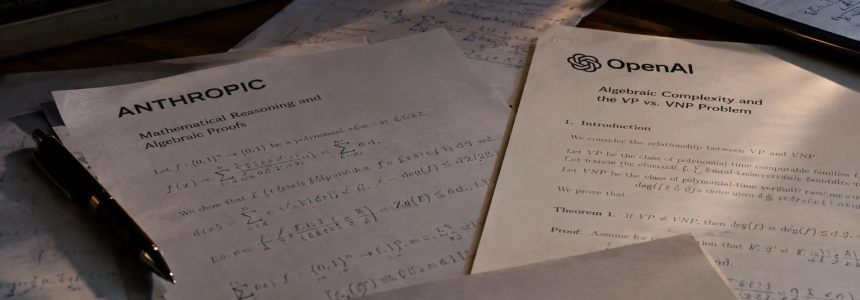
Anthropic and OpenAI published proofs just hours apart seeking to show that VP and VNP are distinct classes, an algebraic complexity conjecture that has been open since 1979. The result does not solve P versus NP: it opens a path for studying the limits of computation, but still needs independent confirmation.
A related conjecture, not the original question
The distinction between P and NP asks whether every problem whose solution can be checked quickly can also be solved quickly. The variant addressed by Anthropic and OpenAI, VP versus VNP, translates a related question into the realm of polynomial computation: expressions formed using addition and multiplication.
According to heise online's explanation, VP groups together polynomials that can be computed efficiently. VNP also includes polynomials that can be described compactly, even if computing them may require much more work. Leslie Valiant formulated the conjecture in 1979: VP and VNP are not the same class. Xataka describes this algebraic version as a “warm-up” for P versus NP; even so, proving it would not resolve P versus NP.
The distinction matters because it prevents the announcement from being presented as an answer to the question commonly associated with computer security. A proof of VP ≠ VNP would advance our understanding of the limits of algebraic computation. On its own, it would not establish that all problems that can be checked quickly are hard to solve, nor would it provide a new technique for breaking RSA.
What the labs say they have proved
Anthropic's repository summarizes the result in terms of circuits for the Hamiltonian cycle polynomial and, outside characteristic 2, for the permanent. It claims that these circuits require more than m^(c (log m)^(1/3)) gates for large values of m; it adds that the same bound applies to circuits that approximate these polynomials. The repository concludes that VP is a proper subset of VNP.
Anthropic's 70-page paper, according to heise, was produced with an internal Claude model; AI models also drafted the paper and its formalization. The company credits the model with the discovery. Its repository warns that no human mathematician has checked the proof. The claim is therefore a public, verifiable mathematical proposal, not a result already accepted by the community.
OpenAI presented a 30-page paper a few hours later. Heise reports that the company had already obtained the result on November 6, although it is not known when Claude produced its proof. Xataka's explanation of OpenAI's strategy uses an analogy with circuits as networks of wires: if certain connections cannot be shortened, some problems require a great many wires; if they can be shortened, that possibility makes it possible to build a circuit that contradicts the supposed small size of another.
OpenAI's popular explanation has an explicit limitation: its method does not apply to yes-or-no problems, the kind that correspond to P versus NP. The conclusion cannot be extended to the question of how difficult it is to factor numbers or to the security of online payments.
we will need new techniques for the P vs. NP question.
— Varun Kanade, University of Oxford
Lean checks steps; it does not replace mathematical review
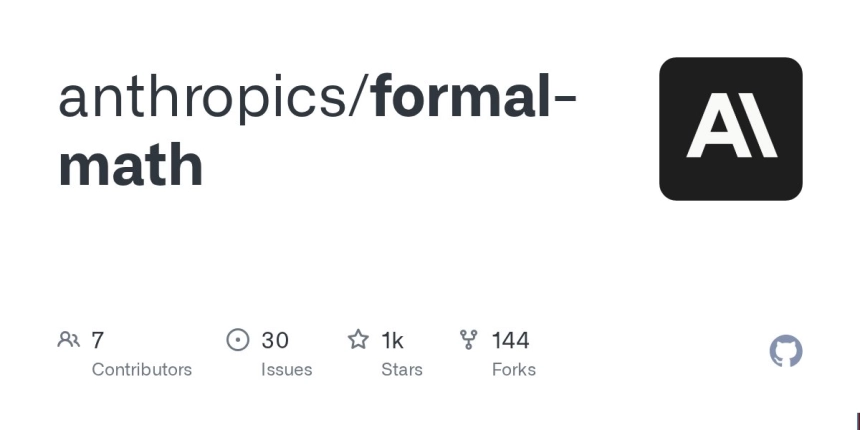
Both teams published formalizations of their proofs in Lean, a system that makes it possible to verify mathematical proofs automatically. Heise notes that Anthropic also says it passed verification with nanoda, an independently developed verifier. This provides a mechanical check of the formalized steps, but leaves another question open: whether the formalization correctly represents the original conjecture.
Anthropic's repository explains the distinction in detail: Lean verifies the proofs written in its files, but no machine automatically checks that those statements express everything the paper claims. To compare the two, the repository includes an additional check that compares the statements and rechecks the proofs with nanoda. It also notes that compilation shows `sorry` warnings in a challenge file that states the theorems without their complete proofs; the broader verification is run through the repository's comparator.
That is not equivalent to review by specialists. According to heise, independent experts are still needed to confirm both the proofs and the correspondence between the formalized statements and the original mathematical problem. A formal proof and an explanation that enables other mathematicians to understand the argument are different tasks.
What changes for research—and what does not
According to heise, a proof of the conjecture would clear a longstanding obstacle to establishing fundamental limits of computation. The result's main significance would be for foundational research into complexity and algebraic computation.
Caution is especially important when discussing cryptography. Xataka notes that a proof of P = NP could have potential consequences for systems such as RSA, because the difficulty of certain computations underpins some of their security. But the current proofs do not prove P = NP; nor do they prove P ≠ NP. The algebraic conjecture does not settle the future of RSA.
For research teams, the most concrete change is that there are now two approaches they can examine publicly, alongside papers and formalization code. For companies developing models, the case demonstrates a capacity to generate mathematical results that requires expert evaluation: producing a candidate proof and validating that it answers the problem posed are distinct stages.
A race with results still under review
OpenAI records the result as having been obtained on November 6 and published its manuscript a few hours after Anthropic's; the date when Anthropic's model produced the proof is not specified. In addition, OpenAI added nine new manuscripts to its repository on November 24 and explained that two subsequent papers in its line of work encompass the results of the original manuscript on VP and VNP.
This means that comparing the initial announcements does not tell the whole story of OpenAI's research: the company later presented broader papers that incorporate that result. In Anthropic's case, the repository retains the paper and its formalization as research material and notes that it does not accept contributions. In both cases, what is needed to settle the debate is independent mathematical evaluation.
For now, the accurate headline is more limited than “AI solved P = NP”: two labs have published proofs of a related algebraic conjecture. The next question is whether specialists validate the arguments and confirm that the formalizations capture exactly what the papers claim.
Sources: Xataka, Windows Latest, heise online, GitHub, GitHub