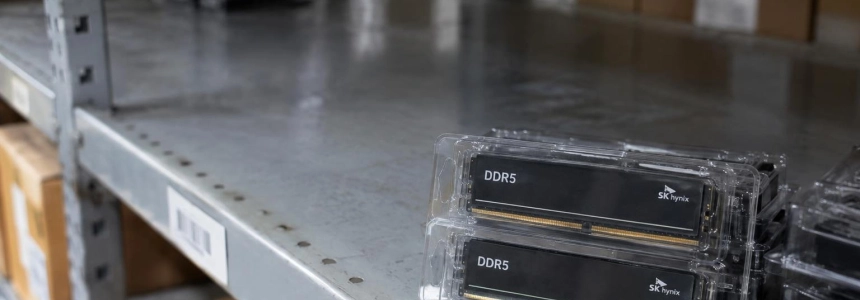
Some memory chips now cost up to ten times more than a year ago, according to a SyFeed summary of the supply pressures affecting the sector.
The specific scope of these increases is not detailed: the types of memory, manufacturers, and affected products are not identified. Tiger Brokers links to an article from The Wall Street Journal whose content is unavailable on the page consulted; Hindustan Times displays the headline but does not provide the text either. Therefore, the increase figure comes from SyFeed’s summary, not from a price table that can be verified here.
Data centers are competing for memory
SyFeed’s explanation is straightforward: the growth of the data centers underpinning the AI boom has triggered a severe shortage of memory chips. The summary describes it as an exceptional supply crisis, but does not specify which memory technologies are most affected or how much of the consumption comes from servers versus other equipment.
This gap matters when interpreting the impact. “Memory” covers components with different uses and markets; without knowing which chips have increased in price, it is not possible to conclude that every computer, phone, or console will become more expensive by the same proportion. The available figure is more limited: SyFeed says some chips have increased tenfold in a year and that higher costs are pushing up prices across the electronics sector.
There are no figures on inventories, production volumes, or contracts, so it is not possible to measure how much of the pressure stems from a physical shortage of components and how much from competition to reserve them.
Purchasing becomes a race
One operational consequence does appear in the summary: some companies are forming dedicated teams to secure supplies. SyFeed describes them as purchasing “war rooms,” a phrase that points to more centralized and urgent procurement management. It does not name any companies or detail what decisions these teams make.
For electronics manufacturers, more expensive memory can put pressure on the cost of building devices. The summary links the shortage to price increases across the sector, although it does not identify specific brands, categories, or announcements. It does not establish whether companies will absorb the additional cost, pass it on to buyers, or modify their products.
But the available sources provide no budgets, installation schedules, or data on delayed projects. Any effect on the expansion of those centers still cannot be quantified.
Cost is not the only effect
SyFeed adds a detail that illustrates the extent of the pressure: the shortage has reportedly even led to theft of memory chips. It does not say where this happened, how many components were stolen, or who was involved, so it cannot be treated as a documented trend across multiple markets. It is, however, part of the description of a supply chain under pressure.
SyFeed also reports that some companies are creating purchasing teams to secure supplies. In addition, its summary mentions memory chip thefts, without specifying where they occurred or how many components were stolen.
For developers, the effect does not appear as a code change or a specific technical limitation. The plausible consequence within what is described is indirect: if the equipment running their services depends on memory that is more expensive or harder to obtain, hardware costs and availability may affect their companies’ purchasing decisions. There are no data to measure this impact or examples of services that have changed their plans.
The figure needs context to inform decisions
A tenfold increase is striking, but its usefulness depends on knowing which component and price it refers to. Without a comparison baseline, an identified model, or a region, it is not possible to translate the figure into how much more a manufacturer will pay for each device or when that cost will reach consumers. The summary only states that some chips recorded this increase over the past year.
It is also unclear whether the price increase is uniform or concentrated in components that are particularly in demand from data centers. That distinction would determine which manufacturers and products face the most pressure, but it is not specified. For now, the most solid conclusion is that the boom in AI infrastructure is competing for memory and that this shortage is already associated with higher electronics prices.
As long as data center demand remains the central factor identified, the question for companies will be whether they can secure supplies without passing the entire cost on to their customers. The available information does not make it possible to predict when the shortage might ease; it does report that some companies have already reorganized their purchasing to find chips.
Sources: Tiger Brokers, Hindustan Times, SyFeed