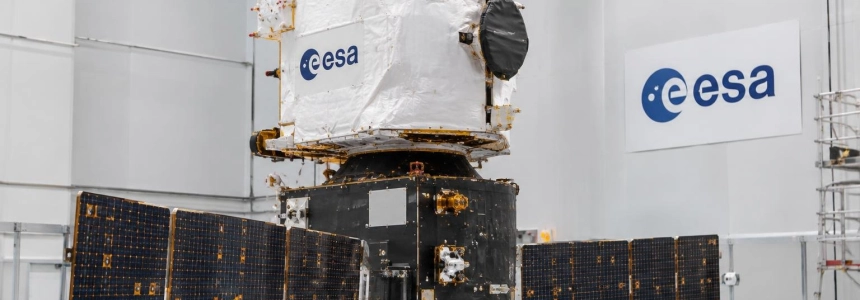
BepiColombo reached Mercury orbit on November 21, after eight years of travel and an insertion maneuver that left teams without news from the spacecraft for longer than expected. The European Space Agency (ESA) confirmed that orbital capture had been completed; it later reported that a software issue shortened the thruster burn.
The maneuver took place at 19:24 Spanish mainland time and lasted 37 minutes, according to Microsiervos. After it ended, the spacecraft took a while to reestablish contact with mission control. ESA ultimately confirmed that the insertion had worked and that telemetry was being evaluated at the ESOC operations center.
The mission first announced that BepiColombo had established contact with Earth and that the flight dynamics team had confirmed the capture. In a later update, ESA clarified that the burn was shorter because of a software issue. The agency said the spacecraft was safe and its teams were investigating what had happened.
An arrival with a shorter maneuver
The discrepancy between the expected and actual duration explains some of the uncertainty in the hours that followed, although ESA confirmed both the orbital capture and the spacecraft’s good condition. The arrival marks the start of a sequence of maneuvers: BepiColombo is not yet in the final science orbits that its two probes will occupy.
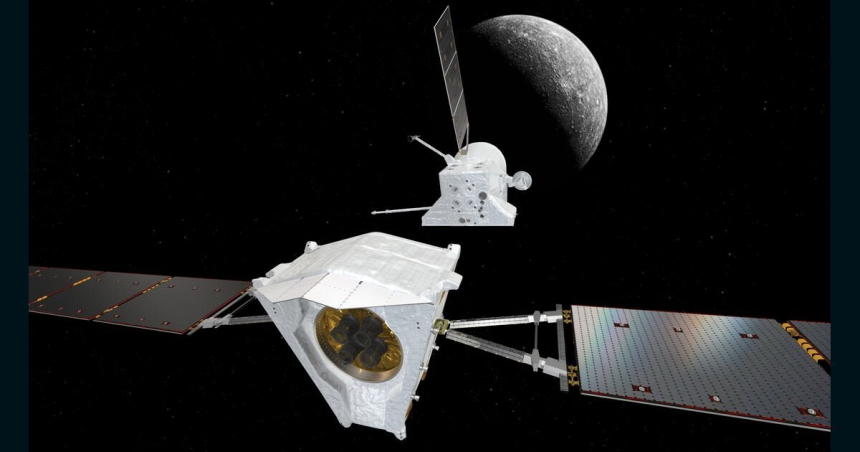
The mission is a collaboration between ESA and the Japan Aerospace Exploration Agency (JAXA). The spacecraft reached Mercury with the European Mercury Planetary Orbiter (MPO), the Japanese Mercury Magnetospheric Orbiter (Mio), and a transport and protection structure. The Mercury Transfer Module (MTM) separated on September 3, 2026, before insertion.
Microsiervos places the spacecraft in a preliminary orbit of 674 by 174,000 kilometers. This elliptical orbit will be adjusted before each orbiter follows its own path around the planet. Mio is scheduled to separate on the night of December 9–10; on December 16, the MOSIF sunshield, which protects Mio during the journey, will be jettisoned.
| Milestone or orbit | Date or parameters | Source |
|---|---|---|
| Insertion into Mercury orbit | November 21, 2026; 37-minute maneuver | Microsiervos |
| Preliminary orbit of the spacecraft | 674 × 174,000 km | Microsiervos |
| Mio separation | December 9–10, 2026 | ESA and Microsiervos |
| Planned orbit for Mio | 590 × 11,640 km | Microsiervos |
| MOSIF separation | December 16 | Microsiervos |
| Planned orbit for MPO | 480 × 1,500 km, planned for March 10 | Microsiervos |
| Start of the science phase | April 2027 | ESA and Microsiervos |
Nature describes an altitude range of 500 to 11,000 kilometers for Mio and 400 to 1,500 kilometers for MPO.
Two orbiters, two different jobs
ESA built the MPO to study Mercury’s surface and interior. In its low polar orbit, it will complete one revolution in about 2.3 hours, according to Hardware Upgrade. Its 11 instruments will investigate the planet’s composition, geology, and topography, as well as its gravitational field and tenuous exosphere.
These instruments include SIMBIO-SYS, a system combining a high-resolution camera, a stereo camera, and the visible and near-infrared spectrometer VIHI. BELA is a laser altimeter that measures terrain elevation. MERTIS will observe in thermal infrared, at wavelengths between 7 and 14 micrometers, to study surface minerals and temperatures.
The spacecraft also carries MIXS, an X-ray spectrometer, and MGNS, which measures gamma rays and neutrons to analyze chemical elements in the crust. SIXS will record X-rays and solar particles. MORE, a radio science experiment with a Ka-band transponder, will measure the gravitational field; ISA will detect small non-gravitational accelerations, and MPO-MAG will measure the magnetic field.
PHEBUS will observe Mercury’s extremely tenuous atmosphere in ultraviolet light. SERENA, meanwhile, brings together sensors for neutral and ionized particles: ELENA, MIPA, PICAM, and STROFIO. Eos summarizes MPO’s goal as mapping the crater-covered surface and cataloging its geology; it also notes that radio science will help determine the size of the core.
Mio will focus on the magnetosphere, the magnetic field, and the plasma surrounding the planet. Its orbit will be much larger and more elliptical, with one revolution taking about 9.3 hours, according to Hardware Upgrade. The Japanese probe will study how Mercury interacts with the solar wind and how its magnetic field changes. Eos points to two questions that remain unanswered: what sustains this field, and why it is offset from the planet’s center.
“What makes this mission truly unique is that, for the first time in space exploration, we are taking two spacecraft close to the planet and putting them into orbit around this mysterious body.”
— Santa Martinez, BepiColombo mission manager at ESA, quoted by Eos
Eight years to brake near the Sun
BepiColombo launched on October 20, 2018, aboard an Ariane 5. Reaching Mercury is not simply a matter of pointing toward the planet: the spacecraft had to lose speed to match its trajectory to that of a world subject to the Sun’s intense gravity. Eos describes the challenge as shedding enough energy to avoid overshooting Mercury; Hardware Upgrade also notes the need to combine gravity assists with braking.
The journey included flybys of Earth, Venus, and Mercury. Microsiervos counts one Earth flyby, two of Venus, and six of Mercury; Eos puts the total number of planetary flybys at nine. The spacecraft passed close to Venus in August 2021 and made approaches to Mercury on October 1, 2021, June 23, 2022, June 19, 2023, September 4 and December 1, 2024, and January 8, 2025.
The original schedule called for insertion in December 2025. Eos attributes the delay to a thruster failure in 2024, which prevented the thrusters from operating at full power and forced a trajectory change. Microsiervos links the change to a decline in the solar panels’ power-generating capacity. In both accounts, the result was a postponement of the arrival until November 2026.
During the journey, the teams were also able to test instruments. Nature reports that MIXS observed the Crab Nebula, the remains of a supernova observed from Earth in 1054. The same publication describes it as the first X-ray imaging camera sent on an interplanetary mission. In September 2026, according to ESA, the MPO instruments were switched on together for the first time since the MTM separated: initial checks found them to be in good condition.
Calibration before science
The arrival phase included tests and adjustments before insertion. ESA reports that on September 24, the MPO tested its axial thrusters for 8 minutes and 42 seconds. The maneuver produced a velocity change of 11.4 meters per second, the first planned trajectory correction after separation from the MTM.
The science phase is scheduled for April 2027, after orbital calibration. The nominal mission will last one year, with an extension planned through 2029, according to Eos; Microsiervos notes that it could be extended by an additional year. BepiColombo will be the second mission to orbit Mercury, after NASA’s MESSENGER, which arrived in March 2011 and ended operations in 2015.
The next immediate milestone will be the separation of Mio and MPO between December 9 and 10. By then, the teams will need to have completed the necessary adjustments so that each probe can begin its independent science journey around Mercury.
Sources: Hardware Upgrade, Microsiervos, ESA, Nature Publishing Group UK, Eos