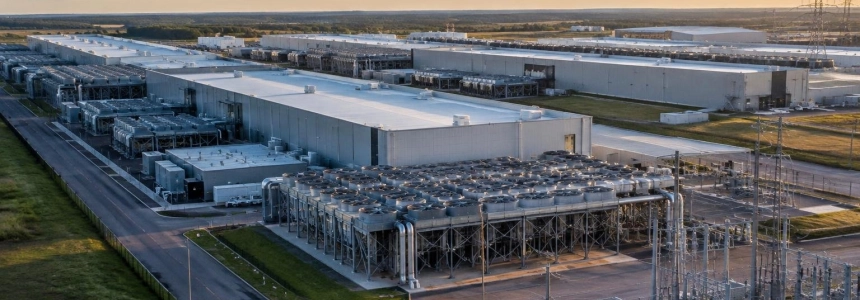
Between May 2024 and April 2025, 403 hyperscale data centers in the United States consumed an amount of electricity comparable to that of entire states: a Harvard study estimates a range of 68 to 99 terawatt-hours (TWh). In its central scenario, consumption was about 82 TWh, close to 1.8% of the electricity used in the country during that period.
The comparison with Michigan conveys the scale well, but it should not be read as a single, indisputable figure. Harvard notes that the upper end of the range approaches the annual consumption of states such as Indiana, Michigan, and Tennessee; the result varies depending on how much the facilities are assumed to have been operating. The TechRadar article presents the comparison with Michigan more directly, while the scientific publication describes a range of scenarios.
What the study measured—and what it didn’t
The study, published in Nature Sustainability, compiled an inventory of 403 operational hyperscale data centers during the period examined. The team used satellite imagery to create the list and estimated each facility’s annual consumption under different load scenarios. It then attributed emissions using data from the United States Environmental Protection Agency and the electricity generation mix of regional grids.
The hyperscale category refers to the largest data centers, which support services such as cloud computing, language model training, and the deployment of artificial intelligence tools. But the study does not identify what share of each facility’s electricity was used for AI and what share went to other operations. And although these facilities are now often associated with the AI boom, not all the data centers included are used for AI, according to WIRED.
The central result—82 TWh and 25.7 million tonnes of CO₂—is an attribution based on electricity consumed and generation in the corresponding regions, not a direct reading from each meter. Across the scenarios, Nature puts emissions at between 21 and 31 million tonnes. The central emissions figure is equivalent to two to three times an earlier estimate for 2018, according to Harvard.
This method makes it possible to compare facilities and regions on a common basis, but it does not answer every question about the impact of building new capacity. The carbon intensity attributed to these data centers was about 314 grams of CO₂ per kilowatt-hour, compared with a national average of about 348 grams. That difference does not eliminate the total volume of emissions: it indicates that, on average, the electricity attributed to hyperscalers was less carbon-intensive than the national mix, although there were significant regional variations.
Location changes the electricity mix
Virginia, Oregon, Ohio, and Iowa accounted for more than half of the consumption analyzed. Location matters because the study calculates emissions based on regional grids: two data centers with similar consumption may receive electricity from different mixes. Harvard notes that some facilities rely much more heavily than others on carbon-intensive generation, and that several are in regions where coal-fired power plants play a significant role.
Overall, approximately 54% of the attributed electricity came from fossil fuels. Harvard and Nature break down the mix as 38% natural gas and 15% coal; the figures are presented as approximate. This does not mean that every data center has the same mix, nor that the fossil-fuel share for a facility can be determined by looking only at the national average.
For companies that develop or contract infrastructure, this has a concrete implication: the region is part of the energy footprint, not just a variable related to connectivity or land availability. The study does not compare operating costs or recommend locations, but it does show that emissions attribution varies between grids and that four states account for most of the demand examined.
A snapshot that may already be outdated
The measurement period ended in April 2025. Gianluca Guidi, lead author and a Harvard postdoctoral researcher, wrote: “The data center boom hasn’t slowed down since our study period ended in April 2025.” He added that facilities have been built, existing campuses have expanded, and demand for AI computing has grown; for that reason, he said, consumption and the carbon footprint could be substantially higher in 2026.
“The data center boom hasn’t slowed down since our study period ended in April 2025. New facilities have been built, existing campuses have expanded, and demand for AI computing continues to grow.”
— Gianluca Guidi, postdoctoral researcher and lead author of the study
WIRED offers another measure of the gap between the inventory and current expansion: the average data center in the sample had a capacity of 40 megawatts, while campuses under development today can reach hundreds or even thousands of megawatts. This comparison does not make those proposals operational facilities; it does warn that the sample’s average size does not necessarily represent the projects now coming online.
There is also an exclusion that affects how the total should be interpreted. The Harvard team could not study every facility because of insufficient data and did not include consumption from data centers powered by their own off-grid generation. WIRED notes that this behind-the-meter generation has become an uncertain factor: it cites up to 189 gigawatts of planned power plants for data centers in the United States. It also says that many of these plants increasingly rely on natural gas turbines and cites a BloombergNEF estimate that, if all the behind-the-meter power plants in the U.S. development pipeline were built, national emissions could rise by 10%.
These figures describe projects and a conditional scenario, not energy already consumed or confirmed emissions. For those developing models, cloud services, or products with AI workloads, the practical distinction is that a grid-based inventory is not enough to determine the impact of facilities that generate their own electricity. Without distinguishing that energy, total demand associated with data centers may be incomplete.
The challenge of comparing consumption and emissions
The research addresses a lack of facility-level data: WIRED notes that data center consumption is not reported separately from other sectors and that each facility’s usage is usually treated as proprietary commercial information. Harvard’s method provides comparable estimates, but it does not replace public meter readings. The distinction matters both for companies calculating their footprint and for those assessing whether a new load will be supplied with electricity of higher or lower carbon intensity.
There is also a distinction between attributed emissions and the effect of adding demand. The study allocates emissions from regional generation among facilities according to their consumption; it does not directly calculate which power plants would increase their output because of a new data center. Its results therefore describe an allocation of emissions, not a forecast of how electricity generation will change as a result of each project.
The lack of visibility may begin to diminish. According to WIRED, the U.S. Energy Information Administration completed pilot surveys on data center consumption in 10 states and is using them to design a possible voluntary survey for the sector. This is not yet an established monitoring system, but a broader registry would make it possible to compare estimates such as those in the study with data reported by facilities.
What the figure leaves up to companies
Harvard does not separate AI consumption from that of other services, so these results do not provide a footprint by workload. A company using a hyperscale service cannot turn the study’s average into a precise estimate for its application: data is missing on the specific facility, its utilization level, and the share of energy covered by on-site generation. This is a significant limitation for teams trying to compare providers or explain their operational emissions.
The research also does not directly measure health effects. Francesca Dominici, the corresponding author, said the researchers want to address this topic in future work. Harvard points to two pathways: CO₂ contributes to climate change, and fossil-fuel power plants associated with demand also emit pollutants such as fine particulate matter, nitrogen oxides, and sulfur dioxide. The current study does not quantify how much of these effects is attributable to data centers or where they occur.
The firm finding is narrower, but difficult to ignore: in a single year, hundreds of facilities consumed an appreciable share of U.S. electricity and were associated with tens of millions of tonnes of CO₂. The next measurement will need to determine whether growth since April 2025 and behind-the-meter generation further increase an accounting that, for now, does not include the entire system.
Sources: TechRadar, Harvard T.H. Chan School of Public Health, Nature, WIRED