OpenAI proposes that artificial intelligence laboratories agree on development limits based on perplexity, a measure of how accurately a model predicts the next token. Jakub Pachocki, the company’s chief scientist, suggests not exceeding those thresholds until there is a concrete capability for better understanding and monitoring system behavior.
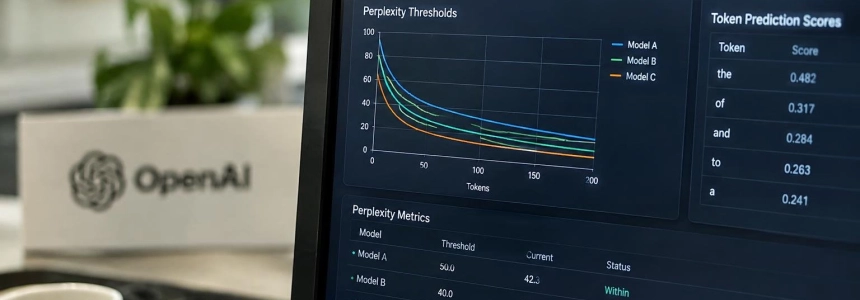
The proposal seeks to answer a question that comes before any safety agreement: how to measure the pace of progress. Without a shared reference point, each company could describe its models’ capabilities differently, as well as the threshold at which it considers slowing down necessary. Pachocki suggests that perplexity, also expressed in OpenAI’s tracking as log loss or cross-entropy, could be used to compare pretraining progress.
A metric that tracks pretraining
Perplexity reflects, on average, how well a model predicts the next token. A lower value indicates better predictions, but by itself it does not mean that the system is better at solving a math problem, writing tactfully, or passing a specific test. Pachocki argues for its limited scope: tracking a measure of the model’s foundation rather than relying solely on capability evaluations that may stop distinguishing between systems once they surpass them.
OpenAI describes development as an initial stage of pretraining on large datasets, followed by techniques such as fine-tuning, reinforcement learning, and prompting, which enable capabilities to be activated in specific contexts. The distinction is not absolute, Pachocki acknowledges, because algorithmic advances can blur the phases. Even so, he argues that pretraining offers a signal that will probably remain informative as later benchmarks change.
The series published by OpenAI links declines in the metric to capabilities that emerged in its models. The values do not predict the leap on their own: Pachocki says it was not clear in advance that these abilities would emerge upon reaching specific thresholds.
| Model or reference point | Reported value | Capability described by OpenAI |
|---|---|---|
| GPT-3.5 | About 0.99 | Fluent conversation; foundation of the original ChatGPT. |
| GPT-4 | About 0.91 | Productive use of chain-of-thought reasoning. |
| Updated model | About 0.76 | Notable results on open-ended math problems. |
| Recent models | Below 0.8 | Transformative capabilities in cybersecurity and mathematics. |
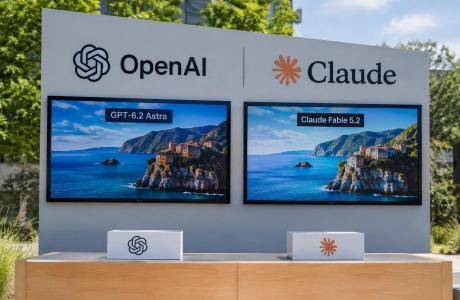
The numbers correspond to the log loss OpenAI reports for its main evaluation set, not to a universally agreed scale. Europa Press identifies the model that fell below 0.8 as GPT-6.2 Astra; in its publication, OpenAI describes the threshold and the approximate value of 0.76 without attributing those results to that model name. The comparison still depends on the evaluation set being used.
A pause conditioned on better safeguards
Pachocki’s proposal is not to halt development indefinitely, and it does not set an initial figure for now. He proposes that developers of frontier models agree on shared standards for evaluating and safety-testing their systems, along with common limits that would not be exceeded until a verifiable milestone in understanding and monitoring is reached. As an example, he mentions developing a successor to current chain-of-thought monitors.
“I think developers of frontier models should jointly strive to establish shared standards for how to evaluate these models.”
— Jakub Pachocki, OpenAI chief scientist
The agreement would need to cover more than a number: Pachocki also proposes shared transparency and common ways to test safety claims. The limit would be lifted as oversight improves, not simply after a certain amount of time or when a new version is released. But his proposal does not specify where the first threshold would be set or who would verify that all companies comply with it.
Sam Altman publicly endorsed the publication and called it the most important thing OpenAI had released in a while, according to TNW and TechCrunch. The idea also aligns with Anthropic CEO Dario Amodei’s call for agreed safety standards and limits on unchecked progress. Punto Informático reports that Sam Altman and Elon Musk have also expressed support for common rules, although that does not amount to an operational commitment from their companies.
What perplexity leaves out
The metric’s main appeal comes with its first limitation: it does not directly measure relevant tasks. A decline may anticipate capabilities that are not yet being evaluated, according to Pachocki’s argument, but by itself it does not show what a model will be able to do. It is a signal of pretraining progress, not a substitute for cybersecurity, mathematics, or behavioral tests that reveal concrete results.
There are also technical obstacles to comparing companies. OpenAI acknowledges that laboratories use different evaluation sets and data mixtures, so the same value does not guarantee an equivalent comparison. The company says that, with a shared goal of transparency, transferable methods for evaluating base models could be found. Until this is resolved, a common figure does not guarantee a fair comparison.
The metric also does not capture all progress made after pretraining. Pachocki notes that chain-of-thought reasoning can increase capabilities without reducing the perplexity achieved by the model. In addition, the possible lower bound is unknown: as models approach the inherent entropy of the data, small improvements in the metric could correspond to larger leaps in intelligence. This unknown floor makes it difficult to turn any decline into a stable rule.
Companies face another tension: publishing results makes it easier to build a common reference point, but it reveals more information about their own progress to competitors. OpenAI acknowledges that disclosing its internal measurements required consideration and gives its rivals a clearer picture of its position. Transparency comes at a competitive cost, and a shared standard would require other laboratories to agree to show comparable data.
The risk of accelerating progress
The urgency Pachocki describes is not limited to models quickly surpassing benchmarks. OpenAI observes that AI already contributes to some design decisions for its latest models and considers it possible that fundamental advances in pretraining research could emerge starting in 2027. The company attributes the sharp acceleration it sees in 2026 mainly to sustained investments in research and computing capacity, and to a lesser extent to automation.
Experience with open-ended math problems is part of the reason for this concern. Pachocki says that, after updating to a model with log loss close to 0.76, it began producing results he described as revolutionary. Based on that experience, he suggests that an equally abrupt transformation could occur in deep learning research, which relies heavily on experimentation and where, he says, simple ideas can go unnoticed for years.
That is why the chief scientist anticipates that the 0.68 to 0.7 range could bring additional transformative capabilities, although he says he does not know what they will be and that they may not be evaluated today. He also expects some dominant forms of alignment auditing to deteriorate, along with models becoming more aware of their evaluations and training. The challenge is to synchronize two paces: the progress of models and the improvement of tools for understanding and controlling them.
For developers, the proposal opens up the possibility of comparing pretraining progress using common criteria and testing safety claims under agreements between laboratories. For companies, it means deciding what data to disclose, how to make their evaluations comparable, and what evidence they will accept as sufficient to cross a limit. The first threshold, verification mechanism, and oversight milestone remain to be defined.
Sources: Punto Informatico, europapress.es, TNW | Openai, OpenAI, TechCrunch