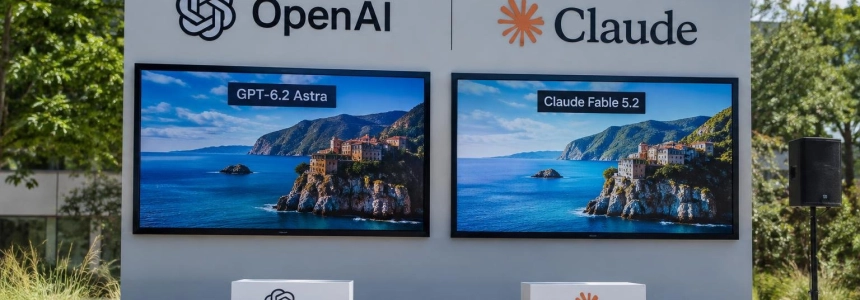
Claude Fable 5.2 won the comparison by 12 points to 11, but GPT-6.2 Astra took less than half the time and, across these three builds, used about one-fifth as many tokens. The result depends on what matters most: Fable does a better job completing a launch mission, while Astra has the edge on the interchange and delivers more polished SVG scenes.
The cost difference needs some clarification: the price per million tokens is identical for both models: $8 for input and $40 for output. The gap comes from the usage observed during the tasks and from another Artificial Analysis metric, which estimates a much higher cost per index task for Fable.
What was compared and how it was scored
The models were given three assignments: a highway interchange as an SVG, a seaside fair in another SVG, and an animated web page for a rocket launch. Each model had one attempt per assignment, with maximum reasoning effort and without opening a browser or running the result to check it.
Points were awarded for the finished artifact, not speed. Astra ran in Codex and Fable in Claude Code; both used their maximum settings and were subject to the same prohibition on running code. Fable's results were the files published on November 9, which were rescored alongside Astra's creations.
| Criterion | GPT-6.2 Astra | Claude Fable 5.2 |
|---|---|---|
| Interchange | 4 points; wins the round | 3 points |
| Seaside fair | 4 points; tie | 4 points; tie |
| Rocket launch | 3 points | 5 points; wins the round |
| Total | 11 points | 12 points |
| Total time | 60 min 17 s | 136 min 03 s |
| Price per million tokens, input/output | $8 / $40 | $8 / $40 |
| Intelligence Index v5.0.1 | 62 | 65 |
| Cost per index task | $4 | $26.54 |
Astra wins on speed and the interchange
Astra completed the interchange in 19 minutes and 40 seconds, compared with Fable's 47 minutes and 17 seconds. Both drew a complete cloverleaf configuration, with grade-separated roads and ramps. The deciding difference in the round was aesthetic: Astra earned all four points for its more attractive image.
Astra's SVG includes 38 vehicles in circulation, lane markings at the ramp entrances and exits, and traffic that disappears under the bridge. Fable drew 50 vehicles and also completed the layout without any errors detected during review, but its edge lines are interrupted on the ramps and turn into short dashes. Under the test's visual criterion, that difference gave the round to Astra.
Astra was also faster on the fair: 19 minutes and 23 seconds, compared with 41 minutes and 45 seconds. Its scene included a pier, a Ferris wheel, a carousel, boats, a lighthouse, and a sunset; the reflection on the water mirrors the animated fair. Fable took longer, but also created a complete scene, with a Ferris wheel, carousel, and reflection on the water.
The fair is decided by a playback glitch
The two scenes share several key elements: each model created 12 gondolas that remain level as the Ferris wheel turns and an eight-horse carousel. In both animations, the horses change positions around the central organ; Astra also makes them rise and fall in different phases.
Astra's scene was richer, but its canopy had a visible defect during animation playback: a red-and-white stripe jumped from side to side and back, about twice in fifteen seconds. The glitch did not appear when reviewing the frames one by one. This flicker cost Astra the point that would have tipped the round; the final result was a four-point tie.
Fable avoided that stumble and animated the canopy stripes as well.
Fable completes the flight that Astra leaves unfinished
The launch was the only round with a clear scoring gap. Fable earned five points by taking the rocket into orbit; Astra received three. Astra's page, called Nightfall 01, features a vehicle beside the tower, a panel with altitude, speed, and graphs, playback controls, and a sequence of countdown, ignition, liftoff, and ascent.
But the animation stops at sustained ascent. It does not show engine cutoff, the separation of the side boosters, or a second stage; nor does it reach orbit. At three minutes, the panel shows an altitude of 161 kilometers and a speed of 3.6 kilometers per second, and the rocket is still climbing at full power.
Fable's AETHER-1 page depicts stage separation and orbital insertion. The sequence includes a poll of six control stations, main engine cutoff, separation three seconds later, and second-stage ignition. The panel confirms an orbit of 203 by 205 kilometers at 28,008 kilometers per hour; the flight reaches that point in about two minutes because mission time advances faster during the longer stretches.
The cost: same list price, different usage
OpenAI released GPT-6.2 Astra on November 17 at a rate of $8 per million input tokens and $40 per million output tokens. This is the same rate listed for Claude Fable 5.2, so there is no fivefold difference in the unit price. However, the token count across the three assignments comes to about 138,000 output tokens for Astra, compared with about 763,000 for Fable.
Including list prices and cached input, these tasks are estimated to cost about $7.50 for Astra and $38 for Fable. That's a nearly fivefold difference in this specific test, not a different per-token rate. Total time showed a similar gap: Astra finished in 60 minutes and 17 seconds, while Fable took 136 minutes and 3 seconds.
The other reference is Artificial Analysis: its Intelligence Index v5.0.1 scores Astra at 62 and Fable at 65. For cost per index task, the figures are $4 and $26.54, respectively. The cost gap favors Astra, although the index puts Fable three points ahead in that evaluation.
When to choose each model
GPT-6.2 Astra is a better fit if the priority is producing artifacts quickly while keeping token usage down. In this comparison, it won the interchange, tied the fair, and took less than half as long as Fable on each assignment. Its weakness was exposed in the launch: the presentation was solid, but the sequence did not complete the mission.
Claude Fable 5.2 is a better choice if the main requirement is an animation that follows an extended sequence through to its final state. It was the only model to take the rocket into orbit and won the overall test by one point. Its observed cost was considerably higher and it took longer, although its total score only narrowly surpassed Astra's.
For tasks similar to the three evaluated here, the choice is not simply between a cheap model and an expensive one: the price per token is the same. The practical decision is between Astra's observed speed and lower usage, and Fable's higher score on the task that required a complete mission.
Source: BitsMinds