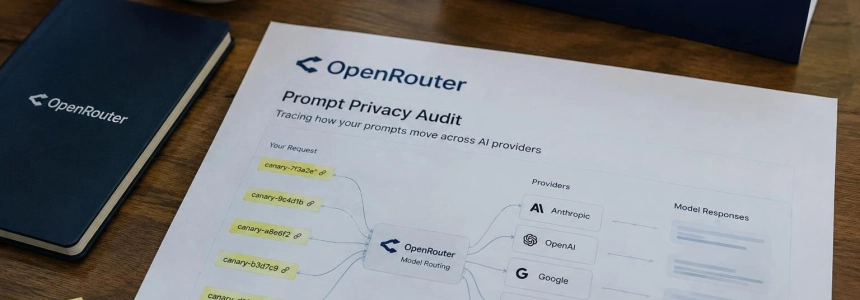
A secret link sent in a test prompt ended up posted in a Feishu chat 24 days later, and was opened from three computers and three phones in Beijing and Shanghai. Dragos traced it there after seeding nearly two million prompts with unique URLs and credentials; the experiment detected both access following intrusions and requests exposed by intermediaries, as well as data that continued circulating despite the Zero Data Retention (ZDR) option.
The study, published by Dragos on November 19, tracked requests between July and November 2026. Each prompt carried distinct secrets: URLs, domain names, and credentials that had not been used anywhere else. If someone accessed them, the researchers could link that activity to the corresponding request, model, router, and privacy settings.
The test did not just check whether a company retained data. Dragos observed attempts to access test systems and AWS accounts, tracked which networks downloaded the links, and reconstructed some of the routes between routers and providers. The result: a prompt can pass through more hands than the model name or the interface it is sent from might suggest.
Three distinct ways a prompt can get out of control
Dragos grouped its findings into three categories. The first was attacker activity targeting three inference providers; the second, marketplace sellers who could read and retain requests through the platform’s normal logging; the third, failures in privacy and retention practices. These are not the same problem: each requires checking a different part of the chain.
| Finding | How it happened | Observed signal |
|---|---|---|
| Compromised providers | Attackers copied requests and tested credentials | Use of AWS keys and tens of thousands of calls to its API |
| Marketplace logging | Sellers enabled request logging | Secret links and passwords used after inference |
| Privacy failures | Services tracked or shared data despite privacy options | URLs accessed days or months later and a link in Feishu |
In the largest-scale incident, an attacker obtained a couple of hundred AWS keys planted by Dragos. Each had been sent in a single request to a provider, during brief windows in late October. All requests from those windows were stolen, including some the provider had rejected before running a model: the copying therefore happened at the entry point.
In some cases, the keys were tested just hours later. The attacker enumerated S3 buckets, searched for secrets in Secrets Manager and Parameter Store, tried to enable models hosted on AWS Bedrock, create keys for its API, and add IAM users to maintain access. The decoy keys generated tens of thousands of calls to the AWS API.
The same attacker appears to have compromised two providers at once: they used secrets sent to both from a rented server. Dragos observed changes in the tools over the three weeks of monitoring and, on November 1, the use of ARTEX, an AI-guided penetration testing framework. In this case, it made few calls to check whether the keys were still active.
“A privacy flag doesn't help when the attacker is already inside,”
— HD Moore, Chief Research Officer
The second route did not require an intrusion. According to Dragos, some sellers on an inference marketplace offered models at low prices and enabled request logging. This let them view and retain prompts using standard features, without breaching the platform or bypassing its controls. The risk was tied to the seller: prompts for the same model sent through another seller were untouched.
In one case, someone opened two secret URLs about a day and a half after inference and tried usernames on the login page. In another, someone using a Mac on a home connection in France tried to log in as root over SSH with passwords included in two prompts; they then tried several AWS keys.
A ZDR option does not guarantee the route
The third route exposed the difference between selecting a privacy setting and controlling what happens to a request at every hop. Dragos observed that a Chinese AI lab accessed secret links from more than half of the prompts sent to its models between July and October. The activity included around two-thirds of requests marked “no data collection” or ZDR.
The same tracker appeared in prompts sent to U.S. hosting providers that resold those models. In other words, choosing a U.S. provider did not prevent requests from reaching the Chinese lab. Later, a Git client in another cloud tried to clone private repositories mentioned in prompts, but only those associated with the lab’s models.
There was also activity attributed to U.S. providers. One kept tracking a secret URL more than two months after a single query to its search endpoint; another revisited links days after each request, regardless of the router used. In the Feishu episode, the link was shared 24 days later. Dragos says it had only given the provider the first eight characters of that URL, suggesting that whoever shared it could read a saved copy of the full prompt.
The path can include routers that forward requests to other routers, resellers, and end providers. Every intermediary that processes the request can see the prompt and response. OpenRouter offers a single endpoint that routes requests to external providers; in its November 22 statement, it said the investigation found no intrusion or unauthorized access to its own systems.
To identify hidden hops, Dragos combined images with unique URLs—the systems downloading them revealed their IP, client, and time—with slightly malformed requests. Nested error messages made it possible to compare each router’s layers with known signatures. The team traced around 2,000 routes: several hundred included unidentified systems, and some led to companies absent from the advertised path.
flowchart LR
    A["Cliente"] --> B["Router visible"]
    B --> C["Intermediario oculto"]
    C --> D["Proveedor de inferencia"]
    D --> E["Modelo"]
    B --> F["Registro de solicitudes"]
    C --> F
    D --> F
The diagram summarizes the hops Dragos sought to detect, not a single route that applies to every request. The team also found one seller that added approximately a thousand hidden tokens to every prompt and another that downloaded images using a shared pay-as-you-go subscription. The results show that the declared commercial route may not describe every system that receives data.
OpenRouter’s response and its limits
OpenRouter removed three providers from its platform, removed 125 endpoints from ZDR eligibility, and notified potentially affected customers. The company explained that these removals included providers flagged by the researchers and others removed as a precaution. To regain eligibility, endpoints will need to provide assurances and pass validation.
The platform also said it would adapt Dragos’s tests to run continuously and verify network routes for third-party forwarding. It should not be assumed that the three providers removed are the same three where Dragos detected intrusions: Dragos did not name them, and OpenRouter also did not publicly identify the providers it removed.
Public notices from providers included by OpenRouter do detail specific incidents. Phala reported that an attacker took control of an inference server and could view request data while it was being processed; it said it contained the incident on November 8. Its preliminary report advises treating as exposed requests to the DeepSeek V4 Flash 0731 model that went through Phala via OpenRouter between October 21 at 00:00 UTC and November 8 at 05:35 UTC, and rotating any included secrets.
Together AI reported that a third party downloaded stored prompt samples after an AI coding agent included a credential in a public GitHub repository. The samples came from June and July requests to MiniMax M3, GLM-5.2, and Kimi K2.6; the company said the attacker searched for credentials and tested some, and that it had set ZDR as the default for new accounts.
Novita, for its part, attributed the routing of some MiniMax requests to the official MiniMax API, beyond what was intended for those customers, to a routing configuration issue. This case illustrates another kind of exposure: a route can change because of a configuration, even when the published finding does not describe an attacker stealing credentials.
What changes for those integrating models
For a company, the decision to use an API does not end with the contract with whoever provides the endpoint. It matters which provider actually receives the request, which intermediaries are involved, and whether retention settings apply at every step. OpenRouter has announced route checks and a review of ZDR eligibility; Dragos, meanwhile, is continuing to work with around a dozen providers.
The experiment offers a concrete way to test controls: insert unique decoys into requests and monitor whether they are used later. A privacy flag can help express a policy, but it will not stop an attacker who has already accessed the server or, on its own, identify an undeclared forwarding route. In the cases described, some test URLs continued to be accessed months after the initial thefts.
For developers, this particularly affects agents and pipelines that automatically incorporate context: Dragos notes that these systems can send credentials within their reach. A fake, traceable secret can serve as an alert if someone uses it; in its explanation of measures for users, OpenRouter also suggests choosing upstream providers rather than accepting a default set, and avoiding reseller marketplaces. Detection of keys with known formats helps, although it does not cover sensitive data that does not look like credentials.
The findings do not make all routers or providers equivalent: the study found differences between sellers and routes, and OpenRouter says it was not breached. They do leave an operational question that is hard to ignore: who receives each prompt? To answer it, the actual route and the handling of data must be verifiable, not merely described in a privacy setting.
Sources: Dragos, The Hacker News, OpenRouter Blog